Tender Automation – Save Time & Win More Bids | Minaions
The government procurement ecosystem is becoming larger, faster, and more competitive every year. Businesses participating in public tenders, searching for a tender for work, managing multiple tender documents, and monitoring various tender portals often struggle to keep up with the growing volume of procurement opportunities.
For MSMEs, OEMs, consultants, freelancers, distributors, startups, and enterprises, winning contracts is no longer just about finding opportunities. Success depends on how efficiently organizations manage procurement tenders, navigate a government tender portal, analyze bid documents, and participate in the modern world of government procurement and public procurement.
This is where tender automation is changing the game.
Modern AI-powered platforms like Minaions are helping businesses automate opportunity discovery, qualification analysis, compliance management, document review, and bid preparation. By reducing manual effort and improving decision-making, Minaions enables organizations to save time, lower operational costs, and win more contracts.
For businesses competing in public tenders, pursuing tenders for small business, and implementing a stronger L1 bidder strategy India, tender automation is becoming an essential competitive advantage.
The Growing Challenge of Public Tenders
The number of public tenders published every day continues to increase.
Today, public tenders are available across:
Infrastructure projects
IT services
Manufacturing contracts
Healthcare procurement
Educational procurement
Consulting services
Businesses participating in public tenders often struggle because every opportunity requires careful review, qualification, documentation, and submission.
Without automation, managing large volumes of public tenders becomes difficult and resource-intensive.
This is why modern procurement teams are increasingly adopting AI-powered procurement tools.
Why Every Tender for Work Requires Better Efficiency
Every tender for work represents a potential business opportunity.
However, every tender for work also requires:
Eligibility verification
Technical review
Commercial evaluation
Documentation preparation
Submission management
Organizations pursuing a tender for work often spend significant time evaluating opportunities that ultimately do not result in contracts.
Businesses seeking a tender for work should therefore focus on qualification efficiency before investing resources.
Minaions helps businesses evaluate every tender for work using AI-powered opportunity scoring and qualification analysis.
Tender Documents Are Consuming Too Much Time
One of the biggest challenges in procurement is managing tender documents.
A typical set of tender documents may include:
Eligibility conditions
Technical specifications
Evaluation criteria
Commercial requirements
Compliance obligations
Organizations participating in procurement tenders often spend hours reviewing tender documents manually.
The increasing complexity of tender documents makes manual review inefficient.
Minaions uses AI-powered intelligence to analyze tender documents automatically and identify critical requirements within minutes.
Why Tender Portals Need Automation
The procurement ecosystem now includes hundreds of tender portals.
Businesses often monitor multiple tender portals including:
GeM
CPPP
State procurement systems
PSU procurement websites
Department procurement platforms
Tracking opportunities across various tender portals manually is extremely time-consuming.
Organizations that automate monitoring across multiple tender portals gain a significant competitive advantage.
Minaions centralizes procurement intelligence from multiple tender portals into a single platform.
Tenders for Small Business Are Growing Rapidly
The number of tenders for small business continues to increase.
Today, governments actively encourage MSME participation through:
Reserved procurement categories
Startup initiatives
Local sourcing programs
Vendor development schemes
Businesses pursuing tenders for small business often face challenges due to limited procurement resources.
Tender automation helps organizations compete effectively in tenders for small business without building large procurement teams.
The future of tenders for small business belongs to organizations that combine agility with intelligent automation.
Procurement Tenders Require Smarter Qualification
Modern procurement tenders are becoming increasingly competitive.
Organizations participating in procurement tenders must evaluate:
Eligibility criteria
Technical capability
Commercial viability
Competition levels
Resource availability
Businesses that pursue every opportunity often waste significant resources.
The key to success in procurement tenders is qualification accuracy.
Minaions helps businesses improve performance in procurement tenders through AI-powered opportunity assessment.
Government Tender Portal Monitoring Is Essential
Every procurement journey begins with a government tender portal.
A typical government tender portal provides:
Tender notices
Procurement updates
Submission instructions
Evaluation information
Contract opportunities
Businesses participating in public procurement should monitor every relevant government tender portal consistently.
The increasing number of opportunities available through every government tender portal makes automation essential.
Minaions automatically tracks opportunities across multiple government tender portal ecosystems.
Government Procurement Is Becoming Data-Driven
The modern world of government procurement is increasingly driven by analytics and automation.
Today's government procurement ecosystem requires businesses to process:
More data
More opportunities
More documentation
More compliance requirements
Organizations participating in government procurement must move beyond spreadsheets and manual workflows.
The future of government procurement belongs to businesses that leverage AI-powered procurement intelligence.
Public Procurement and Competitive Advantage
The scale of public procurement continues to expand rapidly.
Businesses participating in public procurement should focus on:
Opportunity qualification
Compliance readiness
Cost efficiency
Automation
Procurement intelligence
Organizations that improve efficiency within public procurement typically achieve stronger win rates.
Minaions helps businesses optimize participation across the entire public procurement lifecycle.
Bid Documents and Compliance Challenges
Every procurement opportunity requires preparation of bid documents.
Typical bid documents include:
Technical proposals
Financial proposals
Compliance declarations
Experience records
Certifications
Managing bid documents manually often creates delays and errors.
Organizations participating in public tenders should automate preparation and management of bid documents wherever possible.
Minaions helps businesses organize, track, and review bid documents through AI-powered workflows.
Why a Strong Bid No-Bid Decision Framework Matters
One of the biggest reasons businesses lose money is poor opportunity selection.
A strong bid no-bid decision framework helps organizations evaluate:
Qualification fit
Revenue potential
Competitive intensity
Resource requirements
Risk exposure
Businesses using a structured bid no-bid decision framework avoid wasting resources on low-probability opportunities.
Minaions integrates an intelligent bid no-bid decision framework that helps businesses focus on opportunities with the highest success potential.
L1 Bidder Strategy India and Automation
A successful L1 bidder strategy India requires more than aggressive pricing.
The modern L1 bidder strategy India includes:
Better qualification
Competitive intelligence
Cost optimization
Procurement analytics
Risk management
Organizations pursuing a stronger L1 bidder strategy India should combine pricing intelligence with procurement automation.
Minaions helps businesses improve their L1 bidder strategy India through AI-driven procurement insights.
Five Ways Minaions Saves Time and Wins More Bids
1. Automated Tender Discovery
Monitor opportunities across multiple tender portals automatically.
2. AI-Powered Tender Documents Review
Analyze tender documents in minutes.
3. Intelligent Bid No-Bid Decision Framework
Prioritize high-probability opportunities.
4. Automated Bid Documents Management
Organize compliance and submission workflows.
5. Better L1 Bidder Strategy India
Improve pricing intelligence and qualification accuracy.
How Minaions Transforms Tender Management
Minaions provides a complete procurement intelligence platform designed for modern businesses.
Key capabilities include:
Public tenders monitoring
Tender for work qualification
Tender documents analysis
Tender portals aggregation
Tenders for small business discovery
Procurement tenders intelligence
Government tender portal tracking
Government procurement automation
Public procurement analytics
Bid documents management
Bid no-bid decision framework automation
L1 bidder strategy India insights
These capabilities help organizations reduce manual effort while increasing procurement efficiency.
Final Thoughts
The future of procurement belongs to organizations that can move faster, qualify opportunities more accurately, and manage procurement operations efficiently. Businesses participating in public tenders, pursuing a tender for work, managing large volumes of tender documents, and monitoring multiple tender portals can no longer rely solely on manual processes.
From improving performance in procurement tenders and navigating a government tender portal to strengthening participation in government procurement and public procurement, automation is becoming a critical competitive advantage.
Organizations that automate bid documents management, implement a strong bid no-bid decision framework, and improve their L1 bidder strategy India will consistently outperform competitors.
With Minaions, businesses can save time, reduce costs, improve qualification accuracy, and win more bids across the growing procurement ecosystem.
Related Blogs

A small manufacturing firm in Ludhiana missed a ₹2.3 crore contract after spending 14 hours manually scanning the GeM portal, only to find the tender had closed two days earlier. This is not an isolated case.
A small civil engineering firm in Lucknow spent three weeks manually parsing a 420-page NHAI tenders document, only to miss a critical clause in the contractor registration requirements and lose eligibility.

A small manufacturing firm in Ludhiana missed a ₹2.
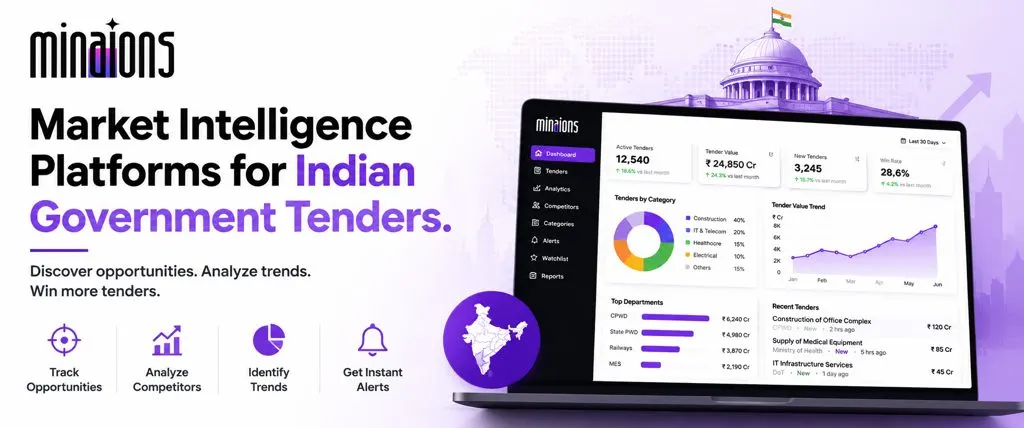
Discover how AI-powered market intelligence platforms streamline tender registration, procurement compliance, and government bidding success.