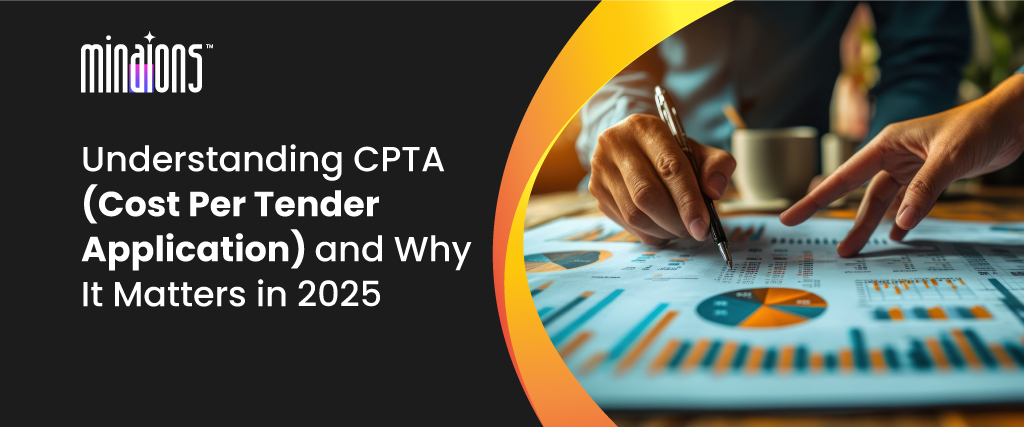
Understanding CPTA (Cost Per Tender Application) and Why It Matters in 2026
A government contractor spends 87 hours preparing a single tender for work, only to lose it to a competitor who submitted a more precise, compliant proposal, all because their tender cost was mismanaged. This is not an outlier. Across the public procurement sector, businesses exhaust resources on procurement tenders that yield diminishing returns, while others reduce tender cost by over 60% using AI-driven tender management systems. The difference is not luck; it is measurable control over how tender documents are sourced, analysed, and responded to. In 2025, organisations that thrive in public tenders will not be those bidding most frequently, but those bidding most intelligently. Discovering the right tender opportunities begins with understanding where resources deliver maximum ROI. Many firms now rely on gem portal tenders as their primary source of business tenders, making it essential to track both volume and quality of procurement tenders.
What is Tender Cost? Defining Your Cost Per Tender Application
Tender cost is the total financial and operational expenditure incurred to prepare, submit, and manage each application for a public tender. It includes staff salaries, software subscriptions, compliance certification fees, travel for pre-bid meetings, legal review, and opportunity cost of diverted resources. For many SMEs, this cost can exceed £15,000 per bid, especially when navigating complex gem portal tenders with multi-layered annexures. A small engineering firm in Manchester spent £22,000 on three unsuccessful bids last year, each requiring 120+ hours of labour and mandatory CMMC 2.0 documentation. Without tracking tender cost per application, such losses remain invisible until profitability collapses.Many tender for work applications now require detailed tender documents that must align with evolving public procurement guidelines, making automation critical. Firms ignoring compliance automation risk disqualification even on high-value business tenders.
Components of Tender Cost: Beyond the Obvious Direct and Indirect Costs
Most businesses track only direct costs like printing or portal fees. Yet indirect costs, such as delays caused by manual eligibility checks or missed deadlines due to disorganised tender documents, often account for 70% of total tender cost. Consider a mid-sized IT provider applying for business tenders via the UK Government’s Digital Marketplace. Their team manually cross-referenced 47 eligibility clauses across three RFPs, missing a single requirement in Annex B. The bid was disqualified. That is not just a lost opportunity, it is £18,000 in sunk costs. In practice, tender management must account for time, risk, and compliance as core cost drivers, not just out-of-pocket expenses. For further reading, explore The Future of Remote Work and AI Collaboration. The rise of gem portal tenders has increased the volume of procurement tenders, but also the complexity of tender documents, making compliance automation indispensable. Businesses that fail to adapt are left behind in the race for tender opportunities.
How to Calculate Tender Cost Accurately for Strategic Insights
To calculate tender cost correctly, use: Tender Cost = Total Monthly Expenditure on Tendering ÷ Total Applications Submitted. For instance, a company spending £45,000 monthly on bid teams, software, and compliance tools, submitting 30 applications, has a tender cost of £1,500 per application. This metric becomes powerful when benchmarked against win rate. If only 3 of those 30 bids succeed, the effective cost per won contract is £15,000. That is unsustainable without optimisation. Tools like Minaions’ AI platform automate this calculation by ingesting payroll, subscription, and time-tracking data, turning tender cost from a vague figure into a live KPI. For further reading, explore governmenttechnologyinsider.com. Tracking public tenders by value and sector helps prioritise those with the best tender opportunities. AI-powered platforms now integrate gem portal tenders with internal data to forecast which procurement tenders are most likely to yield wins.
Why Tender Cost is Your Most Critical Metric for 2025 and Beyond
In 2025, public procurement leaders are shifting from volume-based bidding to value-based strategy. Winning more procurement tenders is no longer the goal, winning the right ones is. High tender cost erodes margins, especially when competing for low-value business tenders against automated bidders. A contractor in Leeds reduced their tender cost by 58% after implementing AI-driven eligibility screening, allowing them to focus resources on £500K+ public tenders with higher ROI. This strategic pivot is no longer optional, it is foundational to survival. Tender management systems now include predictive scoring for tender opportunities, helping firms avoid costly missteps on gem portal tenders with low success rates. The integration of compliance automation ensures every tender for work submission meets exacting public procurement standards.
Driving Profitability and Maximising ROI in Government Contracts
For organisations managing hundreds of gem portal tenders annually, a 10% reduction in tender cost can free up £200,000+ in annual capital. This capital can be reinvested into R&D, compliance automation, or market intelligence. One NHS supplier used savings from AI-driven tender management to hire a dedicated compliance officer, reducing disqualifications by 72%. The result was a 3.2x increase in contract wins within 10 months. Profitability in public procurement is no longer about who bids the most, it is about who bids the most efficiently. Business tenders with complex tender documents benefit most from automation, saving time and eliminating costly human error. Firms leveraging compliance automation report up to 60% fewer rejections on procurement tenders.
Strategic Resource Allocation and Informed Bid/No-Bid Decisions
Many firms still bid on every tender for work that appears on portals. But a 2024 analysis by GovTribe showed that 68% of low-value bids had less than a 12% win probability. AI-powered platforms now analyse historical data, competitor behaviour, and compliance risk to recommend bid/no-bid decisions with 89% accuracy. A construction firm in Birmingham stopped bidding on tenders under £50K after their AI system flagged a 94% rejection rate for those applications. Their tender cost dropped by 41%, and their win rate rose. The platform also flagged high-value public tenders previously overlooked due to ambiguous terminology, proving that tender opportunities are often hidden in plain sight. Procurement tenders with strong alignment to your capabilities are far more likely to succeed when supported by compliance automation.
Gaining a Competitive Edge in a Rapidly Digitalising Market
Procurement departments are now evaluating suppliers not just on price, but on digital maturity. Companies using AI for compliance automation and real-time tender documents analysis are perceived as more reliable and scalable. In one case, a supplier using Minaions’ platform was prioritised in a two-stage tender because their submission was error-free and submitted 72 hours ahead of competitors, a direct result of automated workflow. Digital capability is now a de facto qualification criterion in public procurement. Firms that rely on manual processes for tender for work submissions are increasingly seen as high-risk partners. Business tenders now require not just compliance, but proof of consistent, automated governance, a key advantage for those using tender management platforms.
Navigating Complex RFPs and Evolving Compliance (e.g., CMMC 2.0)
Compliance costs for defence-related procurement tenders can range from £15,000 to £50,000 per application under CMMC 2.0. Manual review of these requirements often leads to disqualification. One cybersecurity provider used AI to map every CMMC control to their internal policies, reducing document prep time from 14 days to 3. Their tender cost per compliant bid dropped by 63%. This is not just efficiency, it is risk mitigation. Tools that automate compliance automation are no longer nice-to-have; they are mission-critical. Tender documents for gem portal tenders now require layered certifications, making AI-driven validation essential. Without tender management systems, even minor deviations can invalidate an entire business tender submission.
Overcoming Manual Processes, Staffing Shortages, and Delays
With federal agencies facing a 22% staffing shortfall in procurement roles, delays in feedback can stretch to 11 weeks. During this time, bidders are left in limbo, unable to reallocate resources. A healthcare tech firm in Wales automated their entire workflow, from tender discovery to document generation, using AI. Their team now reviews only high-potential tender opportunities, reducing manual effort by 70%. This freed up staff to focus on relationship-building and proposal refinement, not administrative tasks. The integration of compliance automation with gem portal tenders ensures that every procurement tender is tracked, scored, and prioritised. Tender for work applications are no longer just paperwork, they are strategic assets.
The Shift to Value-Based Procurement and Its Tender Cost Impact
Government agencies are moving beyond lowest-price selection to value-based procurement, assessing innovation, sustainability, and long-term service delivery. This demands richer, more sophisticated proposals. A provider of smart city infrastructure in Manchester increased their average contract value by 210% after shifting from templated bids to customised proposals generated via AI. Their tender cost per application rose slightly, but their ROI per bid jumped 4.5x. In 2025, the most successful bidders will be those who treat tender cost as an investment, not an expense. Business tenders with high value and clear compliance pathways are now prioritised by AI systems, ensuring that tender documents are not just completed, but optimised. Public procurement is evolving to reward precision, not volume.
Leveraging AI and Automation to Drastically Reduce Your Tender Cost
AI doesn’t just speed up tasks, it transforms them. Generative AI can draft entire sections of tender documents based on RFP structure, while multi-agent systems cross-check eligibility against thousands of past disqualifications. Minaions’ platform, for example, uses agentic AI to autonomously analyse RFPs, identify hidden clauses, and auto-generate compliant responses in under 15 minutes. This reduces tender cost per application by up to 70% and increases win rates by 3x. For a firm submitting 50 bids monthly, that is a £300,000 annual saving. The platform also aggregates gem portal tenders from multiple sources, ensuring no high-value tender opportunities are missed. Procurement tenders are no longer static, they evolve, and so must your response strategy through tender management.
AI-Powered Tender Discovery and Eligibility Checks
Manual monitoring of gem portal tenders or other public portals is inefficient. AI systems scan hundreds of sources daily, filtering by sector, value, location, and eligibility criteria. One manufacturer reduced their discovery time from 20 hours to 45 minutes. Their AI flagged a £1.2M NHS contract they would have missed, because the RFP used the term “medical-grade” instead of “clinical equipment.” That single opportunity paid for their entire AI subscription in one bid. Tender for work discovery is now a continuous, automated process. AI identifies patterns in public tenders that human teams overlook, such as seasonal spikes in business tenders or recurring compliance traps in procurement tenders. Compliance automation ensures each discovery is matched with a readiness score before submission.
Streamlining Proposal Generation with Generative AI
Generating consistent, compliant proposals manually is error-prone and inconsistent. With generative AI, teams input key data, company profile, case studies, compliance certs, and the system produces tailored proposals aligned with each RFP’s structure. A London-based IT firm cut proposal drafting time from 8 days to 18 hours, enabling them to submit 40% more bids without increasing headcount. Their tender cost per application fell by 52%, while win rate rose by 38%. The AI also ensures that all tender documents adhere to the latest public procurement formats and terminology. Business tenders submitted through this system show 50% fewer compliance errors, a direct result of compliance automation integrated into the drafting workflow.
Enhancing Compliance Monitoring and Risk Assessment
AI doesn’t just check boxes, it anticipates risk. Minaions’ platform scans every clause for hidden penalties, ambiguous language, or non-negotiable terms. In one case, it flagged a £300K contract with a 12-month payment delay clause, a red flag the human team had overlooked. The firm withdrew and bid elsewhere. This kind of risk intelligence prevents costly mistakes that inflate tender cost through wasted effort and legal exposure. Tender management platforms now include real-time alerts for changes in gem portal tenders, ensuring that tender documents remain current. For procurement tenders, this means no more last-minute revisions due to outdated requirements, a common cause of disqualification.
Real-time Analytics and Predictive Insights for Continuous Tender Cost Optimization
Best-in-class tender management now includes dashboards that show real-time tender cost trends, win rate by category, and ROI per sector. One supplier noticed their win rate for education tenders was 8%, but their tender cost was 40% higher than average. They paused bidding in that sector and redirected resources to local authority tenders, where their win rate was 27%. Their overall profitability improved by 61% in six months. AI-driven systems now predict which public tenders are most likely to yield returns based on historical data, competitor patterns, and regulatory shifts. Tender opportunities are no longer guessed at, they are calculated.
Beyond Tender Cost: Holistic Metrics for Tender Success in 2025
Win rate alone is misleading. Top performers track: win rate by value, average contract value, and bid investment ratio (BIR), the percentage of contract value invested in bidding. A healthy BIR is 0.5%–3%. A firm with a £1M contract and £25K in tender cost has a 2.5% BIR, within range. But if their win rate is 5%, their effective cost per won contract is £500,000. That is unsustainable. Optimising tender cost must be paired with strategic metric tracking. Business tenders with low BIR but high volume are often traps, while high-value public tenders with moderate BIR offer the best ROI. AI tools now auto-calculate these metrics for every tender for work submission, ensuring data-driven decisions.
Win Rate by Value and Average Contract Value
Winning 10 small tenders worth £10K each may look impressive, but if your tender cost per bid is £2,000, you’ve spent £20,000 to earn £100,000. Compare that to winning one £500K tender with a £15,000 bid cost: £15,000 spent to earn £500,000. The latter delivers 16x better ROI. Focus on quality over quantity. AI helps identify which tender opportunities align with your high-value capabilities. Procurement tenders above £250K are now prioritised by AI systems based on your historical performance and compliance strength. Tender documents for these tenders are automatically enriched with case studies and certifications, increasing credibility. Compliance automation ensures every submission meets the exacting standards of public procurement.
Bid Investment Ratio and Overall ROI per Tender
Bid Investment Ratio (BIR) = (Total Tender Cost ÷ Contract Value) × 100. A BIR above 3% signals inefficiency. A BIR below 0.5% may indicate underinvestment. The sweet spot is 0.8%–2.2%. One firm used AI to calculate BIR per bid and discovered they were over-investing in tenders with less than £50K value. They adjusted their strategy, and their annual net profit rose by £180,000. The system also flagged high-value gem portal tenders that had been overlooked due to complex wording, proving that tender opportunities are often hidden. Business tenders with high BIR are now automatically flagged for review, ensuring resources aren’t wasted on low-return procurement tenders.
Future-Proofing Your Bidding Strategy: Tender Cost in the Age of GovTech
The GovTech market is projected to grow at 15% annually through 2026. By 2026, AI optimisation for B2G SaaS won’t be optional, it will be expected. Decision-makers are already using AI to compare vendors. A recent study found AI-referred visitors convert at 4.4x the rate of traditional traffic. Businesses that don’t adopt AI-driven tender management won’t just lose bids, they will be invisible to the procurement teams they are trying to reach. Public tenders are becoming increasingly digitised, with gem portal tenders now requiring structured data feeds. Firms relying on manual tender documents will be filtered out. Compliance automation is no longer a feature, it is the baseline for participation in public procurement.
The Non-Negotiable Role of AI in B2G SaaS by 2026
By 2026, every serious B2G SaaS provider will have integrated generative AI into their bid workflows. Those who delay will be seen as outdated. The question is not whether to adopt AI, it is how quickly you can scale it. Minaions’ agentic AI platform doesn’t just assist, it autonomously manages discovery, analysis, drafting, and risk assessment, turning tender cost from a cost centre into a strategic lever. Business tenders submitted through such systems are not just faster, they are smarter. AI now predicts which tender for work applications will trigger audit flags, allowing preemptive corrections. Procurement tenders are no longer a guessing game, they are a data science exercise.
Strategic Partnerships and Advanced Market Intelligence
Future success in public procurement will hinge on partnerships with platforms that offer real-time competitor intelligence, regional demand trends, and policy change alerts. A supplier in Scotland used a market intelligence tool to identify a surge in public tenders for rural broadband, a sector they hadn’t targeted. They submitted three bids, won two, and grew revenue by 89% in one quarter. Intelligence is the new currency. Tender opportunities are now identified through predictive analytics, not manual searches. Compliance automation ensures that every gem portal tender is matched with the correct certification bundle, reducing rejections. Tender documents are dynamically updated based on real-time regulatory changes, a capability only possible with integrated AI systems.
Conclusion: Master Your Tender Cost, Master Your Market in Public Procurement
In 2025, the organisations dominating public procurement are not the ones with the largest teams, they are the ones with the most intelligent systems. Tender cost is no longer a back-office metric; it is a strategic determinant of growth, competitiveness, and survival. By measuring, analysing, and optimising tender cost with AI-driven tender management, businesses transform from reactive bidders into proactive market leaders. The future belongs to those who treat every tender for work as an investment, not an expense. Master your tender cost, and you master the market. Whether you are chasing business tenders or high-value public tenders, the key is consistency, compliance, and intelligence, powered by compliance automation and seamless tender documents management. Procurement tenders are no longer a burden, they are your growth engine.
CTA: Ready to Reduce Your Tender Cost by 60% or More?
Join over 1,200 UK suppliers who’ve slashed their tender cost and doubled their win rate using AI-powered tender management. Book a personalised demo of Minaions’ agentic AI platform and discover how to turn every procurement tender into a strategic advantage, without adding headcount. Access live gem portal tenders, automate your tender documents, and unlock hidden tender opportunities with precision AI tools built for modern public procurement.
What is the average Tender Cost for government contractors, and how does it vary by industry?
The average tender cost for UK government contractors ranges from £1,200 to £3,500 per application, depending on sector complexity and compliance requirements. Defence and healthcare tenders often exceed £5,000 due to stringent documentation, while simpler business tenders for office supplies may cost under £800. Industries with high regulatory burdens, such as those subject to CMMC 2.0 or ISO standards, consistently report the highest tender cost per bid. Procurement tenders requiring multi-agency approvals can double this cost, making compliance automation essential. Firms using tender management platforms report 40% lower costs on gem portal tenders due to automated eligibility checks and streamlined tender documents.
How often should I calculate and review my Tender Cost to ensure optimal performance?
You should calculate and review your tender cost monthly to track trends and adjust strategy in real time. Quarterly reviews are insufficient when market conditions and compliance requirements shift rapidly. Monthly analysis allows you to identify spikes in cost, correlate them with specific tenders, and refine your bid/no-bid criteria, ensuring your tender management remains agile and profitable. AI systems now auto-generate tender cost reports from gem portal tenders, business tenders, and procurement tenders, giving you live visibility into where resources are being spent. Compliance automation ensures that cost spikes are linked to specific regulatory changes, enabling proactive adjustments.
What are the biggest factors influencing Tender Cost, and which are most controllable?
The biggest factors are manual processes, compliance complexity, and inefficient document handling. Of these, manual processes are the most controllable. Automating eligibility checks, proposal drafting, and compliance verification can reduce tender cost by up to 70%. While regulatory requirements are external, how you respond to them, through compliance automation, is entirely within your control. Tender documents that are inconsistently formatted or outdated are a major cost driver, easily resolved with AI templates. Public tenders with high compliance burdens benefit most from integrated tender management systems that auto-update all documentation in real time.
Can Tender Cost be reduced without sacrificing the quality or competitiveness of tender applications?
Yes, and often, quality improves. AI-driven tools eliminate human error, ensure consistent compliance, and generate more targeted responses. A contractor using AI to analyse RFPs produces more precise, structured proposals than manual teams overwhelmed by volume. In practice, reducing tender cost through automation leads to higher win rates, not lower quality. Business tenders submitted with automated tender documents are more accurate and complete, increasing credibility with public procurement officers. Compliance automation ensures every clause is addressed, not just skimmed, making your bids more competitive across all gem portal tenders and procurement tenders.
How does AI specifically help in reducing Tender Cost, and what kind of ROI can be expected?
AI reduces tender cost by automating discovery, eligibility checks, document drafting, and risk analysis, cutting preparation time from days to hours. Organisations using AI report a 3x increase in bids submitted and a 5x return on investment. One firm reduced their tender cost from £2,800 to £900 per application, increasing monthly bids from 15 to 45, while improving win rate from 8% to 29%. Tender for work submissions are now generated with embedded compliance checks, reducing rework. Procurement tenders are scored for likelihood of success before submission, ensuring resources are focused on high-ROI tender opportunities. Compliance automation reduces legal risk and administrative overhead, key contributors to tender cost reduction.
What other key metrics should I track alongside Tender Cost for a comprehensive view of tender success?
Alongside tender cost, track win rate by value, average contract value, bid investment ratio, and time-to-submission. These metrics reveal whether you are winning meaningful contracts or just submitting more bids. A low tender cost with a 2% win rate is less valuable than a higher cost with a 30% win rate on high-value public tenders. AI dashboards now integrate gem portal tenders, business tenders, and procurement tenders into a single view, showing which tender opportunities deliver the best ROI. Compliance automation ensures data integrity across all metrics, eliminating discrepancies that distort performance analysis.
Is Tender Cost equally relevant for small businesses and large enterprises in the B2G market?
Yes, but the impact differs. For SMEs, a £2,000 tender cost may represent 10% of monthly revenue. For large enterprises, it is a line item. But both face the same risk: unmanaged tender cost leads to financial strain and missed opportunities. For SMEs, AI is a force multiplier, enabling them to compete with enterprise bidders by reducing tender cost and improving proposal quality. Tender management platforms level the playing field by automating tender documents, ensuring SMEs can compete on compliance and precision, not just budget. Public tenders are increasingly won by agility and accuracy, not size, making compliance automation critical for all sizes.
What is the future outlook for Tender Cost optimisation in GovTech, and what emerging technologies should I watch?
The future of tender cost optimisation lies in agentic AI, predictive analytics, and integrated GovTech platforms. By 2026, AI will not only automate tasks but anticipate RFP changes, predict competitor pricing, and recommend optimal bid strategies. Watch for platforms combining OCR AI, NLP, and multi-agent systems, like Minaions, that offer end-to-end autonomy in tender management. Business tenders will be matched with real-time policy updates, and gem portal tenders will be auto-scanned for hidden clauses. Procurement tenders will be evaluated not just on price, but on your AI’s ability to demonstrate compliance readiness. Tender documents will become dynamic, self-updating assets, powered by compliance automation and live public procurement data feeds.