How to Handle Tender Queries and Clarifications: A Practical Communication Guide
A procurement team at a regional health authority missed a critical deadline for responding to Tender Queries on an open tender for medical equipment, resulting in automatic disqualification. Simultaneously, a small B2G SaaS provider submitted a clarification request that inadvertently revealed its proprietary data architecture, a detail later exploited by a competitor in their landscape bids. These are not isolated incidents. In public procurement, how you handle Tender Queries can make or break your chances of winning government contracts. The stakes are high: ambiguous tender documents, rigid compliance frameworks, and the transparency of 'reply to all' mechanisms mean every question and response carries legal, strategic, and financial weight.
Understanding Tender Queries and Clarifications
Tender Queries are formal requests for clarification submitted by bidders to resolve ambiguities, inconsistencies, or omissions in a tender document. These are not negotiations, they are information-gathering tools designed to ensure all participants operate on the same understanding. In public procurement, a poorly worded query can trigger a chain reaction: misinterpreted requirements lead to non-compliant bids, which in turn result in disqualification. For example, a bidder once asked whether “cloud-based hosting” in a tender document included data sovereignty requirements. The answer, shared with all participants, clarified that data must reside within UK borders, a condition that eliminated several international vendors. This is why understanding the procurement definition is not academic; it is operational. The procurement definition governs every stage of the process, from publication of open tenders to the final award decision. Without a clear grasp of the procurement definition, even well-intentioned bidders risk non-compliance. Many suppliers fail to win government contracts simply because they misunderstand the procurement definition as a guideline rather than a binding framework.
Why Effective Communication is Critical in Public Procurement
Communication in public procurement is governed by principles of fairness, transparency, and auditability. When a bidder submits a Tender Query, the response becomes part of the official record, accessible to all competitors. This creates a unique challenge: you must extract the information you need without revealing your strategic intent. Consider a scenario where a supplier asks whether a specific cybersecurity certification is mandatory. If the response confirms it is, competitors who lack the certification may withdraw, reducing competition. But if the question is phrased as “Can we substitute Certification X with Certification Y?”, it signals a potential gap in capability. Effective communication in open tenders means asking the right question at the right time, using the procurement definition to frame your intent legally and strategically. Open tenders demand precision, every word matters, especially when the requirements to bid on government contracts are strictly enforced. Failure to align with the procurement definition can invalidate even the most technically superior bid.
The Unique Challenges of Public Sector Tendering (Compliance, Transparency, Risk)
Public sector procurement methods are bound by regulations such as the Public Contracts Regulations 2015 and EU Directives, which demand strict adherence to procedural fairness. Unlike private sector bidding, where discussions can be confidential, open bids require all clarifications to be published. This transparency, while fair, introduces risk. A bidder seeking to understand the evaluation weightings for innovation may inadvertently signal that innovation is their differentiator, a vulnerability competitors can exploit in their landscape bids. For example, a local council once received a clarification request asking whether “experience with AI-driven systems” would be scored. The response clarified that only proven, audited systems would qualify, a detail that caused several vendors without such systems to withdraw. Managing this balance requires discipline and often, AI-powered tools to simulate the impact of each question before submission. Understanding procurement methods is essential, as different public bodies may employ varied approaches, from competitive dialogue to restricted procedures, each with its own rules for open bids and landscape bids. The procurement definition must be applied consistently across all procurement methods to maintain integrity.
For Bidders: Crafting Strategic Clarification Questions (Avoiding Information Leakage)
When preparing Tender Queries, bidders must adopt a “need-to-know” mindset. Ask only what is essential to comply with the requirements to bid on government contracts. Avoid speculative or exploratory questions. Instead, anchor your query in the tender document’s language. For instance, rather than asking “What kind of AI tools are you looking for?”, ask: “Does Requirement 7.3(b) permit third-party AI models, or must they be proprietary and hosted on-premise?” This approach minimises strategic exposure. Tools like Minaions’ AI-powered bid management software can analyse past tender documents and flag high-risk phrasing before submission, helping suppliers avoid inadvertent disclosure. This is not automation for automation’s sake, it is risk mitigation. The requirements to bid on government contracts are not merely suggestions; they are non-negotiable thresholds. Many bidders lose government contracts because they overlook one requirement to bid on government contracts, such as proof of financial stability or mandatory certifications. Open tenders often include hidden criteria that only become clear after multiple rounds of clarification. Always cross-check your understanding against the procurement definition before submitting any open bids.
For Contracting Authorities: Providing Clear, Fair, and Compliant Responses
Contracting authorities must respond to Tender Queries with precision, consistency, and timeliness. A delayed or vague response can lead to legal challenges under procurement definition principles. For example, a government department once responded to a clarification with “We will consider all reasonable interpretations,” triggering an immediate protest from a bidder who saw this as favouritism. Best practice is to issue responses in a structured format, referencing the exact clause in the tender document, and distribute them to all participants via the e-procurement platform. The use of automated response templates, validated against compliance matrices, ensures consistency. Platforms like those referenced in mercell.com offer templated workflows that enforce audit trails and prevent unauthorised edits. Procurement methods vary by region and department, so authorities must ensure all responses align with the procurement definition applicable to their jurisdiction. Open bids must be treated with equal rigour, regardless of the size of the supplier, failure to do so breaches the requirements to bid on government contracts and invites legal action.
Navigating the 'Reply to All' Transparency Dilemma
The ‘reply to all’ mechanism in open tenders is both a safeguard and a liability. While it ensures equal access to information, it also allows competitors to reverse-engineer each other’s strategies. A bidder asking whether “subcontracting is permitted” may trigger a cascade of similar questions from others, revealing the entire competitive landscape. To mitigate this, some authorities now use secure, anonymised Q&A portals. Others enforce strict response protocols: no commentary, no examples, no elaboration. For bidders, this means every query must be pre-vetted. Consider a scenario where a supplier seeks to clarify whether a specific technical specification can be met via a workaround. If answered affirmatively, competitors may replicate the solution. Strategic framing, asking for clarification on compliance, not capability, is essential. This is where AI reads an RFP faster and more accurately than your team, identifying hidden risks in question phrasing before submission. The requirements to bid on government contracts are often buried in annexes, AI tools can surface them before you even draft your first open bid. Landscape bids thrive on this kind of intelligence, where competitors use public clarifications to refine their proposals. Open tenders are not just about price, they’re about demonstrating compliance with the procurement definition at every turn.
Streamlining Query Management with AI-Powered Platforms
Manual handling of Tender Queries is slow, error-prone, and non-scalable. AI-powered platforms now automate the entire workflow: categorising queries by type, extracting key clauses from the tender document, suggesting compliant responses, and even generating draft replies. For example, one public sector body reduced its average response time from 72 hours to under 4 hours by deploying an AI system that cross-referenced queries against a regulatory database of past rulings. The system flagged 89% of non-compliant phrasing before human review. These platforms don’t replace judgment, they augment it. In B2G SaaS, AI-native systems now function as control planes, orchestrating not just responses but entire bid preparation workflows. This is the future of procurement methods: not just digital, but intelligent. Procurement methods are evolving rapidly, and organisations that fail to adapt risk falling behind in open tenders. The procurement definition must be embedded into every AI model used for bid analysis. Without this, even the most advanced tools risk misinterpreting the requirements to bid on government contracts. Landscape bids are increasingly won by teams using AI to anticipate which open bids will be disqualified, and why.
Enhancing Compliance and Auditability Through Automation
Every Tender Query and response must be traceable. Manual email chains are audit nightmares. Automated systems log every interaction, timestamp, user, and version change, creating a tamper-proof record. In the event of a challenge, this audit trail can defend the integrity of the process. For instance, during a procurement audit, a local authority was able to demonstrate compliance by showing that all clarification responses were issued within 48 hours, distributed to all bidders, and aligned with the tender document. Tools integrated with e-procurement platforms like Jaggaer embed these controls at the system level, ensuring compliance is not an afterthought but a default. The procurement definition is not static, it evolves with case law and regulation. AI platforms must be updated regularly to reflect changes in procurement methods and requirements to bid on government contracts. Open tenders that ignore this risk becoming obsolete before they even close. Landscape bids that rely on outdated procurement definition interpretations are doomed to fail.
Leveraging Agentic AI for Strategic Information Management and Response Generation
Agentic AI goes beyond automation, it acts. These systems don’t just respond to queries; they anticipate them. By analysing historical tender documents, competitor behaviour, and evaluation criteria, agentic AI can simulate the likely questions from other bidders and recommend optimal responses. For example, if past open bids in a category show that 70% of suppliers ask about delivery timelines, the system proactively suggests including a standard response in the tender document to reduce future queries. This reduces administrative burden and minimises strategic leakage. In landscape bids, this means you’re not just reacting, you’re shaping the conversation. This is the next frontier in public procurement: AI that doesn’t just assist, but advises. Open tenders are no longer won by speed alone, they’re won by strategic foresight. The procurement definition is now the foundation of AI training datasets, ensuring that every recommendation aligns with legal and procedural norms. The requirements to bid on government contracts are increasingly embedded in AI prompts, helping suppliers self-audit before submission. Open bids that leverage this intelligence gain a decisive edge.
Legal, Compliance, and Risk Management Considerations
Failure to manage Tender Queries correctly can lead to bid protests, contract cancellations, or even legal action. Under the Public Contracts Regulations, any preferential treatment, even unintentional, can invalidate a tender. Responses must be neutral, factual, and issued uniformly. For example, a supplier once received a clarification that contradicted the tender document’s technical annex. The authority’s failure to issue a corrigendum led to a successful legal challenge. Always consult legal counsel when a query touches on eligibility, scoring, or material terms. Compliance is not optional, it is the foundation of the procurement definition. The procurement definition is the legal backbone of every open tender, every landscape bid, and every procurement method used in the public sector. Ignoring it risks not just disqualification, but reputational harm and financial penalties. The requirements to bid on government contracts are enforced with increasing rigour, and AI tools are now used by auditors to detect deviations in real time. Open bids that bypass compliance are not just risky, they’re indefensible.
Building an Efficient and Compliant Tender Query Workflow
Effective workflow design begins with clear roles: who submits, who reviews, who approves, and who distributes. Use structured forms within your e-procurement system to standardise submissions. Set automated deadlines for responses, ideally within 5 working days. Integrate AI tools to pre-screen queries for compliance risk. For example, Minaions’ platform automatically flags questions that reference competitor names, pricing assumptions, or proprietary methods. This reduces human error and ensures every Tender Query is handled with the rigour public procurement demands. A well-structured workflow doesn’t just save time, it protects your reputation. The procurement definition must be embedded into every step of the workflow, from query submission to final response distribution. Without this, even the most efficient process can lead to non-compliance. Landscape bids are won by teams who treat the procurement definition as a living document, constantly updated against new regulations and case law. Open tenders that fail to align with the requirements to bid on government contracts are not just rejected, they’re publicly flagged as non-compliant.
Future-Proofing Your Tender Communication Strategy with AI Readiness
By 2026, AI will be a standard budget line item in public procurement. Leading organisations are no longer asking if they should adopt AI, they are asking how to embed it into their core processes. This means training teams to work alongside AI agents, not replace them. It means designing tender documents with AI readability in mind, clear, structured, unambiguous. It means using AI to simulate the impact of every clarification before it’s sent. The organisations that will dominate future government contracts are those treating AI not as a tool, but as a strategic control plane for communication. The future belongs to those who automate compliance, not just tasks. Procurement methods are becoming increasingly data-driven, and the procurement definition is now encoded in machine-readable formats. Open tenders that are not AI-ready will be bypassed by suppliers who understand the requirements to bid on government contracts at a systemic level. Landscape bids are no longer just submissions, they are strategic responses to an algorithmically analysed environment.
Conclusion: Mastering Tender Queries for Competitive Advantage in Public Procurement
Handling Tender Queries is not a clerical task, it is a strategic discipline. In public procurement, every question shapes the competitive landscape, every response defines fairness, and every delay risks disqualification. The most successful bidders and authorities understand that Tender Queries are not about getting answers, they are about managing information with precision, legality, and foresight. Whether you’re navigating open tenders, evaluating landscape bids, or interpreting complex tender documents, the key is not speed, but strategy. As AI becomes central to procurement methods, those who integrate intelligent workflows will outperform those who rely on manual processes. Mastering Tender Queries is no longer optional, it is the defining capability for winning government contracts in the modern era. The procurement definition is your compass. Open tenders are your battlefield. Landscape bids are your opportunity. And the requirements to bid on government contracts? They are your only rulebook.
Call to Action
Ready to transform how your team handles Tender Queries? Discover how Minaions’ AI-powered bid management platform automates clarification workflows, reduces disqualification risk by over 60%, and ensures full compliance with public procurement regulations. Book a demo to see how leading suppliers are winning more government contracts with smarter communication.
What is the primary purpose of clarification in tender evaluation?
The primary purpose of clarification is to ensure all bidders and contracting authorities share a common understanding of the tender document’s requirements and evaluation criteria. This promotes fairness, reduces ambiguity, and prevents disputes after bid submission. Without clear clarification, bidders may misinterpret specifications, leading to non-compliant submissions and legal challenges. In open tenders, this process is especially critical because all responses are publicly visible, making consistency and neutrality non-negotiable. The procurement definition underpins every clarification, without it, the process becomes arbitrary. Open bids depend on this clarity, and landscape bids thrive when the requirements to bid on government contracts are transparently communicated. Procurement methods must be aligned with this principle to maintain legitimacy.
How can AI help manage tender clarification questions more efficiently?
AI can automate the categorisation of Tender Queries, extract relevant clauses from the tender document, suggest compliant response templates, and flag high-risk phrasing that may reveal competitive strategy. It reduces manual effort, accelerates response times, and ensures all answers align with procurement definition standards. For example, AI systems can cross-reference a query against a database of past rulings to recommend legally sound responses, helping teams avoid inadvertent bias or non-compliance. This is especially vital in open tenders where missteps are amplified. AI also helps suppliers navigate the requirements to bid on government contracts by identifying missing documentation before submission. Procurement methods vary widely, and AI tools trained on diverse datasets ensure compliance across all procurement methods, from open bids to negotiated procedures. Landscape bids benefit from AI’s ability to predict which clarifications competitors will ask, giving early movers a strategic advantage.
What are the risks of poorly handled tender queries?
Poorly handled Tender Queries can lead to bid disqualification, legal protests, reputational damage, and loss of government contracts. If responses are inconsistent, delayed, or contain preferential information, bidders may challenge the tender’s fairness. In one case, a supplier was disqualified because its clarification request implied it lacked a required certification, a detail later used by competitors. Poor communication also increases administrative burden and erodes trust in the procurement process. Open tenders are particularly vulnerable, as every response is public. Landscape bids can be undermined if the procurement definition is misapplied, or if the requirements to bid on government contracts are misunderstood. Procurement methods that lack standardisation risk legal exposure, and AI-driven audits are now catching these errors before bids are even submitted.
How do you ensure compliance when responding to tender clarifications?
Compliance requires responding uniformly to all bidders, referencing the exact clause in the tender document, avoiding subjective language, and maintaining a full audit trail. Responses must be factual, neutral, and issued within regulatory timeframes. AI tools can assist by validating language against procurement regulations, ensuring no inadvertent negotiation or bias is introduced. For example, systems can block phrases like “we recommend” or “in our experience,” which could be interpreted as favouritism. The procurement definition must be the sole reference point, not personal interpretation. Open bids demand this rigour. Landscape bids are often won by teams who treat every response as a legal document. Procurement methods vary, but compliance is universal. The requirements to bid on government contracts are not optional, they are the foundation of fair competition.
Can a bidder reveal too much information in a clarification question?
Yes, bidders can inadvertently disclose competitive advantages, technical limitations, or strategic intent through poorly framed Tender Queries. For instance, asking whether “a specific technology is preferred” signals that the bidder relies on that technology. In open bids, such questions are visible to all competitors, who may then adjust their bids accordingly. Strategic framing, focusing on compliance rather than capability, is essential to protect proprietary information while still obtaining necessary clarification. The procurement definition provides the safe boundaries within which questions can be asked. Open tenders reward precision, not speculation. Landscape bids thrive when bidders avoid revealing their differentiators prematurely. The requirements to bid on government contracts often include clauses that penalise strategic leakage, and AI tools now flag these risks before submission.
What is the difference between a tender query and a negotiation?
A tender query seeks clarification on existing requirements in the tender document, while negotiation involves altering terms, pricing, or conditions after submission. In public procurement, negotiation is generally prohibited during the clarification phase. Queries must remain within the scope of the original tender document. Any attempt to use clarification as a backdoor for negotiation, such as asking for a lower performance threshold, can lead to disqualification or legal challenge under procurement definition rules. Open tenders are designed to prevent this. Landscape bids are evaluated strictly against the published criteria, not on private conversations. Procurement methods are structured to eliminate ambiguity, and the requirements to bid on government contracts are explicitly designed to prevent informal negotiation. Even the appearance of negotiation can invalidate an entire open bid process.
What are the best practices for structuring a tender clarification workflow?
Best practices include establishing clear submission deadlines, using a centralised e-procurement platform, assigning dedicated roles for review and approval, maintaining an auditable record of all communications, and integrating AI to automate compliance checks. All responses must be distributed to all bidders simultaneously. Regular training for procurement staff on regulatory frameworks and strategic communication reduces errors. For example, teams using structured workflows with AI validation reduce response errors by up to 70%, ensuring consistency across open tenders and landscape bids. The procurement definition must be the central reference point in every workflow. Open bids depend on this structure. Procurement methods evolve, but the requirements to bid on government contracts remain constant, and must be embedded into every step of the process. AI-powered platforms now ensure that no clarification deviates from the procurement definition, making compliance automatic, not accidental.
Related Blogs
Indian government procurement exceeds ₹30 trillion annually, yet many qualified businesses miss opportunities due to manual processes, fragmented portals, and compliance errors. A single missing Udyam certificate or i...
The Indian public procurement landscape is undergoing significant transformation.
The stakes in Indian government tendering have never been higher.
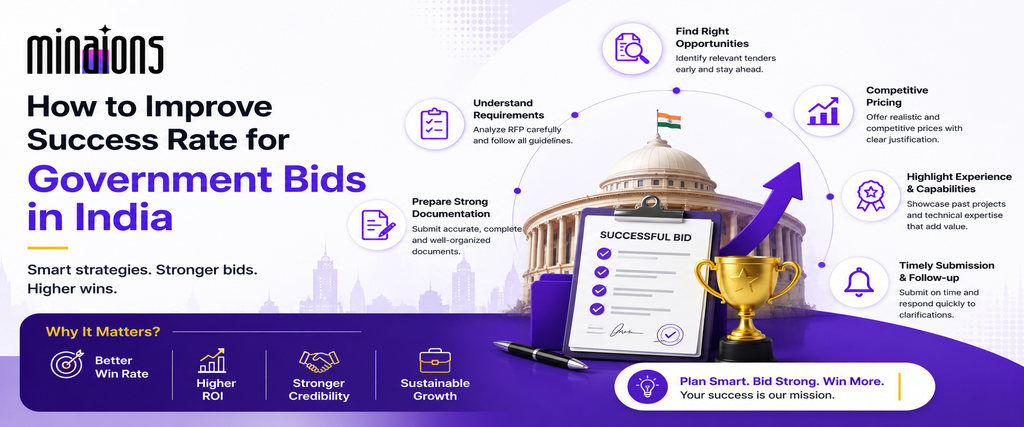
The stakes in Indian government tendering have never been higher. Public procurement spending exceeds ₹50 lakh crore annually, with digital platforms like GeM and CPPP now mandating electronic submissions.