Construction & Infrastructure Tenders: PWD, CPWD, NHAI and How to Bid
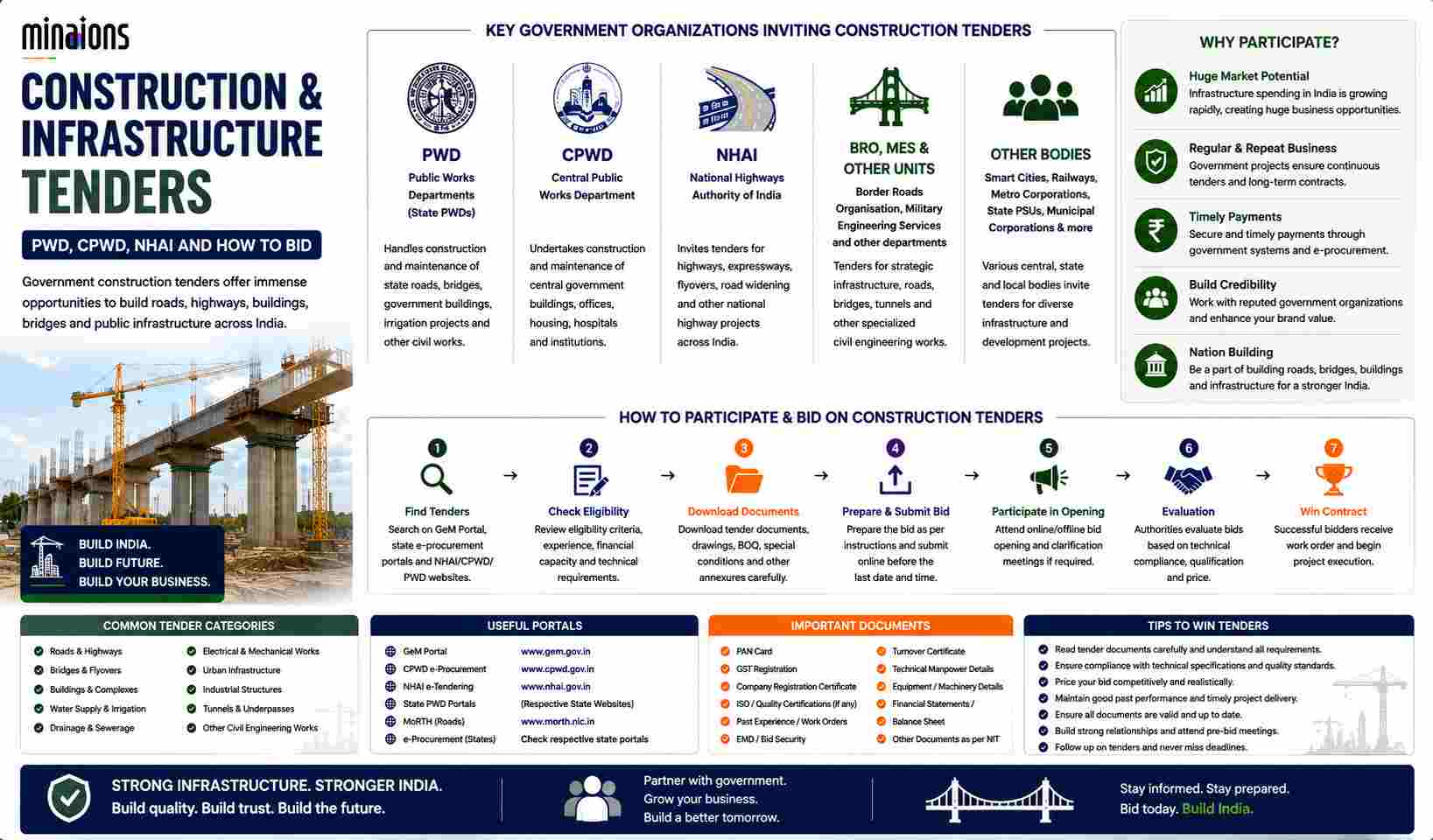
India’s infrastructure sector is witnessing massive growth through highways, bridges, metro projects, smart cities, airports, railways, industrial corridors, urban infrastructure, and government building projects. Departments such as PWD, CPWD, NHAI, Smart City Missions, metro corporations, and public infrastructure agencies regularly publish public bids and tenders for contractors, EPC companies, engineering consultants, architects, and infrastructure firms.
Businesses participating in construction procurement must clearly understand the complete government procurement process India follows for infrastructure projects. Whether companies are participating in the e procurement tender process, analyzing pwd tender result, accessing opportunities through the government of india tender portal, or evaluating the difference between GeM vs CPPP portal, procurement readiness is critical.
The rise of tender digital systems, e tender all india procurement platforms, and centralized procurement workflows has transformed the infrastructure procurement ecosystem. Platforms like Minaions are helping contractors automate procurement workflows, improve compliance, optimize the bid no-bid decision framework, reduce tender disqualification reasons, and improve participation in large-scale public bids and tenders.
Growth of Government Public Procurement in Infrastructure
India’s infrastructure boom is significantly increasing the volume of government public procurement opportunities.
Today, departments such as CPWD, PWD, and NHAI regularly issue public bids and tenders related to:
Highway construction
Smart city infrastructure
Metro rail systems
Water supply projects
Urban redevelopment
Industrial infrastructure
Government buildings
Bridge construction
The expansion of government public procurement is creating enormous opportunities for contractors participating in e tender all india systems.
Businesses participating in government public procurement should continuously monitor the central e tender portal, the government of india tender portal, and every major tender procurement portal to improve procurement visibility.
Tender Digital and Modern Procurement Systems
The rise of tender digital systems has transformed construction procurement workflows.
Modern tender digital platforms now support:
Online bid submissions
Digital documentation
Compliance automation
Procurement tracking
Bid analytics
Procurement visibility
Businesses participating in public bids and tenders should strengthen digital procurement readiness within the evolving tender digital ecosystem.
The adoption of tender digital systems has significantly improved transparency in the broader government procurement process India.
Minaions helps contractors manage tender digital workflows through AI-driven procurement automation and analytics.
E Tender All India and Nationwide Procurement Opportunities
The growth of e tender all india systems has expanded infrastructure procurement opportunities across India.
Today, contractors can participate in e tender all india opportunities across multiple states through centralized procurement systems and digital procurement portals.
The expansion of e tender all india has improved:
Procurement accessibility
Supplier participation
Compliance visibility
Procurement efficiency
Digital bid management
Businesses participating in government public procurement should continuously monitor e tender all india opportunities to improve market reach and procurement participation.
Minaions provides AI-driven procurement intelligence for tracking e tender all india opportunities more efficiently.
Understanding the E Procurement Tender Process
The e procurement tender process is one of the most important aspects of construction procurement.
The standard e procurement tender process generally includes:
Opportunity identification
Tender document download
Eligibility analysis
Technical proposal preparation
Commercial bid preparation
Compliance verification
Final digital submission
Technical evaluation
Financial evaluation
Businesses participating in public bids and tenders should optimize every stage of the e procurement tender process to improve procurement success rates.
The complexity of the e procurement tender process has increased significantly because of digital compliance requirements and evaluation transparency.
Central E Tender Portal and Procurement Visibility
The central e tender portal is one of the most important procurement gateways for infrastructure contractors.
Businesses participating in government public procurement use the central e tender portal to:
Access procurement opportunities
Download tender documents
Track procurement updates
Submit bids digitally
Monitor evaluation status
The increasing adoption of the central e tender portal has improved procurement transparency while increasing competition in public bids and tenders.
Companies participating in e tender all india systems should continuously monitor the central e tender portal to improve procurement visibility.
Government of India Tender Portal and Public Procurement Access
The government of india tender portal plays a major role in India’s infrastructure procurement ecosystem.
Businesses participating in the government procurement process India use the government of india tender portal to:
Track procurement opportunities
Participate in digital procurement
Download procurement notices
Monitor corrigendums
Improve procurement planning
The expansion of the government of india tender portal has significantly improved supplier participation in infrastructure procurement projects.
Minaions helps contractors integrate workflows across the government of india tender portal and multiple tender procurement portal systems.
GeM E Procurement Portal and Construction Procurement
The rise of the gem e procurement portal has also transformed procurement workflows for construction companies.
Today, the gem e procurement portal supports procurement related to:
Construction materials
Electrical equipment
Furniture
IT infrastructure
Smart devices
Safety systems
Businesses participating in government public procurement should understand how the gem e procurement portal integrates with broader infrastructure procurement workflows.
The increasing adoption of the gem e procurement portal has improved procurement accessibility for MSMEs participating in infrastructure projects.
Tender Procurement Portal and Bid Management
Every contractor participating in public bids and tenders should actively monitor a reliable tender procurement portal.
Businesses use a tender procurement portal to:
Identify procurement opportunities
Download tender documents
Track procurement timelines
Monitor corrigendums
Submit bids digitally
The expansion of digital tender procurement portal systems has significantly improved participation in e tender all india procurement projects.
Minaions integrates with multiple tender procurement portal systems to simplify procurement tracking and compliance management.
PWD Tender Result and Competitive Analysis
Monitoring pwd tender result is critical for procurement planning.
Businesses participating in infrastructure procurement should regularly analyze pwd tender result data to:
Understand pricing trends
Analyze competition
Improve bid strategy
Evaluate project demand
The increasing complexity of procurement markets makes monitoring pwd tender result extremely valuable for contractors participating in government public procurement.
Tender Checklist India and Compliance Management
A strong tender checklist India workflow is essential for procurement success.
The standard tender checklist India generally includes:
Eligibility verification
Technical proposal review
Financial documentation
EMD compliance
Vendor certifications
Bid submission readiness
Businesses participating in the government procurement process India should establish strong tender checklist India workflows to reduce operational errors.
Ignoring critical items in the tender checklist India process is one of the biggest tender disqualification reasons in infrastructure procurement.
GeM vs CPPP Portal
Understanding GeM vs CPPP portal differences is critical for infrastructure contractors.
The comparison between GeM vs CPPP portal generally involves:
Procurement categories
Vendor participation
Bid submission workflows
Compliance standards
Procurement scope
Businesses participating in government public procurement should understand the operational differences between GeM vs CPPP portal systems before participating in the e procurement tender process.
The growing importance of understanding GeM vs CPPP portal systems is encouraging contractors to invest in procurement automation and digital readiness.
How to Get Government Contracts India
Many contractors ask how to get government contracts India successfully.
The answer to how to get government contracts India involves:
Understanding the government procurement process India
Monitoring e tender all india opportunities
Managing compliance accurately
Building technical capability
Improving proposal quality
Businesses trying to understand how to get government contracts India should also strengthen financial capability and operational readiness.
Minaions helps contractors optimize workflows related to how to get government contracts India using AI-driven procurement management systems.
How to Write a Bid Proposal India
Understanding how to write a bid proposal India is essential for infrastructure procurement success.
A strong approach to how to write a bid proposal India includes:
Understanding the project scope
Preparing technical documentation
Creating accurate cost estimates
Aligning with compliance requirements
Demonstrating execution capability
Businesses participating in public bids and tenders should continuously improve workflows related to how to write a bid proposal India to improve procurement outcomes.
Weak proposal quality is one of the biggest tender disqualification reasons in infrastructure procurement.
Bid No-Bid Decision Framework
A strong bid no-bid decision framework is critical for contractors participating in infrastructure procurement.
The bid no-bid decision framework helps businesses evaluate:
Technical capability
Financial feasibility
Project profitability
Resource availability
Risk exposure
Organizations participating in public bids and tenders should establish a structured bid no-bid decision framework to improve procurement efficiency.
Minaions provides AI-driven tools for automating the bid no-bid decision framework and improving procurement decision-making.
Tender Disqualification Reasons
Understanding common tender disqualification reasons is essential for procurement success.
Typical tender disqualification reasons include:
Missing documentation
Incorrect pricing
Weak technical proposals
Failure to follow compliance requirements
Late submissions
Incomplete financial information
Businesses participating in the government procurement process India should continuously monitor and reduce common tender disqualification reasons through structured procurement workflows.
Government Tender Software and Procurement Automation
Modern government tender software is becoming essential for infrastructure contractors.
Advanced government tender software helps businesses:
Track procurement opportunities
Monitor procurement updates
Organize tender documents
Improve collaboration
Automate compliance workflows
The increasing complexity of infrastructure procurement has increased the demand for AI-driven government tender software solutions.
Minaions provides advanced government tender software that helps contractors automate procurement operations and improve bid success rates.
Final Thoughts
India’s infrastructure sector continues to create enormous opportunities through government public procurement, public bids and tenders, and large-scale infrastructure modernization projects. Businesses participating in construction procurement must clearly understand the complete government procurement process India follows for procurement management.
From optimizing the e procurement tender process to understanding how to write a bid proposal India, every stage of procurement matters.
Organizations actively participating through the government of india tender portal, improving workflows with AI-driven platforms like Minaions, and understanding the operational differences between GeM vs CPPP portal systems can significantly improve procurement success rates.
As tender digital, e tender all india, and modern procurement systems continue to evolve, businesses investing in structured procurement management, AI-driven analytics, and advanced government tender software will gain a major competitive advantage.
Related Blogs

A small manufacturing firm in Ludhiana missed a ₹2.3 crore contract after spending 14 hours manually scanning the GeM portal, only to find the tender had closed two days earlier. This is not an isolated case.

A small civil engineering firm in Lucknow spent three weeks manually parsing a 420-page NHAI tenders document, only to miss a critical clause in the contractor registration requirements and lose eligibility.

A small manufacturing firm in Ludhiana missed a ₹2.
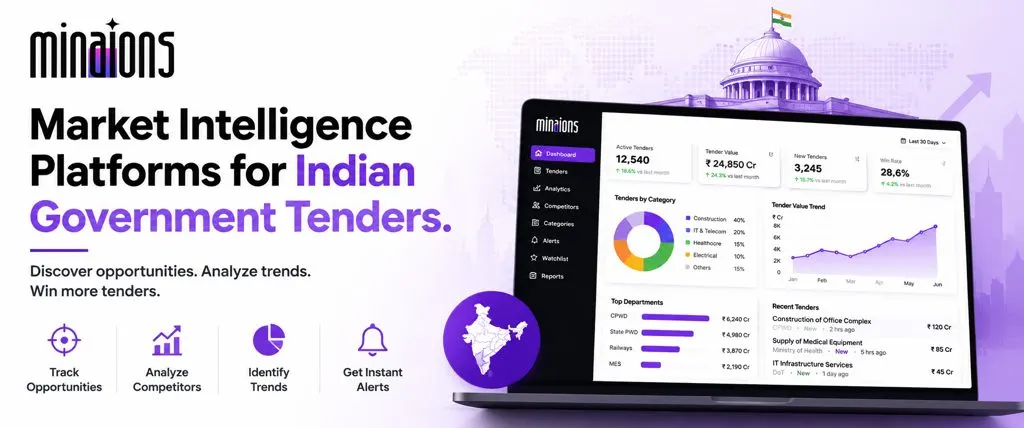
Discover how AI-powered market intelligence platforms streamline tender registration, procurement compliance, and government bidding success.