Education Sector Tenders: Winning Contracts with Schools, IITs, and NVS
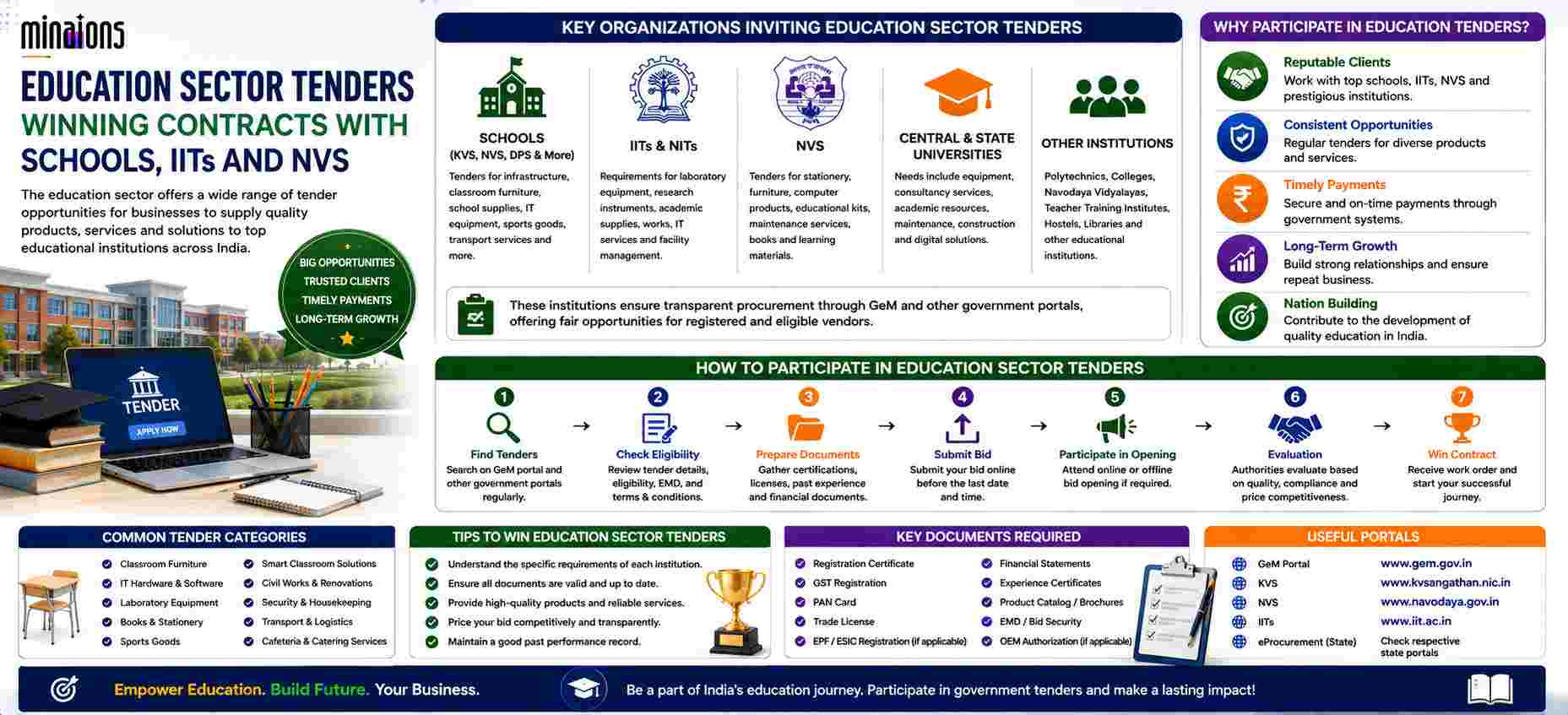
India’s education sector is rapidly becoming one of the largest contributors to public procurement growth. Government schools, IITs, NITs, Kendriya Vidyalayas, Navodaya Vidyalaya Samiti (NVS), universities, public colleges, and research institutions regularly release government contracts and tenders for infrastructure, smart classrooms, digital learning, ERP software, laboratory equipment, networking, furniture, transportation, educational content, and institutional services.
Businesses participating in the education procurement ecosystem must clearly understand the modern tender environment, the complete bidding process, and the growing role of digital procurement systems. Whether companies are participating in gem india tenders, using tender portals in india, or competing in MSME tenders India, procurement readiness is essential for long-term success.
The rise of central public procurement, e-procurement India, and AI-driven procurement management systems has transformed how suppliers participate in educational procurement. Platforms like Minaions are helping businesses automate bid workflows, track tender alerts India, reduce tender disqualification reasons, manage compliance, and improve participation in education-sector projects tenders.
Growth of Government Contracts and Tenders in Education
The ecosystem of government contracts and tenders in education has expanded significantly because of India’s digital education initiatives and institutional modernization programs.
Today, educational institutions regularly release projects tenders for:
Smart classroom infrastructure
ERP implementation
Digital libraries
Laboratory equipment
Educational software
Campus networking
Security systems
Stationery and furniture procurement
The increasing number of government contracts and tenders has created major opportunities for businesses participating in online tenders India and digital procurement systems.
Companies participating in eProcure systems should continuously monitor procurement opportunities to improve market reach.
Understanding the Tender Environment
The modern education-sector tender environment is highly competitive, technology-driven, and compliance-focused.
The current tender environment includes:
Digital procurement workflows
Automated evaluations
MSME procurement preferences
Vendor performance analysis
AI-driven procurement visibility
Businesses participating in central public procurement should carefully understand the evolving tender environment to improve procurement success rates.
The increasing complexity of the education-sector tender environment has encouraged suppliers to adopt AI-driven procurement platforms like Minaions.
Bidding Process for Education Tenders
The education-sector bidding process is structured and documentation-intensive.
The standard bidding process generally includes:
Opportunity discovery through tender portals in india
Reviewing procurement eligibility
Understanding the tender scope
Preparing technical proposals
Financial bid preparation
Compliance verification
Final bid submission
Businesses participating in government contracts and tenders should optimize every stage of the bidding process to improve procurement outcomes.
Weak proposal quality during the bidding process is one of the major tender rejection reasons India suppliers face in educational procurement.
Projects Tenders in Education Sector
The number of education-sector projects tenders is increasing rapidly.
Today, educational projects tenders include procurement related to:
Smart campus systems
Educational ERP software
AI learning platforms
Infrastructure modernization
Library automation
Cloud-based education systems
Businesses participating in projects tenders should focus heavily on compliance, scalability, and technical proposal quality.
The increasing competition in education-sector projects tenders has made procurement automation highly important.
Gem India Tenders and Digital Procurement
The rise of gem india tenders has significantly expanded supplier participation in educational procurement.
Educational institutions increasingly use gem india tenders for:
Computer systems
Networking equipment
Furniture supply
Educational software
Smart classroom devices
Businesses participating in gem india tenders should maintain strong procurement readiness and compliance documentation.
The expansion of gem india tenders has improved procurement transparency across the broader e-procurement India ecosystem.
Minaions helps businesses manage workflows related to gem india tenders and improve procurement visibility.
Central Public Procurement and Institutional Procurement
The education ecosystem heavily relies on central public procurement systems for transparency and procurement efficiency.
The modern central public procurement framework supports:
Digital procurement workflows
Centralized procurement visibility
Standardized bid evaluation
Vendor participation tracking
Businesses participating in government contracts and tenders should understand the operational structure of central public procurement systems before preparing bids.
The increasing complexity of central public procurement has increased the demand for AI-driven procurement management systems.
Tender Portals in India and Opportunity Tracking
Modern tender portals in india are essential for education procurement participation.
Businesses use tender portals in india to:
Identify procurement opportunities
Download tender documents
Monitor corrigendums
Track procurement updates
Submit bids digitally
The expansion of tender portals in india has significantly improved supplier participation in MSME tenders India.
Companies participating in projects tenders should continuously monitor multiple tender portals in india to improve procurement visibility.
Gem CPPP and Procurement Integration
The integration of gem cppp systems is improving procurement standardization across education procurement.
The gem cppp ecosystem supports:
Centralized procurement workflows
Vendor management
Procurement analytics
Bid visibility
Digital procurement automation
Businesses participating in gem india tenders should understand how the gem cppp ecosystem influences procurement participation.
The increasing adoption of gem cppp systems has improved transparency across online tenders India.
E Tender Rules and Procurement Compliance
Compliance with e tender rules is mandatory for educational procurement participation.
The applicable e tender rules generally define:
Bid submission guidelines
Vendor eligibility
Procurement timelines
Technical qualification standards
MSME conditions
Businesses participating in government contracts and tenders should carefully review all e tender rules before preparing submissions.
Ignoring e tender rules is one of the biggest tender disqualification reasons in educational procurement.
Tender Scope and Bid Planning
Understanding the tender scope is essential for procurement success.
The tender scope generally defines:
Technical deliverables
Procurement timelines
Infrastructure expectations
Service obligations
Warranty conditions
Businesses participating in projects tenders should carefully evaluate the complete tender scope before finalizing pricing and technical proposals.
An incorrect understanding of the tender scope is one of the most common tender rejection reasons India suppliers experience.
How to Bid on GeM Portal
Many businesses entering educational procurement ask how to bid on GeM portal effectively.
Understanding how to bid on GeM portal involves:
Vendor registration
Product listing
Bid participation
Compliance documentation
Digital submission workflows
Businesses trying to learn how to bid on GeM portal should also maintain updated company documentation and procurement workflows.
Minaions helps suppliers simplify workflows related to how to bid on GeM portal using AI-driven procurement systems.
MSME Tenders India and Startup Opportunities
The ecosystem of MSME tenders India is expanding rapidly in educational procurement.
Educational institutions increasingly encourage participation through MSME tenders India because of procurement policies supporting local suppliers.
Businesses participating in MSME tenders India can benefit from:
Lower competition
MSME preferences
Faster procurement cycles
Reserved procurement opportunities
The increasing number of MSME tenders India opportunities has created strong growth potential for startups and local suppliers.
Online Tenders India and Procurement Automation
The rise of online tenders India has transformed educational procurement operations.
Today, suppliers can participate in online tenders India remotely through digital procurement systems.
The adoption of online tenders India has improved:
Procurement accessibility
Supplier participation
Procurement visibility
Digital compliance workflows
Businesses participating in online tenders India should strengthen digital procurement readiness to remain competitive.
E-Procurement India and EProcure Systems
The growth of e-procurement India is driving major transformation in educational procurement.
Modern e-procurement India systems now support:
Automated bid submissions
Digital procurement workflows
Centralized compliance management
Real-time procurement analytics
The expansion of eProcure systems has improved procurement efficiency while increasing supplier competition.
Businesses participating in eProcure workflows should focus heavily on proposal quality and operational accuracy.
Tender Alerts India and Procurement Visibility
Tracking tender alerts India is essential for procurement success.
Businesses participating in educational procurement use tender alerts India to:
Identify procurement opportunities early
Improve proposal preparation
Monitor procurement timelines
Track procurement updates
Minaions provides AI-driven tender alerts India systems that help suppliers improve procurement visibility and bid readiness.
Government Tender Software and Bid Management Software India
Modern government tender software has become essential for suppliers participating in educational procurement.
Advanced government tender software helps businesses:
Track procurement opportunities
Manage compliance workflows
Organize tender documents
Improve procurement coordination
The growing complexity of educational procurement has also increased demand for bid management software India.
A reliable bid management software India platform helps suppliers optimize procurement workflows, reduce tender disqualification reasons, and improve operational efficiency.
Minaions provides AI-driven bid management software India solutions that help businesses automate procurement operations and improve bid success rates.
Tender Rejection Reasons India and Tender Disqualification Reasons
Understanding tender rejection reasons India is critical for procurement success.
Typical tender rejection reasons India include:
Incomplete documentation
Pricing errors
Missing certifications
Weak technical proposals
Failure to follow e tender rules
The most common tender disqualification reasons in educational procurement include:
Non-compliance with eligibility criteria
Incorrect bid formatting
Missing financial documents
Delayed submissions
Businesses participating in government contracts and tenders should continuously reduce tender rejection reasons India and tender disqualification reasons through structured compliance workflows.
Final Thoughts
The education sector continues to create enormous opportunities through government contracts and tenders, projects tenders, and institutional procurement programs. Businesses participating in gem india tenders, online tenders India, and the broader e-procurement India ecosystem must clearly understand procurement workflows, compliance standards, and digital procurement systems.
From managing the complete bidding process to reducing tender disqualification reasons, every stage of procurement matters.
Organizations actively tracking tender alerts India, optimizing workflows with government tender software, and using AI-driven platforms like Minaions can significantly improve procurement success rates in the growing education procurement ecosystem.
As central public procurement, gem cppp, and modern eProcure systems continue to evolve, businesses investing in structured procurement management and automation will gain a major competitive advantage.
Related Blogs

A small manufacturing firm in Ludhiana missed a ₹2.3 crore contract after spending 14 hours manually scanning the GeM portal, only to find the tender had closed two days earlier. This is not an isolated case.

A small civil engineering firm in Lucknow spent three weeks manually parsing a 420-page NHAI tenders document, only to miss a critical clause in the contractor registration requirements and lose eligibility.

A small manufacturing firm in Ludhiana missed a ₹2.
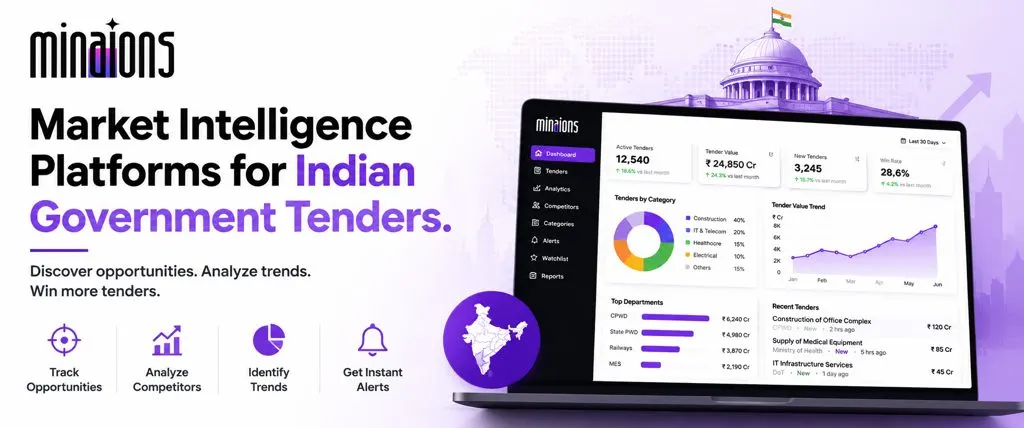
Discover how AI-powered market intelligence platforms streamline tender registration, procurement compliance, and government bidding success.