How AI Reads an RFP Faster and More Accurately Than Your Team
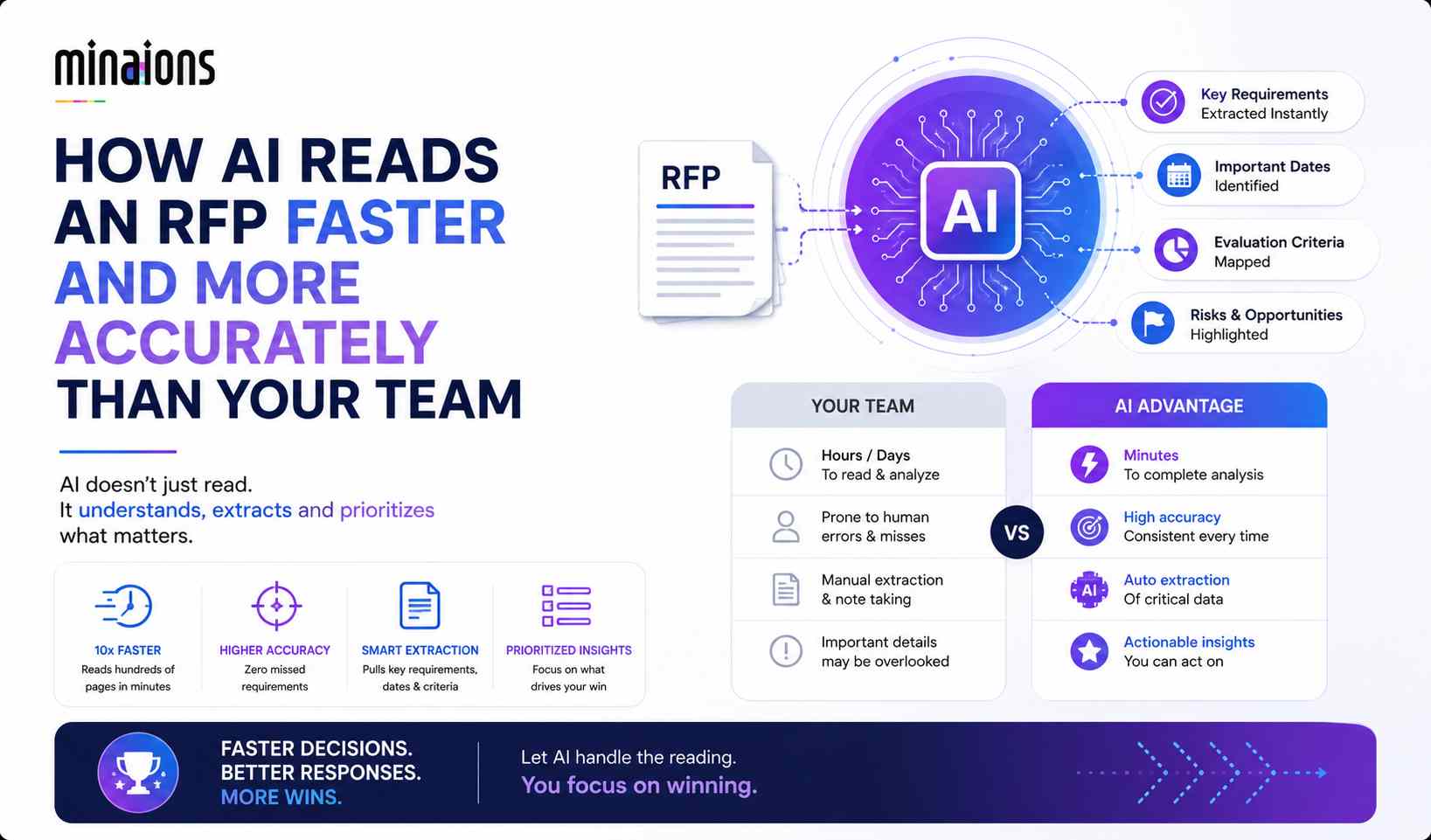
In today’s competitive procurement ecosystem, businesses participating in public procurement and government bidding are handling thousands of pages of tender documents every month. From analyzing the government tender list to preparing detailed rfp proposals, procurement teams spend enormous time reviewing compliance conditions, technical specifications, pricing structures, eligibility requirements, and commercial clauses.
The traditional manual approach to the tender bidding process is slow, error-prone, and expensive. Missing a single clause in a tender can result in disqualification, delayed submissions, or lost revenue opportunities. This is where AI-powered procurement systems are transforming how companies participate in procurement.
Modern AI procurement platforms like Minaions can analyze an RFP in minutes instead of hours. AI can review the government tender list, identify key risks, automate the procurement checklist, optimize rfp proposals, and improve the entire contracting process with significantly higher accuracy than manual procurement teams.
Today, businesses trying to win tenders, participate in gem government tenders, or compete for gem contracts india opportunities are increasingly using AI-driven government tender software and bid management software India platforms to gain a competitive advantage.
Why Manual RFP Reading Slows Down Procurement Teams
Traditional procurement teams manually review hundreds of pages of tender documents during the tender bidding process.
The manual process generally involves:
Reviewing the government tender list
Understanding eligibility conditions
Creating a procurement checklist
Preparing compliance summaries
Building technical submissions
Reviewing commercial conditions
Preparing rfp proposals
This manual workflow creates several operational problems:
Human error
Missed deadlines
Poor document coordination
Inconsistent compliance reviews
Delayed approvals
Weak proposal quality
Businesses trying to win tenders consistently cannot rely entirely on manual procurement operations anymore.
The increasing complexity of gem procurement, gem portal tenders, and gem government tenders has made AI-driven automation essential.
How AI Understands the Tender Bidding Process
AI procurement systems are designed to analyze the complete tender bidding process much faster than traditional procurement teams.
Modern AI platforms can:
Scan the complete government tender list
Identify technical requirements
Extract compliance clauses
Build automated procurement checklist workflows
Detect missing documents
Analyze pricing conditions
Improve rfp proposals
AI systems like Minaions continuously learn from procurement data, helping companies improve their ability to win tenders while reducing operational errors.
The biggest advantage of AI in the tender bidding process is speed and consistency.
AI and Procurement Checklist Automation
One of the biggest challenges in procurement is managing the procurement checklist accurately.
A missed compliance document can lead to immediate rejection during the contracting process.
AI-powered procurement systems automatically generate a structured procurement checklist by reading:
Eligibility criteria
Technical conditions
EMD requirements
Financial qualification
Vendor certifications
Submission deadlines
This automated procurement checklist significantly improves operational accuracy.
Minaions helps businesses automate the entire procurement checklist workflow while reducing manual dependency and compliance risk.
AI Improves Procurement Principles and Compliance
Modern procurement systems rely heavily on standardized procurement principles.
Key procurement principles include:
Transparency
Compliance
Fair competition
Documentation accuracy
Procurement accountability
AI systems help businesses align with these procurement principles by automatically reviewing tender clauses and detecting inconsistencies.
Businesses participating in gem procurement and gem government tenders especially benefit from AI-driven compliance automation because procurement guidelines are often highly detailed.
AI-powered government tender software significantly improves alignment with modern procurement principles.
AI-Powered RFP Proposals
Preparing strong rfp proposals is one of the most time-consuming stages of procurement.
Traditional procurement teams manually draft:
Technical responses
Compliance statements
Scope summaries
Financial explanations
Execution methodologies
AI platforms can now automate major parts of rfp proposals by extracting procurement requirements directly from the RFP.
AI-driven systems like Minaions help businesses:
Improve rfp proposals
Reduce response time
Standardize proposal quality
Detect missing information
Improve submission accuracy
The quality of rfp proposals plays a critical role in helping businesses win tenders consistently.
AI Simplifies the Contracting Process
The contracting process in public procurement is becoming increasingly documentation-heavy.
Modern AI procurement systems simplify the contracting process by:
Reviewing contractual clauses
Extracting payment terms
Identifying legal obligations
Monitoring submission deadlines
Managing document workflows
AI-driven automation significantly reduces delays during the contracting process.
Businesses participating in gem contracts india and gem portal tenders increasingly rely on AI-powered bid management software India platforms to streamline the entire contracting process.
AI in Gem Procurement and Gem Government Tenders
The rise of gem procurement has transformed public procurement across India.
Today, businesses actively participate in:
gem government tenders
gem contracts india
gem portal tenders
Digital procurement workflows
AI helps businesses participating in gem procurement by:
Tracking procurement opportunities
Automating the tender bidding process
Managing compliance
Organizing documentation
Improving bid strategy
The increasing complexity of gem government tenders has made AI-driven government tender software extremely valuable.
GeM Portal Guide for MSME and AI-Based Procurement
Many MSMEs struggle to understand the complete GeM portal guide for MSME workflows.
AI systems simplify the GeM portal guide for MSME process by helping businesses:
Register efficiently
Track opportunities
Understand eligibility
Improve proposal quality
Manage compliance documentation
Businesses following a structured GeM portal guide for MSME strategy can significantly improve participation in gem portal tenders.
Minaions helps MSMEs automate workflows related to the GeM portal guide for MSME and improve procurement visibility.
Tender Checklist India and AI Automation
Managing a detailed tender checklist India workflow manually is extremely difficult.
A typical tender checklist India process may include:
Vendor eligibility verification
EMD compliance
Technical document uploads
Financial statement preparation
Tender submission readiness
AI systems automate the complete tender checklist India process while improving operational efficiency.
Minaions uses AI-driven procurement workflows to optimize the entire tender checklist India lifecycle.
Government Tender Software and Procurement Intelligence
Modern government tender software is transforming how businesses participate in procurement.
Advanced government tender software platforms help companies:
Track the government tender list
Analyze procurement trends
Improve rfp proposals
Automate the tender bidding process
Manage compliance workflows
The increasing complexity of government tenders and gem procurement has made AI-driven government tender software essential.
Bid Management Software India and Smart Procurement
The demand for bid management software India is increasing rapidly because procurement teams need automation and analytics.
A strong bid management software India platform helps businesses:
Improve procurement visibility
Reduce compliance errors
Automate documentation
Optimize pricing strategy
Improve proposal collaboration
Minaions provides AI-driven bid management software India solutions that help businesses improve procurement efficiency and increase their ability to win tenders.
How AI Helps Businesses Win Tenders
AI helps businesses win tenders by improving procurement accuracy and reducing operational delays.
Businesses using AI procurement systems can:
Respond faster
Improve compliance
Reduce procurement errors
Improve proposal quality
Automate procurement workflows
The ability to win tenders consistently now depends heavily on procurement intelligence and operational automation.
Companies participating in gem contracts india, gem portal tenders, and large-scale public procurement increasingly rely on AI-driven procurement systems.
Minaions and AI-Driven Procurement Transformation
Minaions is transforming how businesses participate in public procurement and government bidding.
Minaions helps companies:
Analyze the government tender list
Automate the procurement checklist
Improve rfp proposals
Simplify the contracting process
Manage gem procurement
Optimize gem bidding process
Improve participation in gem government tenders
Businesses using Minaions can significantly improve operational efficiency while increasing procurement success rates.
Final Thoughts
AI is transforming the future of procurement. Traditional manual procurement workflows are no longer sufficient for businesses competing in complex public procurement environments.
From analyzing the government tender list to automating the complete tender bidding process, AI helps businesses reduce risk, improve speed, and increase accuracy.
Organizations participating in gem procurement, gem government tenders, and gem contracts india should invest in AI-driven government tender software and bid management software India platforms to remain competitive.
As procurement ecosystems continue evolving digitally, businesses using AI-powered procurement intelligence platforms like Minaions will gain a major advantage in their ability to win tenders consistently and scale procurement operations efficiently.
Related Blogs
A small manufacturing firm in Ludhiana missed a ₹2.3 crore contract after spending 14 hours manually scanning the GeM portal, only to find the tender had closed two days earlier. This is not an isolated case.

A small civil engineering firm in Lucknow spent three weeks manually parsing a 420-page NHAI tenders document, only to miss a critical clause in the contractor registration requirements and lose eligibility.

A small manufacturing firm in Ludhiana missed a ₹2.
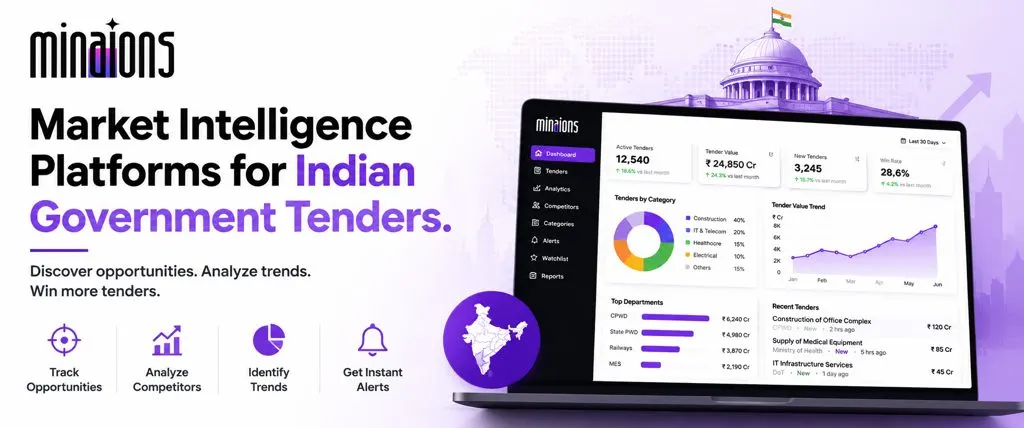
Discover how AI-powered market intelligence platforms streamline tender registration, procurement compliance, and government bidding success.