How MSMEs Can Compete Against Large Companies in Government Bids
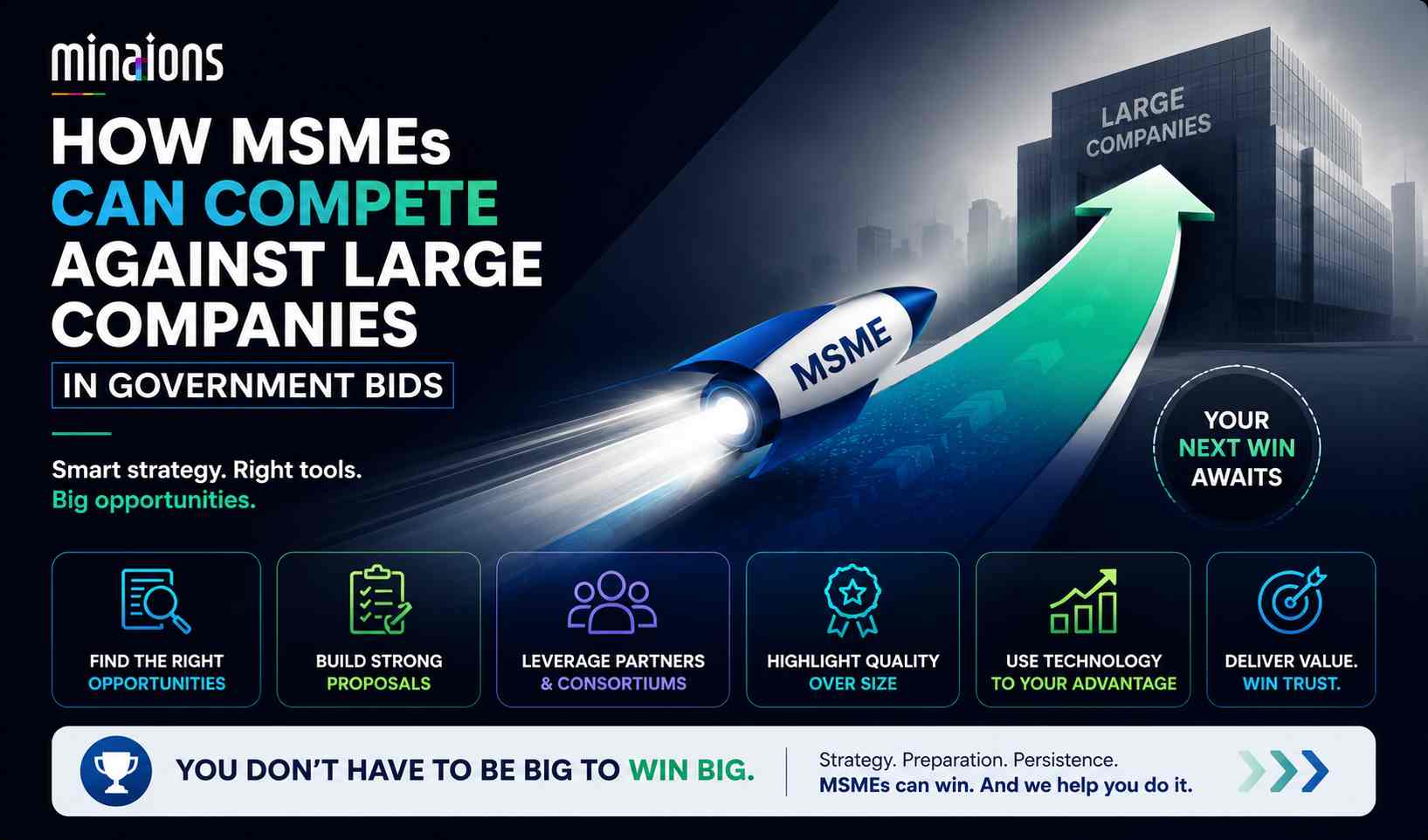
India’s public procurement ecosystem is evolving rapidly, creating major opportunities for startups, local suppliers, service providers, manufacturers, consultants, and small businesses. Today, thousands of MSMEs are participating in public procurement tender opportunities across infrastructure, IT, healthcare, education, logistics, security services, manufacturing, consulting, and digital transformation projects.
However, many MSMEs still believe they cannot compete against large corporations in government procurement. In reality, the rise of digital procurement systems, tendering platforms, and dedicated MSME tenders India policies has created a level playing field for smaller businesses.
Businesses participating in public procurement processes must understand procurement workflows, improve compliance management, optimize bid submissions, and reduce common tender rejection reasons India suppliers face during evaluations.
Platforms like Minaions are helping MSMEs automate procurement workflows, manage documents required for tender submission, track bid opps, improve procurement visibility, and reduce tender disqualification reasons through AI-driven procurement management.
Growth of MSME Tenders India
The ecosystem of MSME tenders India is growing rapidly because of government policies promoting local supplier participation.
Today, MSME tenders India opportunities cover:
IT procurement
Construction services
Digital transformation
Healthcare supply
Smart city projects
Security services
Logistics contracts
Manufacturing procurement
The increasing number of MSME tenders India opportunities has made it easier for small businesses to participate in public procurement tender ecosystems.
Businesses participating in MSME tenders India should continuously monitor procurement opportunities through modern tendering platforms and AI-driven procurement systems.
Understanding Public Procurement Tender Opportunities
A public procurement tender is a procurement opportunity where government departments invite suppliers to submit bids for products, services, or infrastructure projects.
The modern public procurement tender ecosystem includes opportunities from:
Central ministries
State departments
Smart city missions
Public healthcare systems
Educational institutions
Infrastructure agencies
Businesses participating in public procurement tender projects should focus heavily on compliance, operational capability, and proposal quality.
The increasing volume of public procurement tender opportunities is creating strong growth potential for MSMEs across India.
Role of Tendering Platforms in MSME Growth
Modern tendering platforms have transformed how MSMEs participate in procurement opportunities.
Businesses use tendering platforms to:
Track procurement opportunities
Download tender documents
Submit bids digitally
Monitor procurement updates
Analyze procurement trends
The expansion of digital tendering platforms has improved procurement accessibility for businesses participating in MSME tenders India.
Minaions helps MSMEs integrate with multiple tendering platforms to improve procurement visibility and bid management efficiency.
Importance of Tender Form Accuracy
A properly completed tender form is critical for procurement success.
Many MSMEs lose opportunities because of mistakes in the tender form during the evaluation stage.
A standard tender form generally includes:
Company details
Financial declarations
Technical capability
Compliance information
Pricing details
Businesses participating in public procurement tender opportunities should carefully review every tender form before final submission.
Incorrect or incomplete tender form submissions are one of the biggest tender rejection reasons India suppliers experience.
Bid Opps and Opportunity Tracking
Tracking bid opps consistently is one of the most important strategies for MSMEs.
The growing number of bid opps across sectors allows small businesses to identify procurement categories with lower competition and better profitability.
Businesses participating in MSME tenders India should continuously monitor:
Infrastructure bid opps
IT procurement bid opps
Local government bid opps
Startup-focused bid opps
Service-based bid opps
Minaions provides AI-driven systems for tracking bid opps and improving procurement visibility.
Bid Submissions and Proposal Quality
The quality of bid submissions plays a major role in procurement success.
Businesses participating in public procurement processes should ensure all bid submissions are:
Technically accurate
Financially competitive
Properly documented
Fully compliant
Weak bid submissions are one of the primary tender disqualification reasons in public procurement.
MSMEs participating in government procurement processes should establish strong internal workflows for managing bid submissions more efficiently.
New Bids and First-Time Procurement Participation
The rise of digital procurement has significantly increased opportunities through new bids.
Today, many departments encourage startup participation through new bids focused on innovation and local supplier development.
Businesses entering new bids should focus on:
Compliance readiness
Competitive pricing
Proposal quality
Technical clarity
The increasing number of new bids has created major growth opportunities for MSMEs participating in public procurement tender ecosystems.
Government Procurement Processes Explained
The modern government procurement processes are becoming increasingly digital and compliance-focused.
Typical government procurement processes include:
Opportunity publication
Bid document download
Technical qualification
Financial evaluation
Contract award
Businesses participating in government procurement processes should optimize workflows related to documentation, compliance, and procurement timelines.
The increasing complexity of government procurement processes has encouraged MSMEs to adopt automation platforms like Minaions.
Bid Posting and Procurement Visibility
Monitoring bid posting updates is critical for procurement success.
Businesses participating in MSME tenders India should regularly track:
New bid posting
Corrigendum updates
Deadline revisions
Technical clarifications
The growing number of digital bid posting systems has improved procurement visibility across sectors.
Minaions provides automated bid posting tracking to help MSMEs improve opportunity discovery.
Documents Required for Tender Submission
One of the most important aspects of procurement participation is organizing the documents required for tender submission.
Typical documents required for tender submission include:
GST registration
PAN details
Financial statements
Experience certificates
MSME certificates
Compliance declarations
Businesses participating in public procurement tender projects should maintain centralized records for all documents required for tender submission.
Missing documents required for tender submission is one of the most common tender disqualification reasons in procurement evaluations.
Tendering Contractors and MSME Partnerships
Many MSMEs can improve growth by partnering with larger tendering contractors.
Large tendering contractors often outsource portions of government projects to specialized MSMEs.
Businesses collaborating with tendering contractors can gain:
Procurement experience
Project credibility
Operational exposure
Long-term procurement relationships
The increasing collaboration between MSMEs and tendering contractors is improving supplier participation in government procurement processes.
Tender Criteria and Bid Evaluation
Understanding tender criteria is critical for procurement success.
Typical tender criteria may include:
Technical qualification
Financial eligibility
Project experience
Compliance capability
Pricing evaluation
Businesses participating in public procurement processes should carefully analyze every tender criteria requirement before preparing proposals.
Failure to meet tender criteria is one of the leading tender rejection reasons India suppliers experience.
Public Procurement Processes and Digital Transformation
Modern public procurement processes are becoming increasingly AI-driven and automated.
The evolution of public procurement processes now includes:
Automated bid validation
Digital procurement tracking
AI-based procurement analytics
Centralized procurement visibility
Businesses participating in MSME tenders India should adopt procurement automation to improve operational efficiency.
Minaions helps businesses optimize workflows related to modern public procurement processes.
Tender Rejection Reasons India
Understanding common tender rejection reasons India is essential for MSMEs.
Typical tender rejection reasons India include:
Incorrect documentation
Pricing errors
Missing compliance certificates
Weak technical proposals
Incomplete tender form
Businesses participating in public procurement tender opportunities should continuously reduce tender rejection reasons India through structured compliance management.
Tender Disqualification Reasons
The most common tender disqualification reasons include:
Missing eligibility documents
Non-compliance with procurement rules
Incorrect bid formatting
Delayed submissions
Weak financial documentation
Businesses participating in government procurement processes should establish strong compliance workflows to reduce tender disqualification reasons.
Minaions helps MSMEs identify and reduce common tender disqualification reasons through AI-driven procurement intelligence.
How MSMEs Can Compete Successfully
MSMEs can compete successfully against large companies by focusing on:
Faster execution capability
Competitive pricing
Specialized expertise
Better local presence
Strong compliance management
Efficient bid submissions
Smart use of tendering platforms
Businesses participating in MSME tenders India should also invest in automation, procurement analytics, and proposal optimization tools.
Minaions and MSME Tender Success
Minaions is helping MSMEs compete more effectively in public procurement tender ecosystems.
Minaions supports businesses through:
AI-driven procurement tracking
Automated compliance workflows
Opportunity discovery
Tracking bid opps
Managing documents required for tender submission
Improving bid submissions
Reducing tender rejection reasons India
Minimizing tender disqualification reasons
Businesses participating in government procurement processes can use Minaions to improve operational efficiency and procurement success rates.
Final Thoughts
MSMEs no longer need to fear competition from large corporations in government procurement. The growth of MSME tenders India, digital tendering platforms, and AI-driven procurement systems has created enormous opportunities for smaller businesses.
From managing the complete bidding process to organizing all documents required for tender submission, every stage of procurement matters.
Organizations actively tracking bid opps, optimizing bid submissions, reducing tender rejection reasons India, and improving compliance through platforms like Minaions can significantly improve procurement success rates.
As public procurement processes continue to evolve digitally, MSMEs investing in procurement automation and structured bid management will gain a strong competitive advantage.
Related Blogs

A small manufacturing firm in Ludhiana missed a ₹2.3 crore contract after spending 14 hours manually scanning the GeM portal, only to find the tender had closed two days earlier. This is not an isolated case.

A small civil engineering firm in Lucknow spent three weeks manually parsing a 420-page NHAI tenders document, only to miss a critical clause in the contractor registration requirements and lose eligibility.

A small manufacturing firm in Ludhiana missed a ₹2.
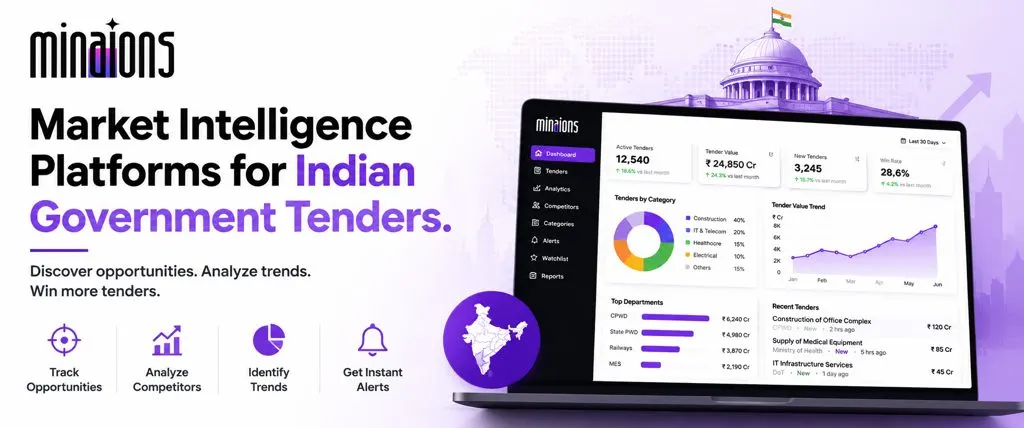
Discover how AI-powered market intelligence platforms streamline tender registration, procurement compliance, and government bidding success.