How to Win Reverse Auctions on GeM Portal: Proven Strategies
India’s procurement ecosystem is becoming increasingly digital, transparent, and highly competitive. One of the most important procurement mechanisms transforming public procurement is the reverse auction GeM system. Businesses participating in government procurement through the GeM platform must now adopt smarter pricing, compliance management, and procurement strategies to remain competitive.
Today, companies participating as a government supplier, analyzing tender details, and competing in the modern tender in gem portal ecosystem must optimize every stage of procurement participation to improve bid success rates.
The rapid growth of digital procurement, AI-driven procurement analytics, and modern reverse auction workflows has increased both competition and opportunity. Platforms like Minaions are helping suppliers improve tender scanning, reduce procurement delay, avoid tender rejection reasons India, and strengthen participation in the evolving ecosystem of reverse auction GeM procurement systems.
Understanding Reverse Auction GeM
The reverse auction GeM mechanism is a procurement process where suppliers compete by reducing prices during a live digital auction.
Unlike traditional procurement systems, the reverse auction GeM model allows suppliers to revise pricing dynamically in real time.
The objective of reverse auction GeM is to:
Improve procurement transparency
Increase supplier competition
Reduce procurement cost
Improve procurement efficiency
Businesses participating in tender in gem portal systems should clearly understand how the reverse auction GeM process operates before entering live procurement competition.
The increasing scale of reverse auction GeM participation has made procurement strategy more important than ever.
Tender in GeM Portal and Digital Procurement
The ecosystem of tender in gem portal procurement is expanding rapidly.
Today, businesses participate in tender in gem portal opportunities related to:
IT procurement
Healthcare procurement
Office supplies
Smart city projects
Infrastructure procurement
Industrial procurement
The increasing volume of tender in gem portal opportunities has created strong growth potential for businesses operating as a government supplier.
Organizations participating in reverse auction GeM should continuously strengthen digital procurement readiness.
Government Supplier and Procurement Competition
The number of businesses operating as a government supplier is increasing rapidly across India.
Today, every government supplier competes aggressively across sectors such as:
Infrastructure
Technology procurement
Healthcare
Defence
Education
Industrial procurement
The increasing number of suppliers in the reverse auction GeM ecosystem has intensified pricing competition significantly.
Businesses participating as a government supplier should therefore focus heavily on pricing discipline, compliance management, and procurement intelligence.
Minaions helps every government supplier optimize procurement workflows using AI-driven procurement analytics.
Tender Details and Bid Planning
Carefully analyzing tender details is one of the most important steps before participating in reverse auctions.
Critical tender details generally include:
Technical specifications
Eligibility criteria
Delivery timelines
Pricing structure
Procurement conditions
Businesses participating in tender in gem portal procurement should carefully review all tender details before participating in a live auction.
Poor analysis of tender details is one of the biggest causes of tender rejection reasons India and tender disqualification reasons.
The increasing complexity of procurement systems has made intelligent analysis of tender details extremely important.
Successful Tender Strategy for Reverse Auctions
Every business wants to build a successful tender strategy for GeM reverse auctions.
A proper successful tender strategy generally includes:
Procurement analytics
Smart pricing
Compliance readiness
Market research
Bid timing strategy
Businesses participating in reverse auction GeM systems should continuously improve procurement discipline to create a consistent successful tender workflow.
The increasing competition in tender in gem portal procurement has made strategic planning essential for long-term procurement success.
Discovery Tenders and Opportunity Analysis
The role of discovery tenders is becoming increasingly important in procurement participation.
Businesses participating in discovery tenders generally gain advantages such as:
Early procurement visibility
Better bid preparation
Market analysis
Pricing optimization
Competitor understanding
Companies participating as a government supplier should actively monitor discovery tenders to improve procurement readiness.
Minaions helps businesses analyze discovery tenders using AI-driven procurement intelligence systems.
Government Buyer Expectations in Reverse Auctions
Understanding government buyer expectations is critical for procurement success.
A typical government buyer usually expects:
Competitive pricing
Compliance accuracy
Timely delivery
Technical quality
Procurement transparency
Businesses participating in reverse auction GeM systems should align procurement strategy with government buyer expectations to improve contract-winning probability.
The increasing sophistication of procurement systems has made government buyer evaluation more detailed and analytics-driven.
Procurement Delay and Reverse Auction Risks
One of the biggest operational challenges suppliers face is procurement delay.
Typical causes of procurement delay include:
Documentation errors
Technical mismatches
Slow approvals
Pricing disputes
Vendor clarification issues
Businesses participating in reverse auction GeM systems should optimize operational workflows to reduce procurement delay.
The growing complexity of tender in gem portal procurement has increased the importance of centralized procurement management.
Minaions helps suppliers reduce procurement delay through automated procurement tracking and compliance monitoring.
Tender Scanning and Procurement Intelligence
The role of tender scanning is becoming increasingly important in public procurement.
Modern tender scanning systems help businesses:
Identify procurement opportunities
Monitor procurement updates
Analyze procurement trends
Improve bid planning
Track competition
Businesses participating in reverse auction GeM systems should continuously strengthen tender scanning capability to remain competitive.
Minaions provides AI-driven tender scanning tools that help suppliers improve procurement visibility and bid readiness.
GeM Portal Guide for MSME
A proper GeM portal guide for MSME is essential for startups and small businesses entering procurement markets.
The standard GeM portal guide for MSME generally includes:
Vendor registration
Product listing
Bid participation
Reverse auction workflows
Compliance management
Businesses participating as a government supplier should carefully follow the GeM portal guide for MSME to improve procurement readiness.
The increasing participation of MSMEs in reverse auction GeM systems has created strong growth opportunities for startups and local suppliers.
Tender Rejection Reasons India
Understanding major tender rejection reasons India is essential for procurement success.
The most common tender rejection reasons India include:
Incorrect pricing
Missing documentation
Technical non-compliance
Eligibility mismatches
Incomplete bid submission
Businesses participating in tender in gem portal procurement should continuously reduce tender rejection reasons India through structured procurement workflows.
The increasing complexity of procurement systems has made compliance accuracy extremely important.
Tender Disqualification Reasons
Major tender disqualification reasons can completely eliminate procurement opportunities.
Typical tender disqualification reasons include:
Failure to meet eligibility criteria
Incorrect bid formatting
Missing certifications
Poor technical compliance
Pricing inconsistencies
Businesses participating in reverse auction GeM systems should carefully manage procurement workflows to reduce tender disqualification reasons.
Minaions helps businesses reduce tender disqualification reasons using AI-driven compliance management systems.
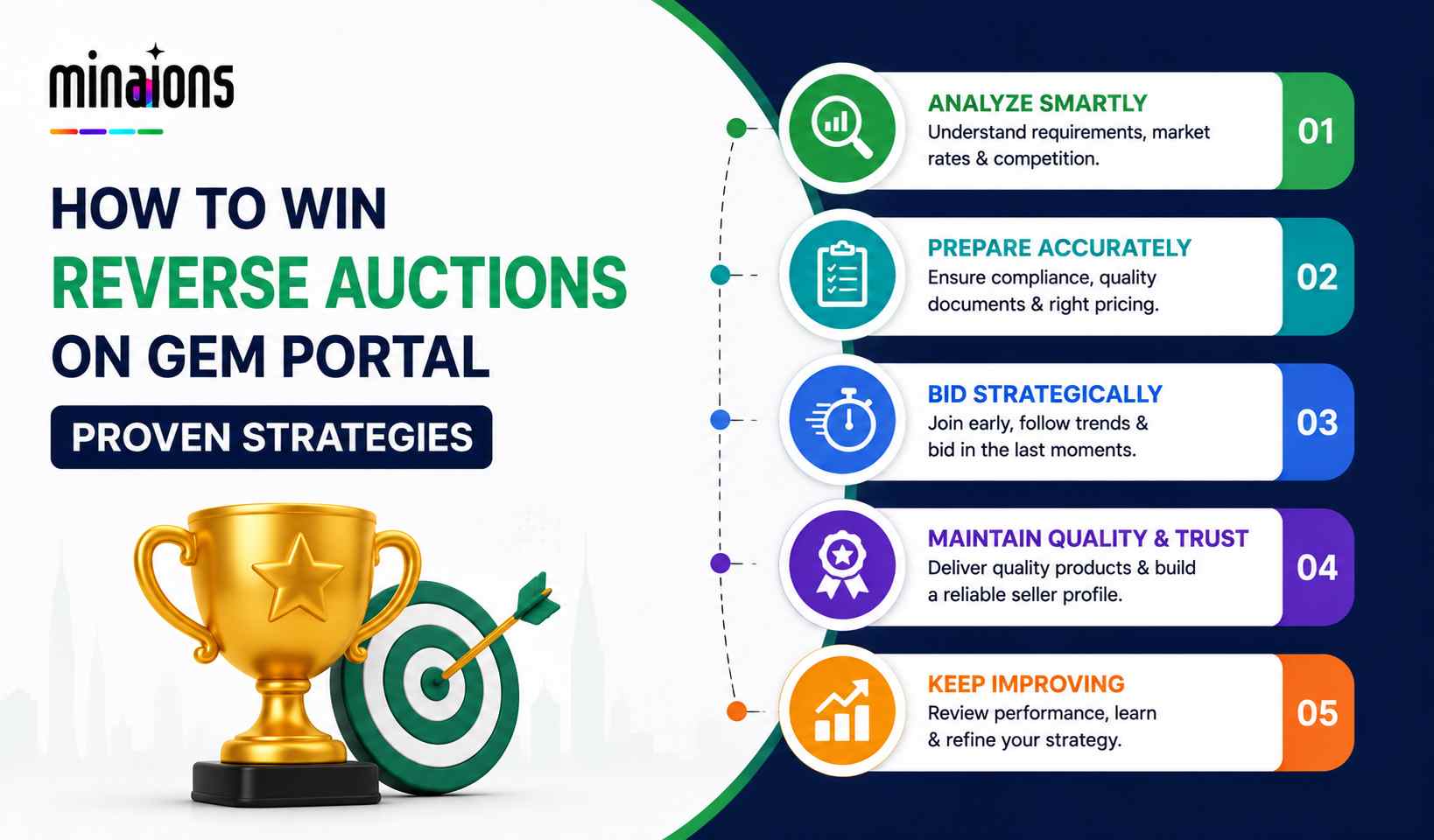
Proven Strategies to Win Reverse Auctions
Businesses aiming to win more procurement opportunities should follow several proven strategies.
Analyze Tender Details Carefully
Accurate analysis of tender details improves bid quality and procurement readiness.
Improve Tender Scanning
Continuous tender scanning helps businesses identify procurement opportunities early.
Follow GeM Portal Guide for MSME
The GeM portal guide for MSME improves procurement participation for startups and MSMEs.
Understand Government Buyer Behavior
Businesses should align proposals with government buyer expectations.
Reduce Procurement Delay
Efficient workflows help minimize procurement delay and improve operational readiness.
Avoid Tender Rejection Reasons India
Businesses should continuously improve compliance management to reduce tender rejection reasons India.
Minimize Tender Disqualification Reasons
Strong documentation and eligibility management help reduce tender disqualification reasons significantly.
Minaions and Smart Reverse Auction Management
Minaions is helping businesses modernize procurement participation through AI-driven procurement automation.
Minaions supports suppliers through:
AI-powered procurement analytics
Smart tender scanning
Procurement tracking
Compliance management
Bid intelligence
Reverse auction analytics
Risk analysis for tender rejection reasons India
Businesses participating in reverse auction GeM can use Minaions to improve procurement efficiency and long-term procurement success rates.
Final Thoughts
The GeM reverse auction ecosystem is becoming one of the most important components of India’s digital procurement infrastructure. Businesses participating in tender in gem portal procurement and operating as a government supplier must clearly understand how reverse auctions function.
From analyzing accurate tender details to improving tender scanning, every stage of procurement matters.
Organizations actively reducing procurement delay, avoiding tender rejection reasons India, minimizing tender disqualification reasons, and using AI-driven platforms like Minaions can significantly improve procurement success rates.
As reverse auction GeM systems continue to evolve digitally, businesses investing in intelligent procurement management and pricing analytics will gain a major competitive advantage.
Related Blogs

A small manufacturing firm in Ludhiana missed a ₹2.3 crore contract after spending 14 hours manually scanning the GeM portal, only to find the tender had closed two days earlier. This is not an isolated case.
A small civil engineering firm in Lucknow spent three weeks manually parsing a 420-page NHAI tenders document, only to miss a critical clause in the contractor registration requirements and lose eligibility.

A small manufacturing firm in Ludhiana missed a ₹2.
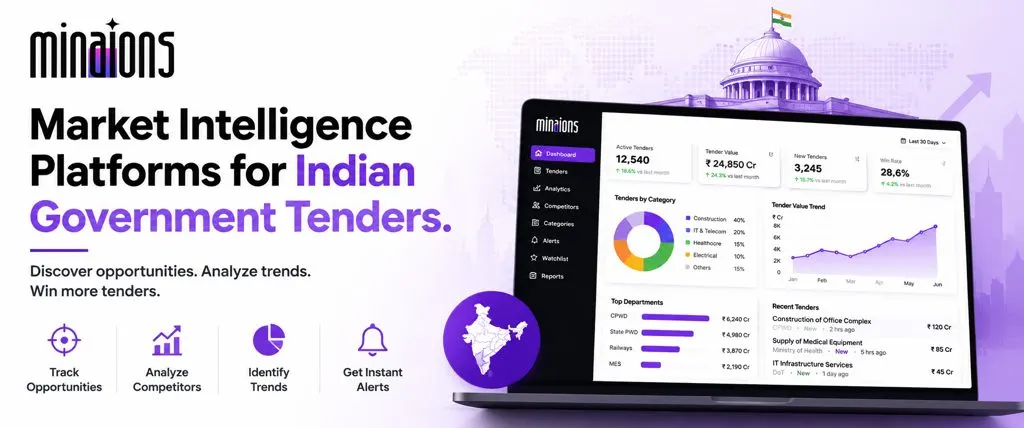
Discover how AI-powered market intelligence platforms streamline tender registration, procurement compliance, and government bidding success.