Should MSMEs Hire a Tender Consultant or Use AI? A Practical Comparison
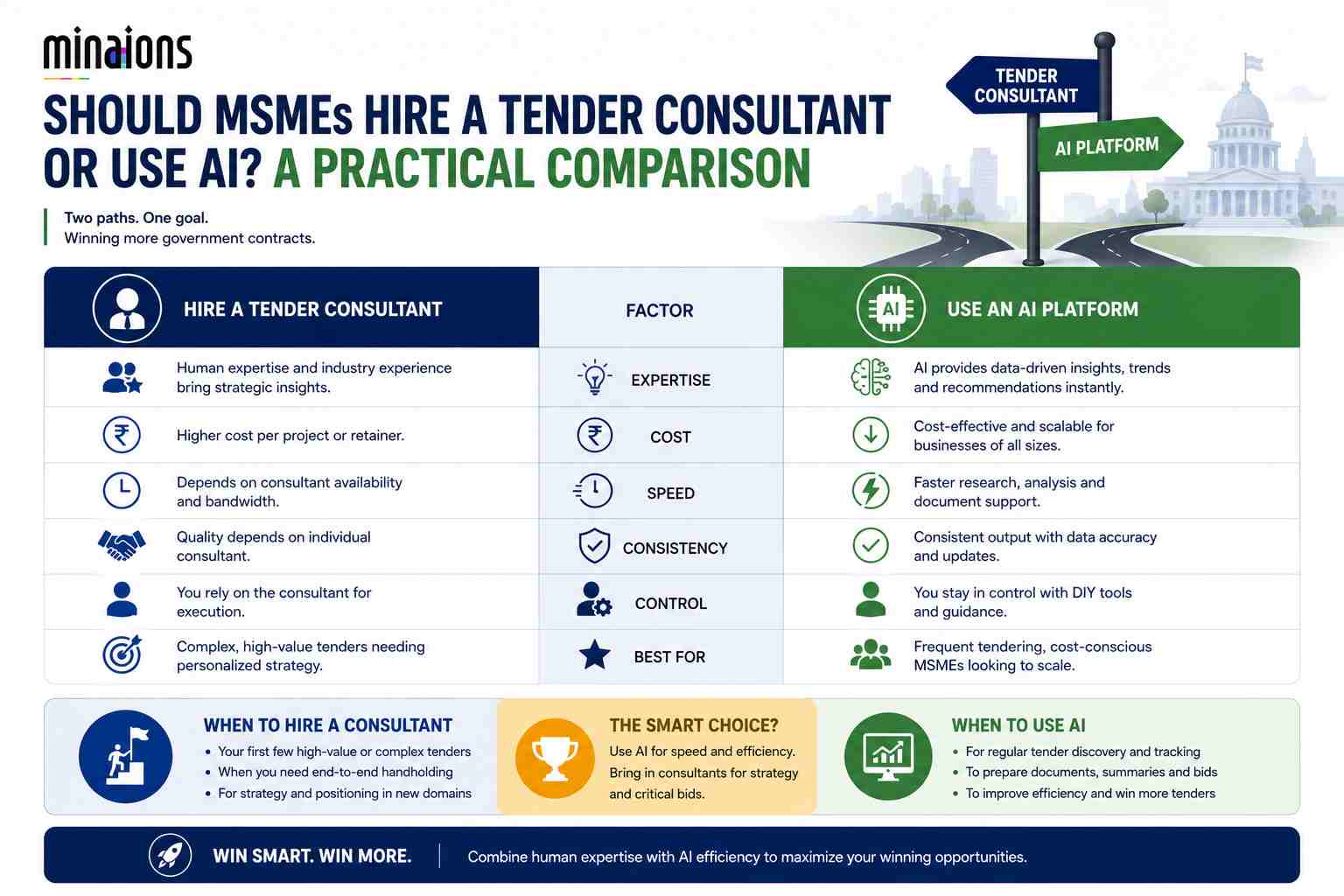
India’s public procurement ecosystem is growing rapidly, creating massive opportunities for MSMEs participating in MSME tenders India, online tenders India, and public procurement projects across sectors such as infrastructure, IT, healthcare, education, construction, logistics, and manufacturing. However, one major question many businesses ask today is whether they should hire a traditional tender consultant or adopt AI-driven tender management systems to manage the modern government tender process.
With the rise of automation, AI-driven procurement tools, and digital procurement workflows, MSMEs now have multiple options to manage tender compliance, track opportunities, and improve participation in small government tenders and large-scale procurement projects. Platforms like Minaions are transforming the way businesses manage the tender process for government contracts, helping MSMEs automate procurement workflows and improve operational efficiency.
This article provides a practical comparison between traditional tender consultants and AI-driven procurement platforms for businesses participating in MSME tenders India and modern online tenders India ecosystems.
The Changing Government Tender Process in India
The modern government tender process has become highly digital, compliance-focused, and documentation-intensive.
Today, most departments manage procurement through:
Digital procurement portals
GeM procurement systems
E-tendering workflows
AI-driven evaluation systems
Automated compliance verification
Businesses participating in MSME tenders India and small government tenders must understand the complete government tender process to improve bid success rates.
The increasing complexity of the government tender process has made businesses depend heavily on either procurement consultants or AI-powered tender management systems.
What Does a Tender Consultant Do?
A traditional tender consultant helps businesses manage procurement participation manually.
Tender consultants generally support:
Bid preparation
Documentation review
Procurement tracking
Compliance verification
Pricing strategy
Proposal submission
Businesses participating in online tenders India and building construction tenders often hire consultants to manage the complete tender process for government contracts.
However, traditional consultants usually depend heavily on manual workflows, spreadsheets, and basic procurement tracking methods.
As the volume of MSME tenders India and small government tenders increases, manual procurement management becomes difficult to scale.
What Are AI Tender Management Systems?
Modern tender management systems use AI, automation, analytics, and centralized procurement workflows to simplify procurement participation.
Advanced tender management systems help businesses:
Track procurement opportunities
Monitor tender up updates
Manage tender compliance
Automate bid tracking
Improve document organization
Monitor tender on time submission workflows
Businesses participating in online tenders India increasingly prefer AI-driven tender management systems because they improve speed, accuracy, and scalability.
Platforms like Minaions provide AI-powered tender management systems specifically designed for businesses participating in the modern government tender process.
Tender Consultants vs AI: Cost Comparison
One of the biggest differences between a consultant and AI-driven tender management systems is cost efficiency.
Traditional consultants usually charge:
Monthly retainers
Per-bid fees
Success-based commissions
Documentation charges
For businesses participating in multiple MSME tenders India opportunities, these costs become very high.
AI-driven tender management systems generally provide subscription-based pricing, making procurement management more scalable and affordable.
Businesses participating in small government tenders and recurring online tenders India opportunities can significantly reduce procurement costs using automation platforms like Minaions.
Speed and Tender On Time Submission
One of the biggest challenges in the modern government tender process is ensuring tender on time submission.
Missing deadlines is one of the most common reasons businesses lose procurement opportunities.
Traditional consultants may manage multiple clients simultaneously, increasing the risk of delayed submissions.
AI-driven tender management systems improve tender on time performance through:
Automated alerts
Workflow reminders
Deadline tracking
Centralized dashboards
AI-driven procurement notifications
Businesses participating in building construction tenders and large-scale MSME tenders India projects especially benefit from automation-driven tender on time management.
Minaions helps businesses automate tender on time workflows and reduce operational delays.
Tender Compliance and Documentation Accuracy
Modern procurement systems require extremely high levels of tender compliance.
Businesses participating in the government tender process must manage:
Technical documentation
Financial documents
EMD compliance
Vendor certifications
Eligibility proofs
Digital signatures
Traditional consultants often depend on manual document handling, increasing the risk of compliance errors.
AI-driven tender management systems improve tender compliance by automating:
Document validation
Checklist tracking
Submission workflows
Compliance reminders
Centralized documentation
The growing complexity of online tenders India has made AI-driven tender compliance management extremely important.
Procurement Manual and Process Understanding
Every procurement department follows a detailed procurement manual.
The applicable procurement manual generally defines:
Eligibility conditions
Submission formats
Procurement timelines
Evaluation criteria
Technical requirements
Businesses participating in MSME tenders India and building construction tenders should carefully understand the relevant procurement manual before preparing bids.
Traditional consultants may interpret the procurement manual manually, while AI-driven platforms can automate compliance workflows based on procurement rules.
Minaions helps businesses align workflows with the relevant procurement manual to improve procurement accuracy.
Tender Up Tracking and Opportunity Discovery
The ability to track tender up opportunities quickly is critical for procurement success.
Businesses participating in small government tenders and online tenders India should monitor procurement opportunities continuously.
Traditional consultants may manually search portals for tender up notifications.
AI-driven tender management systems automate:
Opportunity discovery
Procurement tracking
AI-driven alerts
Smart opportunity recommendations
Minaions provides intelligent tender up tracking systems that help businesses identify opportunities faster.
Building Construction Tenders and Large Procurement Projects
The competition within building construction tenders is extremely high.
Businesses participating in building construction tenders must manage:
Technical qualification
Financial eligibility
Compliance workflows
Bid coordination
Multi-department documentation
Traditional procurement management becomes difficult for companies handling multiple building construction tenders simultaneously.
AI-powered tender management systems improve operational scalability and workflow visibility for infrastructure contractors.
How to Bid on GeM Portal
Many MSMEs entering procurement markets ask how to bid on GeM portal successfully.
Understanding how to bid on GeM portal involves:
Vendor registration
Product listing
Bid participation
Digital submission
Compliance documentation
Businesses trying to learn how to bid on GeM portal should understand that procurement systems are becoming increasingly automated.
Minaions helps suppliers simplify workflows related to how to bid on GeM portal using AI-driven procurement systems.
MSME Tenders India and AI Adoption
The ecosystem of MSME tenders India is expanding rapidly.
Businesses participating in MSME tenders India often face challenges such as:
Limited procurement staff
Documentation complexity
Tight deadlines
Compliance management
Procurement visibility
AI-driven tender management systems help businesses participating in MSME tenders India automate procurement workflows and improve operational efficiency.
The increasing competition in MSME tenders India is encouraging more businesses to adopt procurement automation.
Online Tenders India and Future Procurement Trends
The future of online tenders India is becoming increasingly digital and AI-driven.
Modern procurement systems now rely heavily on:
AI-driven analytics
Automated evaluations
Digital workflows
Smart procurement tracking
Real-time procurement visibility
Businesses participating in online tenders India should invest in automation and AI-driven procurement management to remain competitive.
Platforms like Minaions are helping businesses modernize procurement operations and improve participation in the evolving government tender process.
Tender Process for Government Contracts: Consultant or AI?
The ideal approach depends on business scale and procurement maturity.
Traditional consultants may still be useful for:
Specialized procurement projects
One-time procurement participation
Highly technical proposals
However, businesses participating regularly in small government tenders, building construction tenders, and recurring MSME tenders India generally benefit more from AI-driven tender management systems.
AI improves:
Speed
Scalability
Tender compliance
Procurement visibility
Tender on time management
Workflow automation
Why MSMEs Are Choosing Minaions
Minaions is helping MSMEs modernize procurement operations through AI-driven procurement intelligence and automation.
Minaions supports businesses through:
AI-powered tender management systems
Smart tender up tracking
Automated tender compliance
Workflow automation
Procurement analytics
Bid tracking
GeM support
AI-driven alerts for online tenders India
Businesses participating in the modern government tender process can use Minaions to reduce manual effort, improve submission accuracy, and scale procurement operations more efficiently.
Final Thoughts
The procurement ecosystem in India is evolving rapidly, and MSMEs must adapt to remain competitive. Businesses participating in MSME tenders India, small government tenders, and the broader online tenders India ecosystem should carefully evaluate whether manual procurement consulting is sustainable in the long term.
From managing the complete tender process for government contracts to ensuring strong tender compliance, AI-driven procurement systems now provide significant operational advantages.
Organizations investing in modern tender management systems, automation platforms like Minaions, and AI-driven procurement workflows can significantly improve procurement efficiency, reduce operational risk, and improve long-term success in the evolving government tender process.
Related Blogs
A small manufacturing firm in Ludhiana missed a ₹2.3 crore contract after spending 14 hours manually scanning the GeM portal, only to find the tender had closed two days earlier. This is not an isolated case.
A small civil engineering firm in Lucknow spent three weeks manually parsing a 420-page NHAI tenders document, only to miss a critical clause in the contractor registration requirements and lose eligibility.

A small manufacturing firm in Ludhiana missed a ₹2.
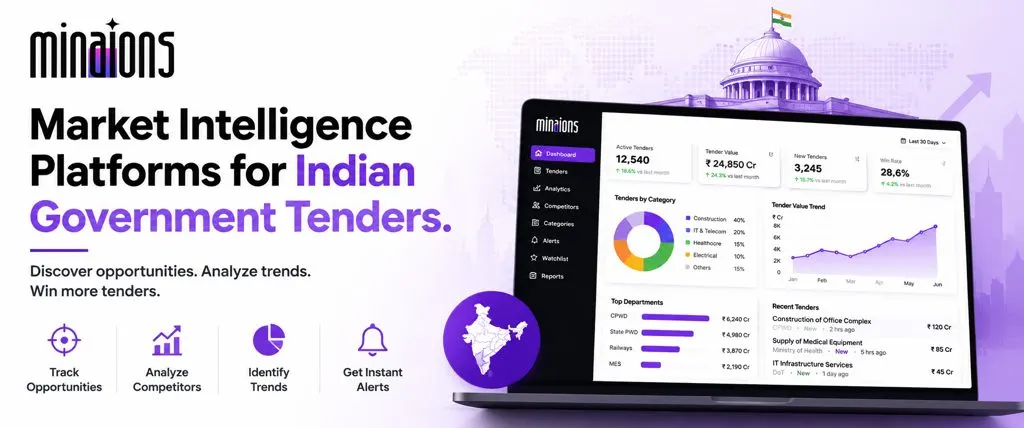
Discover how AI-powered market intelligence platforms streamline tender registration, procurement compliance, and government bidding success.