Smart City Tenders: How to Bid for Urban Tech and Infrastructure Contracts
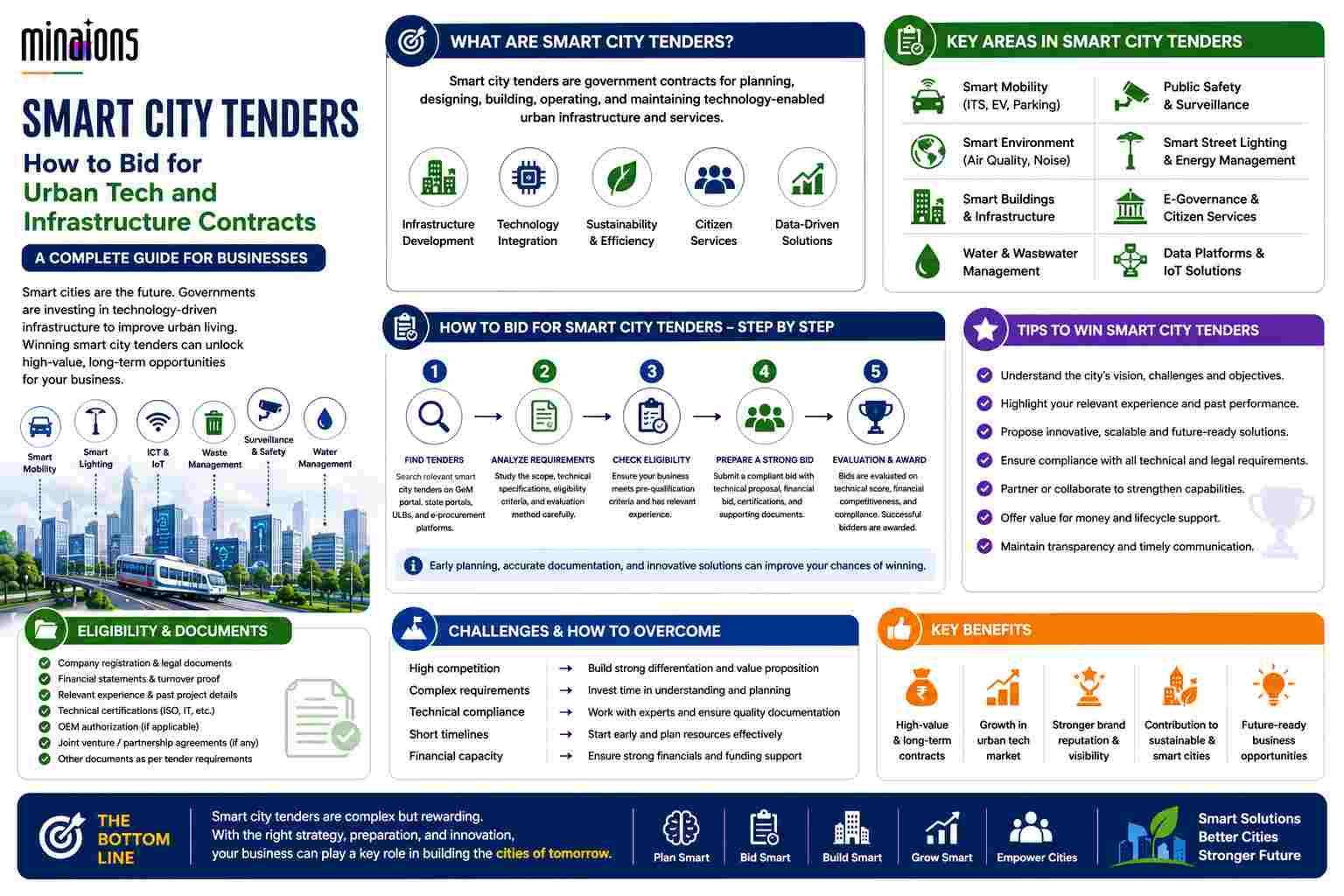
India’s Smart City Mission has created massive opportunities for technology companies, infrastructure firms, consultants, system integrators, surveillance providers, IoT companies, EPC contractors, and digital transformation firms. Today, businesses participating in urban development projects must understand the complete government procurement process India follows for Smart City procurement.
From surveillance systems and command centers to smart lighting, EV infrastructure, traffic management, public Wi-Fi, water management, waste management, and digital governance solutions, Smart City projects involve large-scale bidding and procurement opportunities. Businesses participating in public service tenders and infrastructure projects must understand the steps for tendering process, procurement compliance, and technical evaluation standards to improve success rates.
Companies like Minaions that provide procurement intelligence, tender automation, AI-driven bid management, and compliance workflows are helping businesses simplify the tender applying process, manage tender bidding documents, and optimize the overall government procurement process India follows for public procurement.
Understanding Company Tender Meaning in Smart City Projects
Before participating in Smart City procurement, businesses should clearly understand the company tender meaning within the procurement ecosystem.
The term company tender meaning generally refers to the formal process where a company submits proposals, pricing, technical capability, and compliance documents to compete for public procurement opportunities.
In Smart City procurement, the company tender meaning becomes more strategic because projects often involve:
Large infrastructure execution
Technology integration
Multi-vendor coordination
Long-term services contracts
Compliance with strict govt tender guidelines
Businesses participating in public service tenders should clearly understand the company tender meaning to prepare stronger proposals and improve procurement readiness.
Govt Tender Guidelines for Smart City Procurement
Compliance with govt tender guidelines is critical for every Smart City project.
Most Smart City procurement projects follow structured govt tender guidelines covering:
Technical eligibility
Financial qualification
Bid security requirements
Compliance documentation
Evaluation methodology
Project execution capability
Businesses participating in bidding and procurement for urban infrastructure must carefully review all applicable govt tender guidelines before preparing proposals.
Ignoring govt tender guidelines is one of the biggest tender disqualification reasons in Smart City procurement.
Companies using procurement automation platforms like Minaions can simplify compliance management related to govt tender guidelines and reduce operational risk.
Services Contracts in Smart City Projects
The Smart City ecosystem includes multiple services contracts related to:
IT infrastructure
Surveillance systems
Traffic management
Smart governance
Waste management
Public safety systems
Network operations
Businesses participating in services contracts should focus heavily on operational capability, technical compliance, and proposal quality.
Many Smart City services contracts also involve long-term maintenance and support obligations, making technical expertise extremely important.
Organizations participating in public service tenders should carefully evaluate project scope before entering the tender applying process.
Importance of Tender Bidding Documents
The quality of tender bidding documents significantly influences procurement success.
Smart City procurement authorities carefully evaluate all tender bidding documents during the procurement lifecycle.
Typical tender bidding documents include:
Technical proposals
Financial statements
Project experience
Compliance certificates
Architecture diagrams
Solution presentations
Businesses participating in bidding and procurement should carefully organize all tender bidding documents before final submission.
Poorly managed tender bidding documents often result in rejection during technical evaluation in procurement.
Minaions helps businesses centralize and automate tender bidding documents management to improve proposal quality and compliance accuracy.
Understanding Tender Structure in Smart City Projects
The tender structure of Smart City projects is often complex because procurement may involve multiple technologies, vendors, and execution phases.
A standard Smart City tender structure may include:
Technical qualification stage
Financial evaluation stage
Proof of concept
Presentation rounds
Consortium eligibility
Service-level requirements
Businesses participating in public service tenders should carefully understand the complete tender structure before submitting bids.
The complexity of the tender structure often increases in projects involving command centers, smart mobility systems, and integrated urban infrastructure.
Technical Evaluation in Procurement
One of the most important stages in Smart City procurement is technical evaluation in procurement.
The technical evaluation in procurement process generally assesses:
Technical capability
Infrastructure readiness
Team expertise
Project experience
Product scalability
Compliance standards
Businesses participating in services contracts should prioritize proposal quality because technical evaluation in procurement often carries significant scoring weightage.
Weak proposal quality is one of the most common tender disqualification reasons during technical evaluation in procurement.
Platforms like Minaions help companies optimize technical submissions and improve scoring during technical evaluation in procurement.
Importance of Tender Terms
Every Smart City project contains specific tender terms that define procurement obligations and project expectations.
Typical tender terms may include:
Payment conditions
Performance guarantees
SLA obligations
Penalty clauses
Warranty conditions
Delivery timelines
Businesses participating in government procurement process India projects should carefully review all tender terms before entering the tender applying process.
Ignoring critical tender terms can create financial and operational risks even after contract award.
Public Service Tenders and Urban Development
The Smart City ecosystem is driving rapid growth in public service tenders across India.
Today, public service tenders cover:
Smart transportation
Smart governance
Urban surveillance
Water management
Renewable energy
Citizen engagement systems
Businesses participating in public service tenders should focus on innovation, compliance, and scalability.
The increasing competition in public service tenders is encouraging businesses to adopt AI-driven procurement platforms like Minaions for smarter bidding and procurement workflows.
Tender Applying Process Explained
The tender applying process for Smart City projects is highly structured.
The standard tender applying process generally includes:
Opportunity identification
Downloading tender bidding documents
Reviewing govt tender guidelines
Understanding the tender structure
Preparing technical submissions
Commercial bid preparation
Final bid submission
Businesses participating in services contracts should establish centralized workflows for the tender applying process to improve operational efficiency.
A poorly managed tender applying process often leads to rejection during evaluation.
Steps for Tendering Process
Understanding the steps for tendering process is critical for procurement success.
The standard steps for tendering process include:
Tender identification
Eligibility analysis
Bid planning
Documentation preparation
Technical submission
Financial submission
Evaluation participation
Businesses participating in government procurement process India projects should carefully optimize every stage of the steps for tendering process.
Companies using Minaions can automate several workflows within the steps for tendering process, reducing operational delays and compliance errors.
Bidding and Procurement in Smart City Ecosystem
The ecosystem of bidding and procurement in Smart City projects is becoming increasingly technology-driven.
Modern bidding and procurement systems involve:
AI-driven compliance checks
Automated documentation
Procurement analytics
Digital workflows
Real-time bid tracking
Businesses participating in public service tenders should invest in digital procurement systems to improve bidding and procurement efficiency.
The growing complexity of Smart City procurement has made technology-driven bidding and procurement workflows essential.
How to Get Government Contracts India
Many businesses entering Smart City procurement ask how to get government contracts India successfully.
The answer to how to get government contracts India involves:
Understanding govt tender guidelines
Building procurement credibility
Improving technical capability
Organizing tender bidding documents
Optimizing the tender applying process
Managing the complete government procurement process India
Businesses trying to understand how to get government contracts India should also focus on long-term compliance and procurement relationships.
Bid No-Bid Decision Framework
A strong bid no-bid decision framework is essential for Smart City procurement.
The bid no-bid decision framework helps businesses determine whether a procurement opportunity aligns with:
Technical capability
Financial strength
Resource availability
Strategic priorities
Profitability expectations
Organizations participating in services contracts should implement a structured bid no-bid decision framework to improve bid efficiency and reduce resource wastage.
Minaions helps businesses automate the bid no-bid decision framework using AI-driven procurement intelligence.
Tender Disqualification Reasons
Understanding common tender disqualification reasons is critical for procurement success.
Typical tender disqualification reasons include:
Incomplete documentation
Non-compliance with govt tender guidelines
Incorrect pricing
Weak technical proposals
Failure during technical evaluation in procurement
Missing mandatory certifications
Businesses participating in government procurement process India projects should continuously monitor and reduce common tender disqualification reasons through structured compliance workflows.
Government Procurement Process India
The modern government procurement process India follows is becoming increasingly digital, transparent, and analytics-driven.
The evolving government procurement process India uses now includes:
Digital bid submissions
AI-driven evaluations
Automated compliance checks
Centralized procurement visibility
Data-driven procurement analytics
Businesses participating in Smart City projects should optimize workflows related to the complete government procurement process India follows for modern public procurement.
Final Thoughts
Smart City projects are creating massive opportunities across infrastructure, technology, mobility, governance, and urban services. Businesses participating in public service tenders, services contracts, and Smart City infrastructure projects must clearly understand the complete government procurement process India follows for procurement management.
From managing tender bidding documents to improving technical evaluation in procurement, every stage of the tender applying process matters.
Organizations investing in structured bidding and procurement workflows, AI-driven compliance systems, and platforms like Minaions can significantly improve procurement success rates while reducing common tender disqualification reasons.
As Smart City procurement continues to grow, businesses that optimize the steps for tendering process, implement a strong bid no-bid decision framework, and understand how to get government contracts India effectively will gain a major competitive advantage.
Related Blogs

A small manufacturing firm in Ludhiana missed a ₹2.3 crore contract after spending 14 hours manually scanning the GeM portal, only to find the tender had closed two days earlier. This is not an isolated case.

A small civil engineering firm in Lucknow spent three weeks manually parsing a 420-page NHAI tenders document, only to miss a critical clause in the contractor registration requirements and lose eligibility.

A small manufacturing firm in Ludhiana missed a ₹2.

Discover how AI-powered market intelligence platforms streamline tender registration, procurement compliance, and government bidding success.