The Role of OCR AI in Tender Processing: Reading Scanned PDFs in Any Language
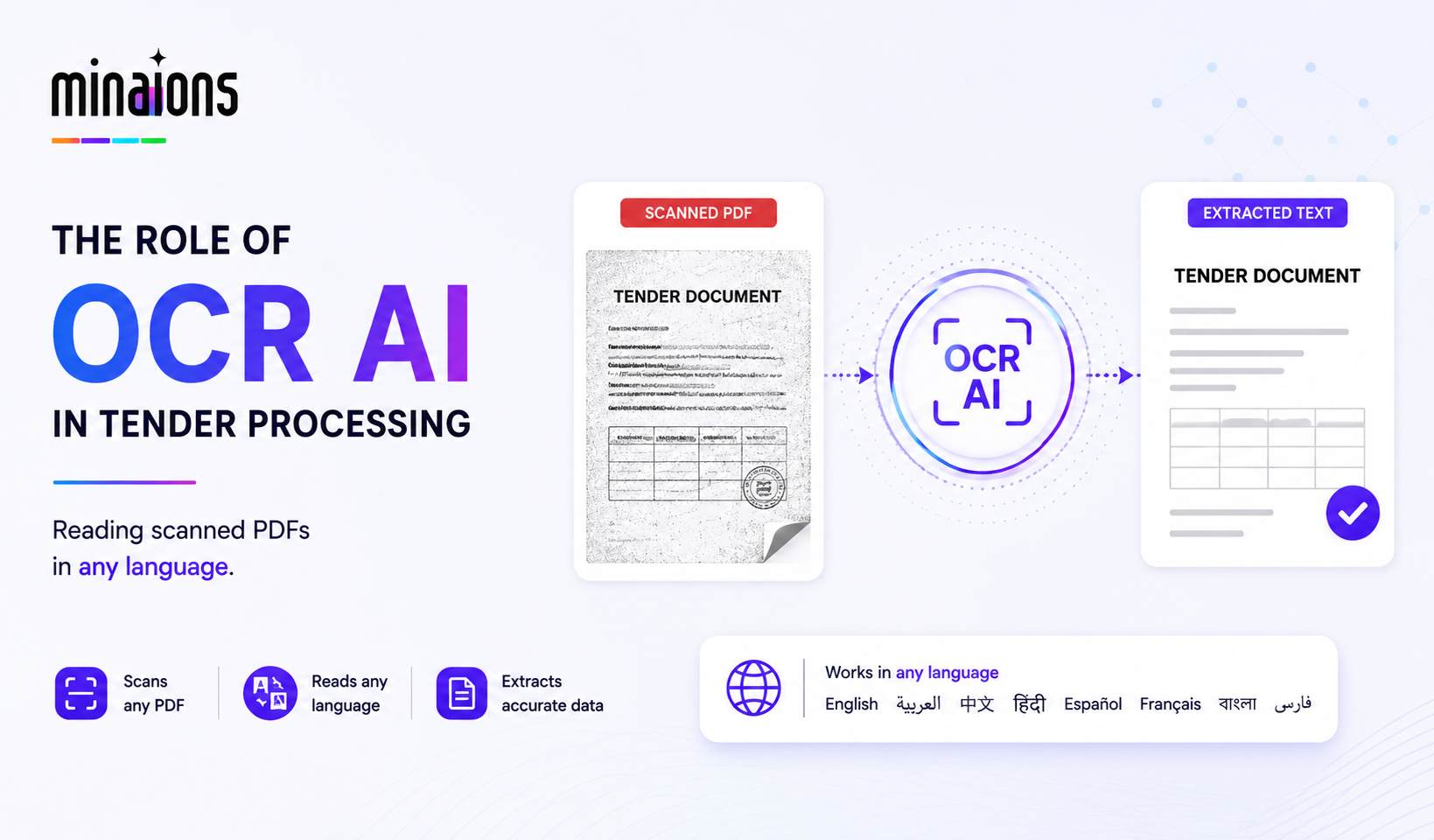
The procurement ecosystem in India is rapidly becoming digital, but one of the biggest challenges in modern e procurement and e tendering workflows is handling scanned documents and multilingual tender files. Every day, thousands of government tenders, govt tenders, and procurement notices are uploaded as scanned PDFs, handwritten documents, image-based files, and multilingual contracts across the growing tender india ecosystem.
Businesses participating in tender in government sector opportunities often struggle to process complex tender documents manually. From extracting technical clauses and identifying the tender processing fee to understanding compliance conditions within a bid document, procurement teams spend countless hours reviewing files during bid evaluation.
The rise of OCR AI is transforming how companies manage electronic tenders, automate e procurement, and improve efficiency in government tender software and bid management software India platforms. Companies like Minaions are leading this transformation by integrating AI-powered OCR technology into procurement workflows to simplify tender analysis, automate document extraction, and improve participation in government tenders and govt tenders.
What is OCR AI in Tender Processing?
OCR AI, or Optical Character Recognition Artificial Intelligence, is a technology that converts scanned images, PDFs, handwritten text, and multilingual documents into machine-readable text.
In the modern e tendering ecosystem, OCR AI helps businesses participating in government tenders and electronic tenders automatically extract critical procurement information from scanned files.
OCR AI systems used in government tender software can identify:
Eligibility criteria
Technical specifications
Submission deadlines
Compliance requirements
Financial clauses
The tender processing fee
Bid qualification conditions
Evaluation methodology
Businesses participating in tender in government sector opportunities are increasingly using OCR AI to automate document review and improve efficiency during bid evaluation.
Why OCR AI is Important for Tender India Ecosystem
The growing tender india ecosystem generates massive volumes of procurement documents daily.
Thousands of government tenders and govt tenders are published through e procurement platforms in multiple formats and languages. Many procurement departments still upload scanned PDFs instead of searchable digital files.
Without OCR AI, procurement teams participating in electronic tenders must manually review every a bid document, creating operational delays and increasing compliance risks.
OCR AI helps businesses participating in tender in government sector procurement by:
Automating data extraction
Reducing manual effort
Improving document accuracy
Accelerating bid evaluation
Identifying the tender processing fee
Improving multilingual document analysis
The increasing complexity of e tendering workflows has made OCR AI a critical component of modern bid management software India systems.
OCR AI and Bid Evaluation
One of the most important procurement stages is bid evaluation.
The bid evaluation process often requires procurement teams to review hundreds of pages within a bid document submitted for government tenders and govt tenders.
OCR AI significantly improves bid evaluation by automatically extracting:
Financial data
Vendor eligibility
Technical specifications
Compliance declarations
Commercial conditions
Businesses participating in electronic tenders can use OCR-powered government tender software to accelerate the entire bid evaluation workflow.
Minaions integrates OCR AI into procurement workflows to improve bid evaluation speed and reduce operational errors.
Reading Scanned PDFs in Any Language
One of the biggest advantages of OCR AI is multilingual capability.
Many government tenders and govt tenders in the tender india ecosystem are published in:
English
Hindi
Tamil
Bengali
Marathi
Gujarati
Telugu
Regional languages
Traditional e procurement systems often struggle with multilingual scanned documents.
OCR AI helps businesses participating in electronic tenders automatically read multilingual a bid document files and convert them into searchable data.
This capability is becoming essential for suppliers participating in tender in government sector procurement opportunities across multiple states.
Tender Processing Fee Identification Using OCR AI
The tender processing fee is one of the most critical procurement details in public procurement.
Missing or misunderstanding the tender processing fee can result in bid rejection during bid evaluation.
OCR AI integrated into government tender software can automatically identify:
The tender processing fee
EMD requirements
Security deposit clauses
Submission conditions
Businesses participating in e tendering and electronic tenders can reduce compliance risk by using OCR-powered procurement systems.
Minaions uses AI-driven OCR technology to automatically identify the tender processing fee and other compliance requirements from scanned procurement documents.
OCR AI in Government Tender Software
Modern government tender software is rapidly evolving with AI-driven automation.
Advanced government tender software now includes:
OCR AI document extraction
Automated compliance analysis
Smart procurement analytics
Bid tracking systems
Multilingual document processing
Businesses participating in government tenders should adopt OCR-enabled government tender software to improve procurement efficiency.
The increasing complexity of e procurement workflows has made AI-driven government tender software essential for businesses participating in tender india opportunities.
Bid Management Software India and OCR Automation
The rise of bid management software India solutions is transforming procurement operations.
Modern bid management software India platforms use OCR AI to:
Extract data from a bid document
Identify procurement clauses
Organize procurement workflows
Improve bid evaluation
Track procurement deadlines
Businesses participating in govt tenders should invest in OCR-enabled bid management software India systems to reduce manual workload and improve proposal quality.
Minaions provides AI-powered bid management software India solutions that simplify procurement operations for businesses participating in government tenders and electronic tenders.
OCR AI and E Procurement Automation
The future of e procurement is heavily dependent on AI-driven automation.
Modern e procurement systems now integrate OCR AI to:
Read scanned PDFs
Analyze procurement clauses
Identify the tender processing fee
Improve bid evaluation
Automate compliance workflows
Businesses participating in e tendering should adopt OCR-powered e procurement systems to remain competitive in the expanding tender india ecosystem.
The increasing scale of government tenders has made OCR AI one of the most important technologies in procurement automation.
Electronic Tenders and AI-Driven Processing
The growth of electronic tenders has increased the need for automated document analysis.
Every day, procurement teams participating in electronic tenders review multiple scanned procurement documents manually.
OCR AI helps businesses participating in electronic tenders by:
Extracting structured data
Identifying procurement clauses
Detecting compliance conditions
Improving workflow speed
The increasing complexity of electronic tenders has encouraged organizations to adopt AI-powered procurement systems like Minaions.
Tender in Government Sector and Digital Transformation
The ecosystem of tender in government sector procurement is rapidly becoming digital.
Today, businesses participating in tender in government sector opportunities must manage:
Large procurement files
Multilingual documents
Scanned PDFs
Complex compliance workflows
OCR AI helps suppliers participating in tender in government sector procurement automate document review and improve operational efficiency.
The expansion of e procurement and electronic tenders is accelerating the adoption of OCR AI across procurement workflows.
Minaions and OCR AI Tender Automation
Minaions is transforming procurement automation through OCR AI and intelligent procurement systems.
Minaions helps businesses:
Read scanned procurement files
Extract information from a bid document
Identify the tender processing fee
Improve bid evaluation
Simplify e tendering
Manage government tenders
Automate workflows in bid management software India
Businesses participating in govt tenders can use Minaions to reduce manual procurement effort and improve procurement accuracy.
Future of OCR AI in Tender India
The future of tender india procurement will increasingly depend on OCR AI, automation, and intelligent procurement analytics.
Modern government tender software and bid management software India platforms are evolving rapidly with:
AI-driven document extraction
Smart procurement analytics
Automated compliance workflows
Multilingual OCR capability
Real-time procurement visibility
Businesses participating in government tenders, govt tenders, electronic tenders, and e procurement systems should adopt OCR AI early to remain competitive.
As the tender india ecosystem continues to grow, OCR AI will become one of the most important technologies in procurement automation and intelligent bid evaluation.
Related Blogs

A small manufacturing firm in Ludhiana missed a ₹2.3 crore contract after spending 14 hours manually scanning the GeM portal, only to find the tender had closed two days earlier. This is not an isolated case.

A small civil engineering firm in Lucknow spent three weeks manually parsing a 420-page NHAI tenders document, only to miss a critical clause in the contractor registration requirements and lose eligibility.

A small manufacturing firm in Ludhiana missed a ₹2.
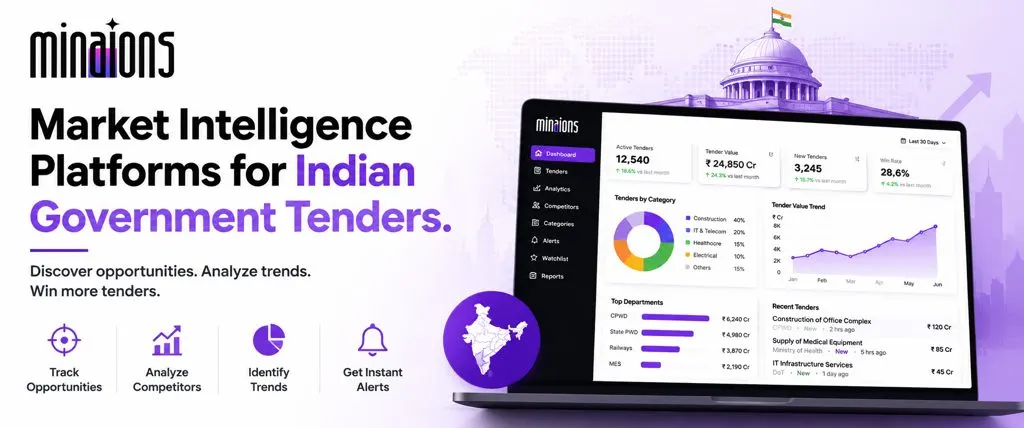
Discover how AI-powered market intelligence platforms streamline tender registration, procurement compliance, and government bidding success.