What Is Agentic AI and Why Is It a Game-Changer for Government Tendering
India’s public procurement ecosystem is becoming increasingly digital, data-driven, and competitive. Businesses participating in procurement bids, managing bids and contracts, and competing in large-scale public procurement tender opportunities are facing growing challenges related to compliance, documentation, timelines, and operational complexity. As procurement volumes increase, traditional procurement workflows are no longer enough.
This is where Agentic AI is transforming the future of government tendering.
Agentic AI is redefining how businesses manage tender automation, monitor procurement opportunities, optimize the public tender process, and improve participation in software bids and public procurement projects. Companies like Minaions are using advanced AI systems to automate procurement workflows, reduce compliance errors, improve bid accuracy, and simplify participation in complex government procurement ecosystems.
The rise of AI-driven procurement management is revolutionizing the way businesses handle contract and procurement workflows, comply with tender rules and regulations, and navigate evolving public procurement policies and e tender rules and regulations.
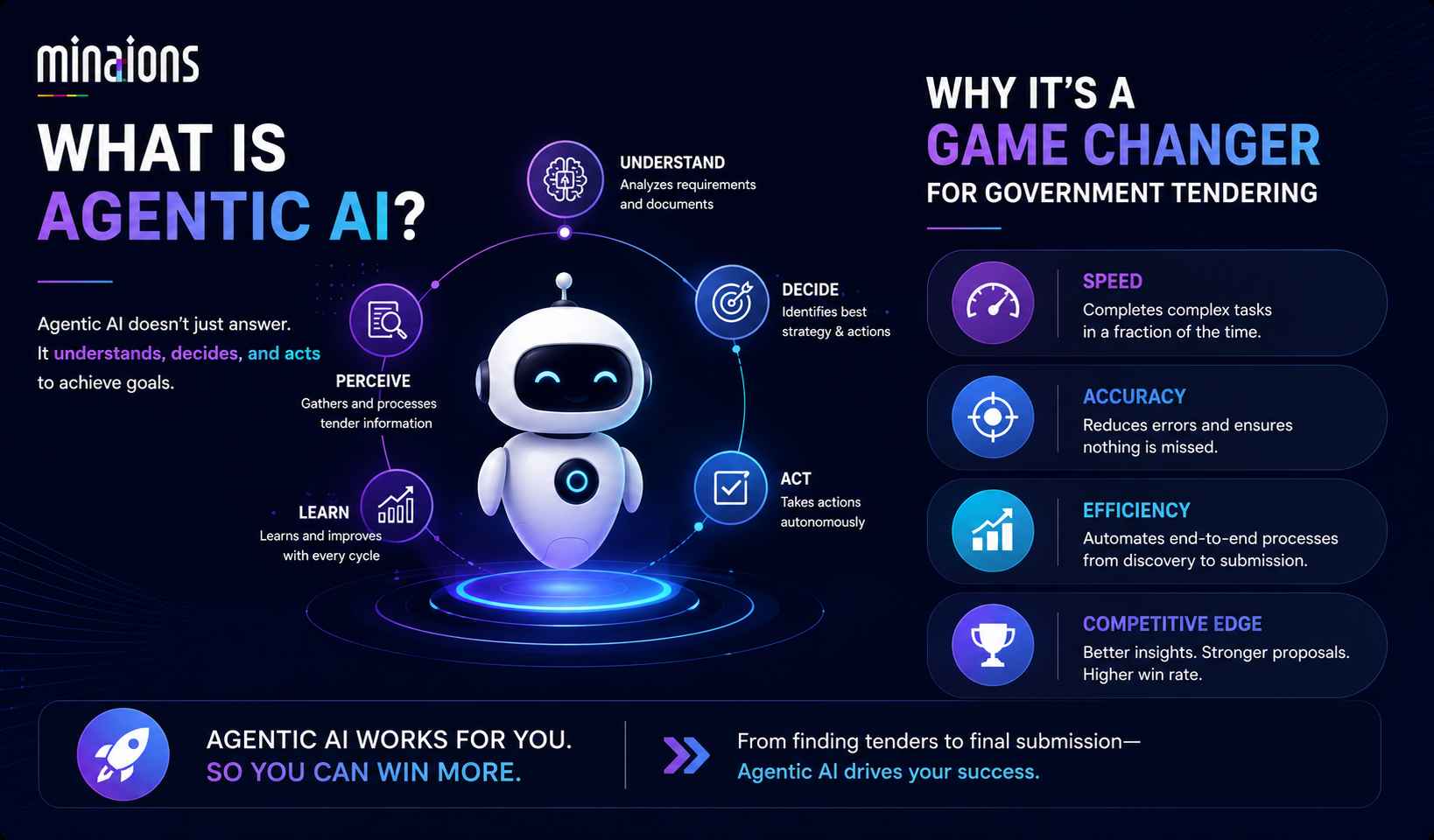
What Is Agentic AI?
Agentic AI refers to intelligent AI systems capable of independently managing tasks, making decisions, executing workflows, and continuously improving operational outcomes.
Unlike traditional automation tools, Agentic AI can actively analyze procurement data, interpret tender rules and regulations, optimize the public tender process, and support businesses participating in procurement bids and bids and contracts.
In the procurement ecosystem, Agentic AI can:
Monitor procurement opportunities
Analyze public procurement policies
Automate compliance workflows
Improve tender automation
Optimize pricing strategies
Simplify bid preparation
Reduce tender checklist India errors
The growing complexity of contract and procurement workflows is making Agentic AI essential for businesses participating in modern public procurement tender ecosystems.
Tender Automation and the Future of Procurement
The rise of tender automation is one of the biggest transformations happening in public procurement today.
Traditional procurement workflows often involve manual tracking, document management, compliance review, and repetitive administrative work. Modern tender automation systems powered by Agentic AI now simplify these processes significantly.
AI-driven tender automation helps businesses:
Track procurement opportunities automatically
Analyze procurement documents
Monitor compliance requirements
Organize bid documentation
Reduce operational delays
Improve proposal accuracy
Minaions is helping businesses implement AI-driven tender automation workflows to improve procurement efficiency and reduce bid management complexity.
The increasing scale of procurement bids and software bids has made intelligent tender automation essential for procurement success.
Procurement Bids and AI-Driven Decision Making
The number of procurement bids across India is growing rapidly.
Today, businesses participate in thousands of procurement bids related to infrastructure, software, healthcare, education, logistics, AI systems, cybersecurity, and Smart City projects.
Agentic AI helps businesses participating in procurement bids by:
Prioritizing high-potential opportunities
Monitoring procurement trends
Evaluating project feasibility
Reducing manual analysis
The growing complexity of procurement bids has increased the need for intelligent procurement analytics and automation systems.
Minaions uses Agentic AI to help businesses manage procurement bids more efficiently through centralized procurement intelligence.
Bids and Contracts Management with Agentic AI
Managing multiple bids and contracts manually is becoming increasingly difficult.
Organizations participating in public procurement often handle hundreds of bids and contracts simultaneously. Agentic AI simplifies this process by automating tracking, analysis, compliance verification, and workflow coordination.
AI-driven systems for bids and contracts management can:
Monitor deadlines
Organize procurement workflows
Track procurement status
Improve collaboration
Reduce operational risk
The increasing number of bids and contracts in India’s procurement ecosystem is accelerating the adoption of AI-driven procurement platforms like Minaions.
Public Procurement Tender Ecosystem
The modern public procurement tender ecosystem is highly structured and compliance-driven.
Today, every public procurement tender involves:
Technical evaluations
Financial analysis
Compliance verification
Digital procurement workflows
Centralized bid submissions
Agentic AI improves participation in public procurement tender projects by simplifying procurement operations and automating repetitive tasks.
Businesses participating in public procurement tender opportunities should invest in AI-driven systems to improve operational efficiency and reduce procurement delays.
Public Tender Process and Intelligent Automation
The traditional public tender process often involves multiple operational challenges.
The standard public tender process generally includes:
Opportunity discovery
Compliance review
Technical proposal preparation
Financial bid preparation
Documentation verification
Final bid submission
Agentic AI simplifies the entire public tender process through intelligent workflow management and predictive procurement analytics.
The increasing complexity of the public tender process is encouraging businesses to adopt AI-driven procurement automation platforms.
Minaions helps businesses optimize the public tender process through automated workflows and centralized procurement management.
Software Bids and Technology Procurement
The number of software bids in India’s public procurement ecosystem is growing rapidly.
Government departments increasingly issue software bids for:
ERP systems
AI platforms
Cybersecurity solutions
Smart governance software
Data analytics systems
Cloud infrastructure
Businesses participating in software bids should focus heavily on compliance management, technical proposal quality, and procurement automation.
Agentic AI helps companies participating in software bids improve proposal quality and optimize bid management workflows.
Tender Rules and Regulations Compliance
Compliance with tender rules and regulations is one of the biggest challenges in public procurement.
Every procurement project follows specific tender rules and regulations related to:
Eligibility criteria
Documentation requirements
Financial standards
Procurement timelines
Technical compliance
Agentic AI systems can automatically analyze tender rules and regulations and identify compliance gaps before submission.
Minaions helps businesses automate compliance management related to tender rules and regulations using AI-driven procurement workflows.
The increasing complexity of tender rules and regulations makes AI-powered compliance systems extremely valuable.
Contract and Procurement Transformation
The future of contract and procurement management is becoming increasingly AI-driven.
Modern AI-powered contract and procurement systems now support:
Intelligent document analysis
Automated workflow management
Procurement forecasting
Risk assessment
Vendor evaluation
Businesses participating in large-scale bids and contracts should strengthen AI-driven contract and procurement workflows to remain competitive.
The increasing operational complexity of contract and procurement systems is driving rapid adoption of intelligent procurement platforms.
Public Procurement Policies and AI Adaptation
The evolving landscape of public procurement policies is increasing compliance complexity.
Modern public procurement policies increasingly focus on:
Digital procurement transparency
MSME participation
Local manufacturing
Sustainable procurement
Vendor accountability
Agentic AI helps businesses interpret and adapt to changing public procurement policies more efficiently.
Companies participating in public procurement tender opportunities should continuously monitor evolving public procurement policies to reduce procurement risk.
E Tender Rules and Regulations
Digital procurement systems also involve detailed e tender rules and regulations.
The applicable e tender rules and regulations generally define:
Digital bid submission standards
EMD compliance
Document upload requirements
Procurement timelines
Portal-specific workflows
Businesses participating in procurement bids should carefully comply with all e tender rules and regulations to avoid disqualification.
Agentic AI platforms like Minaions can automate compliance validation related to e tender rules and regulations and reduce operational errors.
Tender Checklist India and Procurement Accuracy
A strong tender checklist India workflow is essential for procurement success.
The standard tender checklist India generally includes:
Eligibility verification
Compliance review
Technical documentation
Financial statements
Bid formatting
Submission readiness
Agentic AI can automate the complete tender checklist India process by validating procurement documentation before submission.
Businesses participating in bids and contracts should continuously optimize the tender checklist India workflow to reduce compliance errors.
Government Tender Software and Procurement Intelligence
Modern government tender software is becoming essential for procurement participation.
Advanced government tender software helps businesses:
Track procurement opportunities
Manage compliance
Analyze procurement trends
Organize documentation
Improve procurement visibility
Minaions provides AI-driven government tender software solutions that help businesses improve procurement efficiency and operational control.
The growing complexity of public procurement tender ecosystems has increased the importance of intelligent government tender software.
Bid Management Software India and AI Automation
The demand for bid management software India is increasing rapidly because of growing procurement complexity.
Modern bid management software India systems powered by Agentic AI can:
Automate bid workflows
Improve proposal collaboration
Track procurement timelines
Analyze procurement opportunities
Reduce manual workload
Businesses participating in software bids and procurement bids should invest in advanced bid management software India systems to remain competitive.
Minaions provides AI-driven bid management software India solutions that help businesses streamline procurement operations and improve bid success rates.
Why Agentic AI Is a Game-Changer for Government Tendering
Agentic AI is changing government procurement because it combines automation, intelligence, analytics, and decision-making into a single procurement ecosystem.
Businesses using Agentic AI for tender automation, contract and procurement, and public procurement tender management can achieve:
Faster procurement workflows
Better compliance accuracy
Improved bid quality
Reduced operational costs
Higher procurement visibility
Smarter procurement decisions
The future of procurement will increasingly depend on AI-powered systems capable of managing the complete public tender process intelligently.
Final Thoughts
India’s public procurement ecosystem is evolving rapidly with increasing digitalization, procurement complexity, and competitive pressure. Businesses participating in procurement bids, managing bids and contracts, and competing in software bids must adopt smarter procurement systems to remain competitive.
From improving tender automation to simplifying compliance with e tender rules and regulations, Agentic AI is transforming every stage of the procurement lifecycle.
Organizations using AI-driven platforms like Minaions for government tender software, bid management software India, and intelligent procurement workflows can significantly improve procurement success rates.
As public procurement policies, contract and procurement systems, and digital procurement ecosystems continue to evolve, Agentic AI will become one of the most important competitive advantages for businesses participating in modern government tendering.
Related Blogs
A small manufacturing firm in Ludhiana missed a ₹2.3 crore contract after spending 14 hours manually scanning the GeM portal, only to find the tender had closed two days earlier. This is not an isolated case.

A small civil engineering firm in Lucknow spent three weeks manually parsing a 420-page NHAI tenders document, only to miss a critical clause in the contractor registration requirements and lose eligibility.

A small manufacturing firm in Ludhiana missed a ₹2.
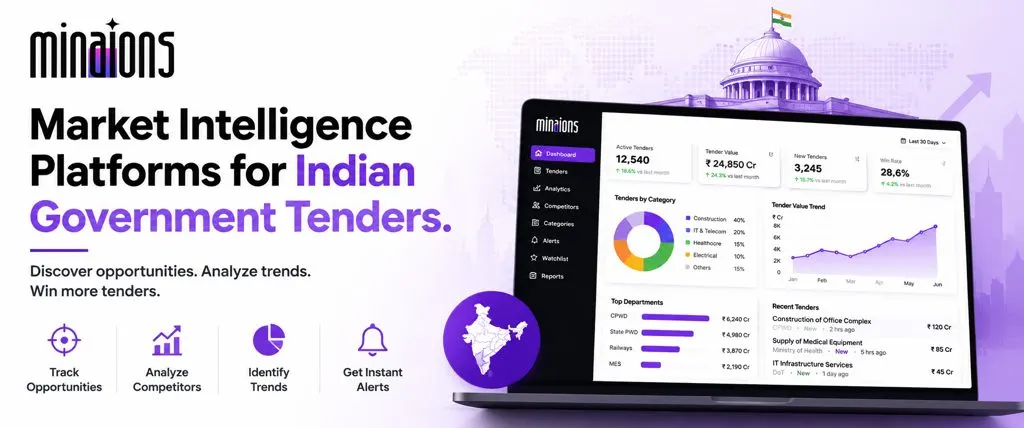
Discover how AI-powered market intelligence platforms streamline tender registration, procurement compliance, and government bidding success.