AI Eligibility Check vs Manual Eligibility Check: A Head-to-Head Comparison
India’s public procurement ecosystem is becoming increasingly digital, competitive, and compliance-driven. Businesses participating in govt e tender, e tender govt, and large-scale procurement opportunities are under constant pressure to improve qualification accuracy, reduce bid rejection, and speed up procurement workflows.
One of the most critical stages in the tendering process is eligibility analysis. Traditionally, businesses manually reviewed procurement documents before submitting an e tender application. However, with the rise of AI-driven procurement platforms and advanced government tender software, companies are increasingly replacing manual eligibility checks with automated AI-based systems.
Today, organizations participating in government tender categories, preparing to bid in tender opportunities, and competing as a government supplier must understand the difference between AI eligibility checks and manual procurement review processes.
Platforms like Minaions are helping businesses automate procurement analysis, improve qualification accuracy, manage procurement references, and optimize workflows related to e tender application management and government tender software systems.
Understanding the Role of Eligibility Checks in Procurement
Eligibility verification is one of the most important stages in the tendering process.
Every business participating in govt e tender opportunities must verify:
Financial eligibility
Technical capability
Work experience
Compliance certifications
Vendor registrations
Turnover requirements
An incorrect eligibility interpretation during an e tender application can lead to immediate rejection.
Businesses participating in multiple government tender categories should therefore maintain structured procurement workflows to reduce qualification errors.
The increasing complexity of e tender govt systems has made eligibility analysis more important than ever.
What is Manual Eligibility Check?
A manual eligibility check involves human review of procurement documents before participating in an e tender application.
Traditionally, procurement teams manually reviewed:
Eligibility conditions
Technical criteria
Financial requirements
Experience conditions
Compliance declarations
Mandatory certifications
Businesses participating as a government supplier have relied on manual workflows for decades during the tendering process.
However, the growing volume of government tender categories and increasing complexity of govt e tender systems are making manual procurement analysis slower and riskier.
What is AI Eligibility Check?
An AI eligibility check uses intelligent automation and advanced government tender software to evaluate procurement eligibility automatically.
AI-based procurement systems can analyze:
Tender qualification conditions
Vendor eligibility
Financial capability
Technical criteria
Experience requirements
Compliance gaps
Businesses participating in e tender govt systems are increasingly adopting AI-driven workflows to improve procurement speed and reduce operational risk.
Platforms like Minaions provide AI-driven eligibility analysis for businesses participating in multiple government tender categories and complex procurement projects.
The Growing Complexity of Govt E Tender Systems
The ecosystem of govt e tender procurement is rapidly expanding across India.
Today, organizations participate in govt e tender opportunities related to:
Infrastructure
IT procurement
Defence procurement
Healthcare procurement
Smart city projects
Educational procurement
The increasing competition within govt e tender systems has made accurate eligibility analysis critical for procurement success.
Businesses participating in multiple government tender categories should therefore automate procurement workflows wherever possible.
E Tender Govt Systems and Digital Procurement
Modern e tender govt systems are highly compliance-driven.
Businesses participating in e tender govt workflows must carefully manage:
Eligibility analysis
Technical submissions
Financial compliance
Procurement documentation
Vendor registrations
The increasing complexity of e tender govt systems has increased the demand for intelligent government tender software platforms.
Organizations participating as a government supplier should continuously improve digital procurement readiness.
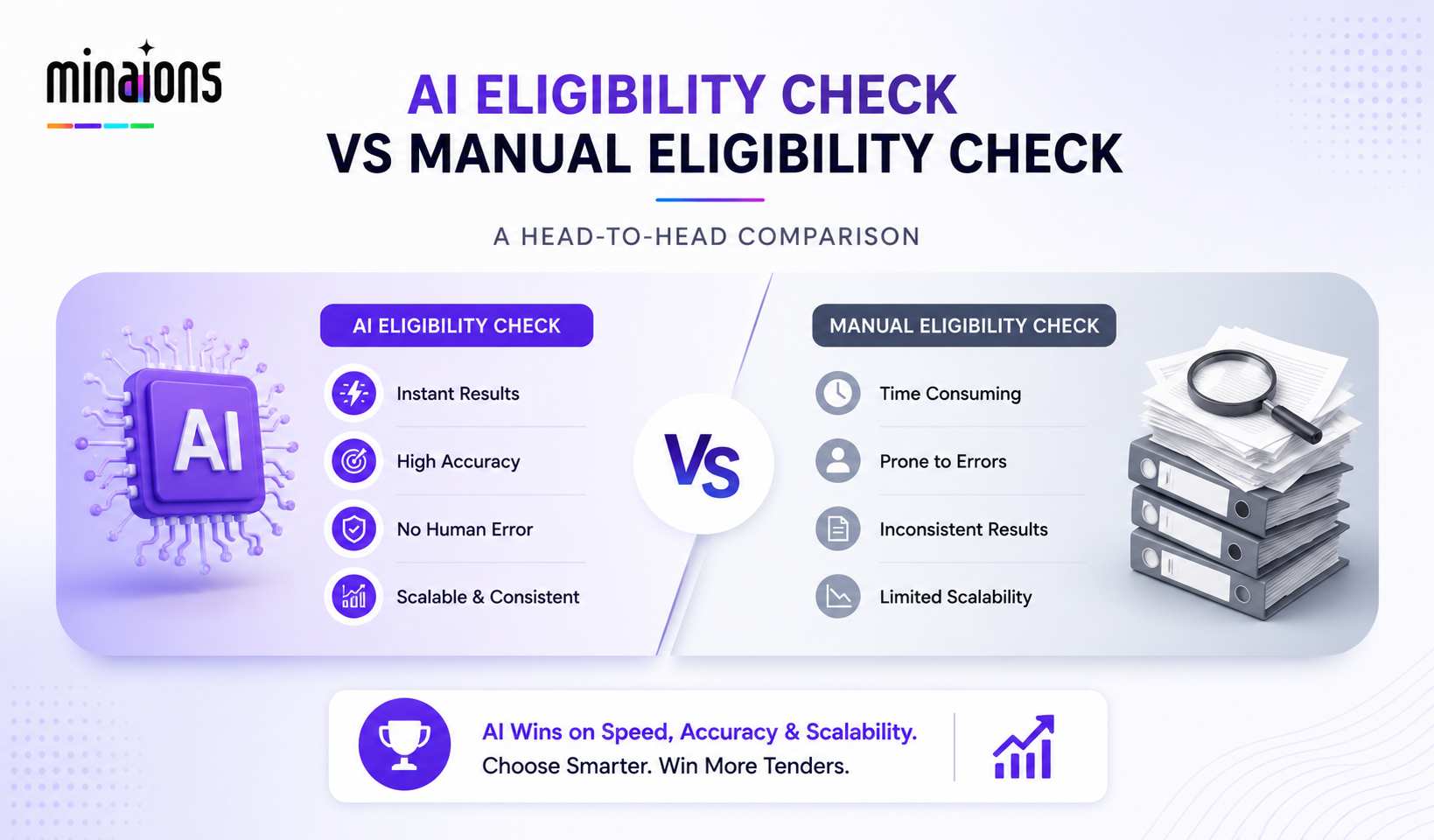
AI vs Manual Eligibility Check: Speed Comparison
One of the biggest differences between AI systems and manual review is speed.
A manual eligibility review for a large e tender application may take several hours or even days.
AI-driven government tender software can analyze procurement documents in minutes.
Businesses participating in multiple government tender categories often struggle with time management during the tendering process.
Minaions helps businesses accelerate eligibility analysis through AI-driven procurement automation and intelligent procurement references mapping.
The increasing volume of govt e tender opportunities has made speed a critical competitive advantage.
AI vs Manual Eligibility Check: Accuracy Comparison
Manual procurement analysis depends heavily on human interpretation.
Even experienced procurement teams may overlook:
Hidden eligibility conditions
Corrigendum updates
Technical inconsistencies
Missing certifications
Financial qualification clauses
AI-based government tender software significantly improves procurement accuracy during the e tender application process.
Businesses participating in e tender govt systems can reduce operational errors using AI-driven procurement intelligence.
Minaions helps suppliers improve accuracy while participating in multiple government tender categories simultaneously.
Procurement References and Historical Analysis
One major advantage of AI systems is the ability to analyze historical procurement references automatically.
AI-driven procurement systems can compare:
Previous tender conditions
Historical bid patterns
Qualification trends
Vendor performance benchmarks
Manual teams generally struggle to process large volumes of procurement references efficiently.
Businesses participating as a government supplier can use AI systems to improve strategic decision-making during the tendering process.
Minaions provides intelligent procurement references analysis to help businesses improve bid readiness and qualification accuracy.
Government Supplier Challenges in Manual Procurement
Every government supplier faces operational challenges during procurement participation.
Manual workflows often create problems such as:
Delayed eligibility review
Inconsistent compliance checks
Human errors
Missed deadlines
Poor document coordination
The increasing complexity of govt e tender systems has made traditional workflows difficult to scale.
Businesses operating as a government supplier across multiple sectors should therefore invest in intelligent procurement automation.
The Tendering Process and Operational Efficiency
The modern the tendering process has become increasingly digital and analytics-driven.
The standard the tendering process generally includes:
Opportunity discovery
Eligibility analysis
Technical document preparation
Compliance verification
Financial submission
Technical evaluation
Contract award
Businesses participating in multiple government tender categories should optimize every stage of the tendering process to improve procurement efficiency.
AI-driven government tender software platforms like Minaions help suppliers automate large portions of the tendering process.
Government Tender Categories and Procurement Complexity
The number of government tender categories is increasing rapidly.
Today, businesses participate in government tender categories related to:
Construction
IT procurement
Defence
Healthcare
Education
Infrastructure
Renewable energy
The growing complexity of government tender categories has increased the importance of automated procurement analysis.
Businesses participating in multiple government tender categories should adopt AI-driven procurement systems to improve scalability.
Bid in Tender Decisions and AI Analysis
Businesses preparing to bid in tender opportunities must evaluate qualification risk carefully.
AI systems help businesses decide whether to bid in tender opportunities by analyzing:
Eligibility probability
Resource availability
Financial feasibility
Historical procurement trends
Manual procurement teams often struggle to process such data efficiently.
Minaions helps businesses improve strategic decisions before they bid in tender opportunities across multiple procurement sectors.
E Tender Application and Compliance Automation
The complexity of the modern e tender application process has increased significantly.
Businesses participating in e tender application workflows must carefully manage:
Compliance documents
Technical declarations
Financial records
Eligibility certifications
Vendor registrations
AI-driven government tender software helps businesses automate large portions of the e tender application process.
Minaions supports suppliers through AI-driven e tender application workflows and intelligent procurement management systems.
Government Tender Software and AI Procurement Platforms
Modern government tender software is transforming procurement participation across India.
Advanced government tender software platforms now support:
AI eligibility analysis
Automated compliance checks
Procurement analytics
Tender tracking
Intelligent document management
Businesses participating in govt e tender systems should invest in advanced government tender software to remain competitive.
Minaions provides AI-powered government tender software solutions designed specifically for businesses participating in complex procurement ecosystems.
Why Minaions is Different
Minaions is helping businesses modernize procurement operations through AI-driven automation.
Minaions supports organizations through:
AI eligibility analysis
Smart procurement references mapping
Automated compliance validation
Faster e tender application workflows
Intelligent bid tracking
Procurement analytics
Businesses participating in multiple government tender categories can use Minaions to improve procurement efficiency and reduce qualification risks.
Final Thoughts
The future of procurement is increasingly AI-driven, automated, and data-centric. Businesses participating in govt e tender, e tender govt, and modern public procurement systems must rethink traditional procurement workflows to remain competitive.
From managing accurate e tender application workflows to analyzing complex procurement references, every stage of the tendering process matters.
Organizations participating as a government supplier, investing in AI-driven government tender software, and optimizing participation across multiple government tender categories can significantly improve procurement success rates.
As procurement systems continue to evolve digitally, businesses using intelligent platforms like Minaions will gain a major competitive advantage over manual procurement operations.
Related Blogs
A small manufacturing firm in Ludhiana missed a ₹2.3 crore contract after spending 14 hours manually scanning the GeM portal, only to find the tender had closed two days earlier. This is not an isolated case.
A small civil engineering firm in Lucknow spent three weeks manually parsing a 420-page NHAI tenders document, only to miss a critical clause in the contractor registration requirements and lose eligibility.

A small manufacturing firm in Ludhiana missed a ₹2.
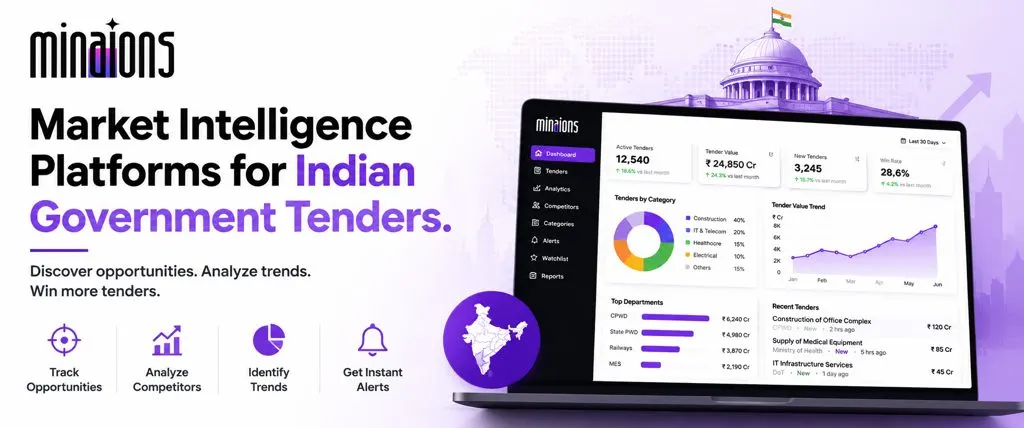
Discover how AI-powered market intelligence platforms streamline tender registration, procurement compliance, and government bidding success.