Bidding vs Reverse Auction in GeM: Which is Better for Suppliers?
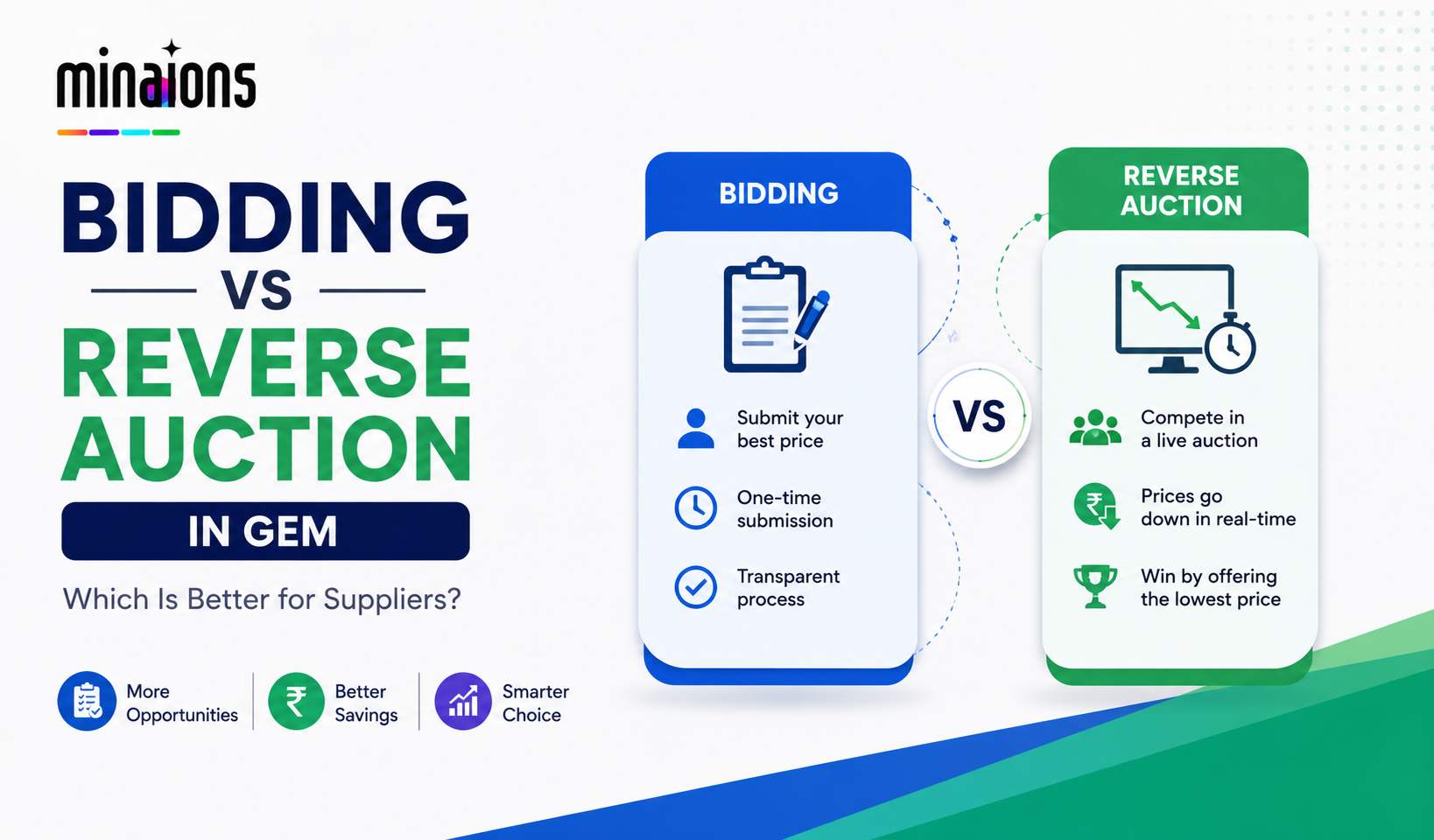
Bidding vs Reverse Auction in GeM: Which is Better for Your Supplier Business?
In the evolving landscape of Public Procurement, suppliers face a critical crossroads: navigate the static precision of traditional bidding or enter the dynamic, real-time pressure of reverse auctions on the Government e-Marketplace (GeM). With GeM procurement surpassing Rs 1.24 trillion in Q1 2024-25 and mandates now requiring central departments to procure through this platform, the choice between methods is no longer tactical, it is strategic. For suppliers, especially MSMEs and startups, misjudging the optimal approach can mean lost contracts, eroded margins, or disqualification under stringent General Financial Rules. The question is not merely which method is faster or cheaper, but which aligns with your business capabilities, product profile, and long-term sustainability in a system increasingly governed by AI-driven transparency and competitive rigour.
The Evolving Landscape of Public Procurement on GeM
Public Procurement in India has undergone a fundamental transformation with the rise of GeM as the centralised, digital marketplace for government purchases. What began as a simple e-tendering portal has evolved into a sophisticated ecosystem governed by GFR Rule 149, with over 60,000 government buyers and more than 1.5 million registered sellers. This shift has elevated procurement from a bureaucratic exercise to a data-rich, compliance-heavy operation where efficiency, transparency, and competitive pricing are non-negotiable. Suppliers must now operate within a framework that demands not only adherence to regulatory standards but also agility in responding to real-time market dynamics.
Why GeM is Critical for B2G Suppliers
For suppliers targeting public sector contracts, GeM is no longer optional, it is essential. The platform provides direct access to a vast, structured buyer base across ministries, PSUs, and state governments. Its digital architecture ensures end-to-end traceability, reducing opportunities for favouritism and increasing trust. Suppliers who master GeM gain not just volume but credibility, as successful participation signals operational reliability to both buyers and future partners. The platform’s focus on MSME inclusion has further widened the opportunity, with order values from small businesses rising steadily toward FY 2025-26. Yet, without a clear strategy for bidding versus reverse auction, even well-positioned suppliers risk being outmanoeuvred by competitors leveraging automation and predictive intelligence.
The Role of GovTech and B2G SaaS in Modern Tendering
The integration of GovTech and B2G SaaS solutions has redefined supplier capabilities on GeM. Tools designed for automated tender discovery, eligibility validation, and bid optimisation are no longer luxuries, they are baseline requirements. Platforms such as Minaions enable suppliers to process hundreds of tenders daily, extract key compliance criteria using NLP, and simulate competitive bid ranges before submission. These technologies mitigate the complexity of GeM’s interface, reduce human error in documentation, and provide real-time insights into market pricing trends. For suppliers operating at scale, this technological edge translates into higher win rates and improved cash flow predictability, directly addressing the chronic challenge of payment delays and operational inefficiency.
Understanding GeM Bidding: The Traditional Approach
GeM bidding follows a sealed-offer model, where suppliers submit their proposals, typically in two packets (technical and financial), by a fixed deadline. The buyer then evaluates bids based on predefined criteria, including technical compliance, quality, delivery timelines, and price. This method is particularly suited for complex or customised goods and services where specifications matter as much as cost.
Advantages for Suppliers in GeM Bidding
Traditional bidding allows suppliers to emphasise value beyond price. A vendor offering certified quality, extended warranties, or integrated after-sales support can differentiate their offering in a way that reverse auctions do not permit. It also provides breathing room for pricing strategy, as there is no real-time pressure to undercut competitors. For suppliers of niche products or technical services, this method preserves profit margins while showcasing expertise. It is the preferred route for solutions requiring detailed documentation, such as IT infrastructure, medical equipment, or specialised consultancy services.
Challenges and Considerations for Bidding
The primary challenge lies in the subjective evaluation process. Even with technical compliance, a bid may be disqualified if the evaluation committee perceives a competitor’s proposal as more comprehensive. Documentation errors, missing certifications, or unclear pricing structures can lead to immediate rejection. Furthermore, the lack of visibility into competitor bids means suppliers must rely on historical data and market intelligence to estimate a winning range, a task that becomes increasingly difficult without AI-driven analytics.
Demystifying GeM Reverse Auctions: The Dynamic Price Battle
Reverse auctions on GeM involve multiple sellers competing in real-time to offer the lowest price for a standardised commodity or service. The process typically unfolds over a fixed window, open, limited, or multi-round, where bidders see the current lowest bid but not the identity of the bidder. The system automatically awards the contract to the lowest eligible bidder (L1) at the close of the auction.
Strategic Benefits for Suppliers in Reverse Auctions
Reverse auctions offer speed and scale. For suppliers of standardised products, such as office supplies, electronics, or basic IT hardware, they provide a direct path to high-volume contracts. The platform’s transparency ensures fair competition, and the automated nature reduces administrative overhead. Suppliers who can achieve economies of scale and maintain lean operations often thrive in this environment, particularly when supported by AI tools that forecast optimal bid thresholds and simulate competitor behaviour.
Navigating the Pitfalls: Disadvantages and Risks for Suppliers
The most significant risk is the race to the bottom, where intense competition drives prices below sustainable levels. Suppliers may win bids only to face losses due to underpricing, quality compromises, or inability to fulfil orders. Additionally, technical glitches, last-minute bid adjustments, and lack of real-time monitoring can lead to missed opportunities. Without accurate cost modelling and dynamic pricing tools, suppliers are vulnerable to being outbid by entities with lower overheads or deeper capital reserves.
Bidding vs Reverse Auction: A Strategic Comparison for Suppliers
Key Differences in Process and Outcome
Traditional bidding prioritises a holistic assessment of value, while reverse auctions prioritise price alone. Bidding is suited for complex, non-commodity items with variable specifications; reverse auctions dominate for standardised, high-volume goods. The former offers strategic control over presentation; the latter demands operational precision and speed.
When to Choose Bidding: Ideal Scenarios for Suppliers
Choose traditional bidding when your offering includes technical complexity, proprietary features, or service-based value. For instance, a supplier providing custom software integration for a ministry’s digital workflow will benefit from presenting case studies, compliance certifications, and support structures that a reverse auction cannot accommodate. Bidding also suits suppliers with higher cost structures who cannot compete on price alone but can compete on reliability and innovation.
When to Embrace Reverse Auction: Maximizing Opportunities
Reverse auctions are ideal for suppliers of commoditised products with low differentiation, high volume potential, and tight cost controls. A vendor selling standardised USB drives, printer toner, or basic furniture can leverage automation tools to monitor thousands of auctions daily, adjust bids in real time, and secure consistent order flow. This model works best when paired with AI-driven inventory and pricing systems that ensure profitability even at L1 levels.
Leveraging Agentic AI for Unmatched Advantage in GeM Procurement
AI-Powered Bid Management: Precision in Every Proposal
AI solutions such as those developed by Minaions transform supplier capabilities by automating the entire tender lifecycle. From parsing complex GeM bid documents using NLP to validating eligibility against GFR Rule 149, these systems eliminate manual errors and accelerate response times. For bidding, AI can generate tailored proposals by aligning technical responses with buyer requirements. For reverse auctions, it simulates competitor pricing based on historical data and market trends, recommending optimal bid increments that preserve margins while ensuring competitiveness.
Optimizing Reverse Auction Performance with AI-Driven Insights
Suppliers using AI for reverse auctions gain a predictive edge. By analysing past auction outcomes, product categories, and seller behaviour patterns, these tools identify the sweet spot between winning and profitability. They alert suppliers to suspiciously low bids from new entrants, flag potential quality risks, and recommend when to hold firm or make a final adjustment. This data-driven approach turns reverse auctions from a gamble into a repeatable, scalable revenue channel.
Ensuring Compliance and Mitigating Risk with Enterprise AI
Compliance is the bedrock of GeM participation. AI systems continuously monitor regulatory updates, cross-check documentation against mandatory fields, and auto-flag discrepancies before submission. This reduces the risk of disqualification due to minor errors, a common pitfall for MSMEs navigating the portal’s complexity. Furthermore, AI enhances supplier risk profiles by tracking payment history, delivery performance, and customer feedback, building trust with buyers over time.
Future-Proofing Your GeM Strategy: Trends and Innovations (2025-2026)
The Growing Impact of AI in Government Tendering
By 2025, over 89% of global procurement teams are projected to adopt generative AI, and GeM is no exception. With GeM 5.0 introducing AI-driven vendor ranking and automated compliance checks, suppliers who rely on manual processes will fall behind. AI-powered chatbots, such as GeM AI powered by Amazon Bedrock, are already improving user experience for millions of sellers. The future belongs to those who integrate intelligent systems into their procurement workflows, not those who treat GeM as a static portal.
GeM's Evolution: What Suppliers Need to Know
GeM’s SAHAYAK programme, launching thousands of certified trainers to assist sellers, underscores the government’s commitment to inclusion. However, digital literacy alone is not enough. The real advantage will come from suppliers who combine this support with enterprise-grade B2G SaaS tools that automate the heavy lifting of compliance, pricing, and bid preparation. As sustainability and supplier diversity metrics gain traction, AI will also begin evaluating bids against ESG criteria, further widening the gap between manual and intelligent suppliers.
Conclusion: Empowering Suppliers for GeM Success
The choice between bidding and reverse auction on GeM is not binary, it is contextual. Success lies not in choosing one method over the other, but in aligning your strategy with your product, capacity, and technological readiness. For suppliers seeking sustainable growth, the path forward is clear: leverage AI to turn complexity into clarity, risk into resilience, and competition into competitive advantage. In Public Procurement, the winners are not always the lowest bidders, they are the most prepared.
What is the primary difference between bidding and reverse auction on GeM for suppliers?
In traditional bidding on GeM, suppliers submit sealed offers by a deadline, and the buyer evaluates them based on price and technical compliance. In a reverse auction, multiple sellers compete in real-time by progressively lowering their prices to win the contract.
What are the main risks for suppliers participating in GeM reverse auctions?
The main risks include intense price competition leading to unsustainable margins, potential for low-quality bids from competitors, and the need for real-time monitoring and rapid price adjustments.
How can AI-powered solutions improve a supplier's chances in GeM bidding and reverse auctions?
AI solutions can significantly improve win rates by automating tender discovery, analyzing complex bid documents, performing eligibility checks, predicting winning bid ranges, and enabling dynamic, data-backed pricing strategies in real-time. This reduces human error and provides strategic insights.
Related Blogs

A small manufacturing firm in Ludhiana missed a ₹2.3 crore contract after spending 14 hours manually scanning the GeM portal, only to find the tender had closed two days earlier. This is not an isolated case.

A small civil engineering firm in Lucknow spent three weeks manually parsing a 420-page NHAI tenders document, only to miss a critical clause in the contractor registration requirements and lose eligibility.

A small manufacturing firm in Ludhiana missed a ₹2.
Discover how AI-powered market intelligence platforms streamline tender registration, procurement compliance, and government bidding success.