How Natural Language Processing (NLP) Makes Tender Discovery Smarter
India’s public procurement ecosystem is becoming increasingly digital, data-driven, and competitive. Every day, thousands of opportunities are published across multiple tender portal systems, procurement websites, and digital procurement networks. Businesses participating in government procurement, government tenders, government bids, and government contracts often struggle to identify the right opportunities quickly and efficiently.
The rapid growth of online tenders India, e-procurement India, and digital eProcure systems has significantly increased procurement data volume. Companies participating in government contracting, managing govt contracts, or competing in the expanding tender india ecosystem need smarter procurement intelligence to remain competitive.
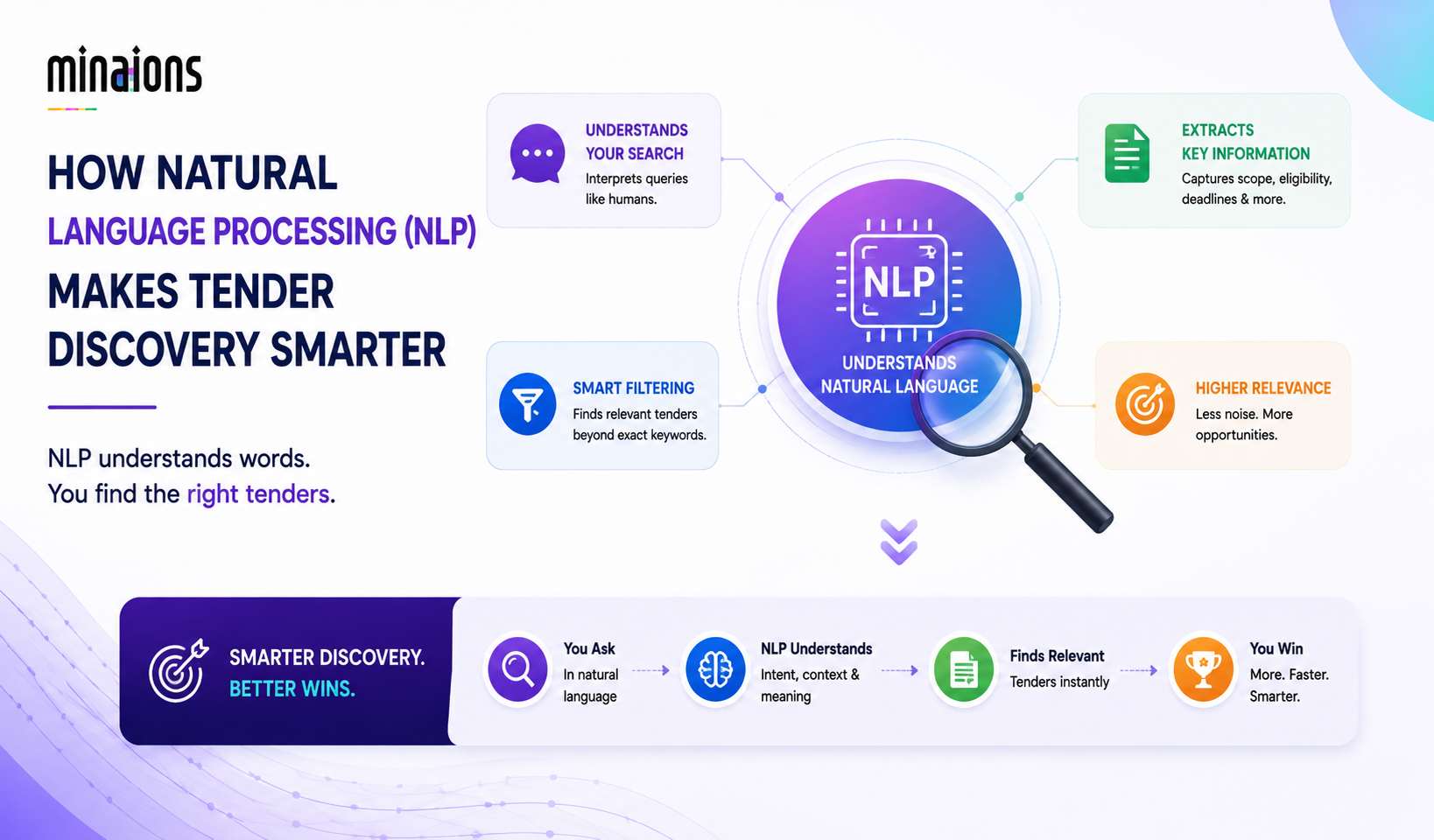
This is where Natural Language Processing (NLP) is transforming the procurement industry. NLP-powered systems can analyze massive amounts of procurement data, understand tender language, automate bid discovery, improve tender alerts India, and simplify the complete tendering process. Platforms like Minaions are using AI and NLP to help businesses discover relevant government tenders, reduce procurement workload, and improve participation in MSME tenders India and large-scale procurement opportunities.
What is NLP in Government Procurement?
Natural Language Processing or NLP is an artificial intelligence technology that enables systems to understand, process, analyze, and categorize human language.
In the context of government procurement, NLP helps businesses automatically analyze procurement documents, tender descriptions, bid conditions, technical requirements, and procurement eligibility.
Modern NLP systems used in government tenders can:
Analyze procurement language
Categorize tender opportunities
Generate intelligent tender alerts India
Improve procurement search accuracy
Simplify the tendering process
Identify relevant government contracts
Businesses participating in government bids and government contracting can use NLP-driven systems to improve procurement efficiency significantly.
Challenges in Traditional Tender Discovery
The traditional process of finding relevant procurement opportunities is extremely time-consuming.
Businesses participating in government tenders often need to manually monitor multiple tender portal systems, procurement websites, and eProcure platforms.
The biggest challenges include:
Massive procurement data volume
Complex procurement terminology
Multiple procurement categories
Frequent corrigendums
Duplicate opportunities
Time-consuming document reviews
Companies participating in govt tenders and online tenders India often miss opportunities because of poor procurement visibility.
NLP helps solve these challenges by automating procurement intelligence and opportunity discovery.
Role of Tender Portal Systems in Procurement
A modern tender portal is one of the most important tools in public procurement participation.
Businesses participating in government procurement use a tender portal to:
Discover procurement opportunities
Download tender documents
Monitor procurement timelines
Track corrigendums
Submit bids digitally
The expansion of digital tender portal systems has significantly increased participation in government tenders and govt contracts.
However, manually monitoring every tender portal is inefficient. NLP-powered systems automate this process by scanning multiple procurement sources simultaneously.
Minaions uses NLP-based procurement intelligence to monitor procurement opportunities across multiple tender portal systems automatically.
NLP and Government Procurement Intelligence
The scale of government procurement in India is enormous.
Every day, procurement opportunities are released across sectors such as:
Infrastructure
Healthcare
Education
Defence
IT services
Logistics
Renewable energy
Businesses participating in government procurement often struggle to identify the most relevant opportunities quickly.
NLP systems analyze procurement descriptions, eligibility conditions, and procurement categories to identify relevant government bids automatically.
This significantly improves efficiency in government contracting and digital procurement workflows.
Smarter Discovery of Government Tenders
The number of government tenders published daily across India is extremely large.
Businesses participating in government tenders often face difficulties because procurement opportunities are spread across multiple platforms.
NLP-powered procurement systems improve discovery of government tenders by:
Understanding procurement keywords
Identifying procurement categories
Matching opportunities with business profiles
Prioritizing relevant opportunities
Reducing irrelevant procurement noise
The growing complexity of government tenders has made AI-driven procurement intelligence essential.
Minaions uses NLP algorithms to improve the discovery of highly relevant government tenders for businesses across industries.
Government Bids and Intelligent Opportunity Matching
The ecosystem of government bids is highly competitive.
Businesses participating in government bids need to identify procurement opportunities quickly before competitors.
NLP systems improve government bids discovery by analyzing:
Tender scope
Technical eligibility
Bid values
Procurement categories
Industry relevance
The use of NLP in government bids significantly improves procurement visibility and decision-making.
Companies participating in govt tenders can use NLP-driven systems to prioritize the most profitable opportunities.
Government Contracts and AI-Based Procurement Analysis
Winning government contracts requires more than simple opportunity discovery.
Businesses participating in government contracts need detailed procurement analysis, bid qualification assessment, and opportunity prioritization.
NLP systems help businesses analyze:
Procurement conditions
Bid requirements
Contract duration
Technical obligations
Risk indicators
The increasing complexity of government contracts has increased the importance of AI-driven procurement management systems.
Minaions helps businesses analyze government contracts using NLP-powered procurement intelligence and automation.
Government Contracting and Automation
The modern ecosystem of government contracting is becoming increasingly technology-driven.
Businesses participating in government contracting now use AI systems to automate:
Procurement discovery
Bid categorization
Compliance tracking
Opportunity scoring
Procurement analytics
The rise of NLP in government contracting has improved procurement speed, operational efficiency, and bid visibility.
Organizations participating in MSME tenders India and large-scale govt contracts can significantly improve operational efficiency through AI-driven procurement systems.
Tender Contract Analysis with NLP
Every tender contract contains detailed procurement language and technical requirements.
NLP systems help businesses analyze every tender contract by identifying:
Eligibility conditions
Technical requirements
Submission deadlines
Risk indicators
Compliance obligations
Businesses participating in government procurement should use NLP-driven analysis to evaluate every tender contract more accurately.
The growing complexity of procurement documentation makes manual review inefficient.
Tendering Process and NLP Automation
The complete tendering process involves multiple operational and compliance workflows.
The standard tendering process generally includes:
Opportunity discovery
Eligibility analysis
Document preparation
Bid submission
Compliance verification
Procurement tracking
NLP improves the tendering process by automating procurement categorization and procurement intelligence workflows.
Businesses participating in government tenders and e-procurement India systems can reduce operational workload significantly through NLP automation.
Govt Tenders and AI-Driven Procurement Visibility
The ecosystem of govt tenders is becoming increasingly competitive.
Businesses participating in govt tenders should use NLP-powered procurement systems to:
Improve procurement visibility
Monitor procurement opportunities
Reduce irrelevant bid searches
Improve opportunity matching
The increasing number of govt tenders across India makes AI-driven procurement intelligence highly valuable.
Minaions helps suppliers improve visibility across govt tenders using advanced NLP and AI systems.
Tender India and Procurement Intelligence
The future of tender india is becoming increasingly data-driven and AI-powered.
Modern procurement systems within the tender india ecosystem are rapidly adopting:
AI procurement analytics
Automated opportunity discovery
NLP-driven categorization
Intelligent procurement recommendations
Businesses participating in tender india should invest in AI-driven procurement systems to remain competitive in future procurement markets.
MSME Tenders India and Smart Opportunity Discovery
The ecosystem of MSME tenders India is growing rapidly.
However, businesses participating in MSME tenders India often struggle to identify the right procurement opportunities quickly.
NLP systems improve discovery of MSME tenders India opportunities by analyzing procurement eligibility and supplier categories automatically.
This helps MSMEs participate more efficiently in government procurement and government bids.
Online Tenders India and Digital Procurement
The rise of online tenders India has transformed procurement participation.
Businesses participating in online tenders India now rely heavily on AI-driven procurement intelligence for opportunity tracking.
NLP improves online tenders India participation by automating:
Opportunity filtering
Procurement categorization
Bid prioritization
Procurement alerts
The increasing scale of online tenders India has made procurement automation essential.
E-Procurement India and EProcure Systems
The expansion of e-procurement India and eProcure systems has increased procurement accessibility while also increasing procurement complexity.
Modern e-procurement India systems generate massive procurement data volumes daily.
NLP helps businesses participating in eProcure systems by simplifying procurement search, bid discovery, and opportunity analysis.
The growing scale of e-procurement India has accelerated the adoption of AI-driven procurement systems.
Tender Alerts India and Automated Procurement Tracking
The role of tender alerts India has become critical in modern procurement participation.
Businesses participating in government tenders use tender alerts India to:
Track procurement opportunities
Monitor procurement updates
Identify relevant bids quickly
Improve bid preparation timelines
Minaions provides AI-powered tender alerts India systems that use NLP to deliver highly relevant procurement opportunities automatically.
Tender Checklist India and Compliance Automation
A strong tender checklist India workflow is essential for procurement success.
NLP systems help businesses automate the tender checklist India process by identifying:
Missing compliance documents
Eligibility gaps
Procurement risks
Submission requirements
Businesses participating in government contracts and govt contracts can reduce procurement errors significantly through NLP-driven compliance systems.
Minaions and NLP-Powered Procurement Intelligence
Minaions is transforming procurement discovery through AI and NLP-driven automation.
Minaions helps businesses:
Monitor multiple tender portal systems
Discover relevant government tenders
Track government bids
Improve tender alerts India
Simplify the tendering process
Manage tender checklist India workflows
Businesses participating in government contracting, eProcure, and online tenders India can use Minaions to improve procurement visibility and operational efficiency.
Final Thoughts
Natural Language Processing is transforming the future of government procurement, government tenders, and digital procurement systems. Businesses participating in government bids, government contracts, and govt tenders must adopt AI-driven procurement intelligence to remain competitive.
From automating the complete tendering process to improving tender alerts India, NLP significantly improves procurement efficiency and opportunity discovery.
Organizations actively participating in MSME tenders India, online tenders India, and the broader e-procurement India ecosystem can gain a major competitive advantage by using AI-driven procurement platforms like Minaions.
As the tender india ecosystem continues to evolve, NLP-powered procurement systems will become essential for smarter procurement visibility, faster bid discovery, and better procurement decision-making.
Related Blogs
A small manufacturing firm in Ludhiana missed a ₹2.3 crore contract after spending 14 hours manually scanning the GeM portal, only to find the tender had closed two days earlier. This is not an isolated case.

A small civil engineering firm in Lucknow spent three weeks manually parsing a 420-page NHAI tenders document, only to miss a critical clause in the contractor registration requirements and lose eligibility.

A small manufacturing firm in Ludhiana missed a ₹2.
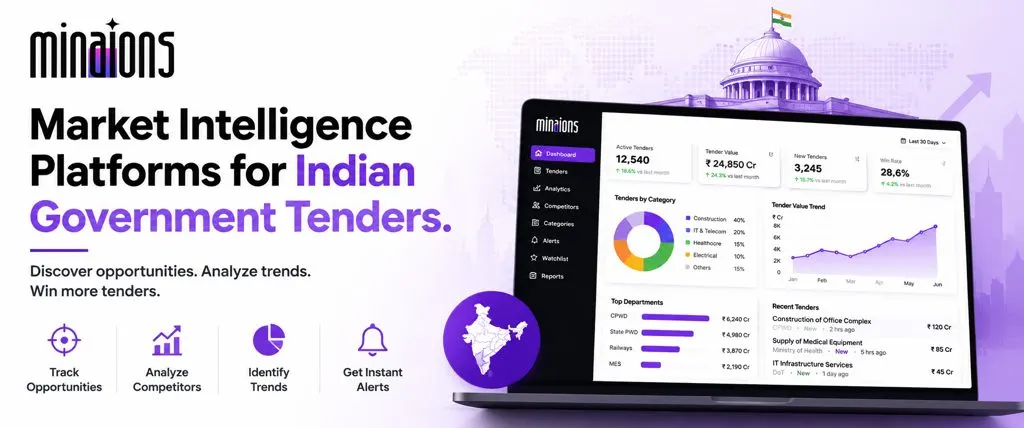
Discover how AI-powered market intelligence platforms streamline tender registration, procurement compliance, and government bidding success.