How Small Businesses Can Form Consortiums to Win Large Government Tenders
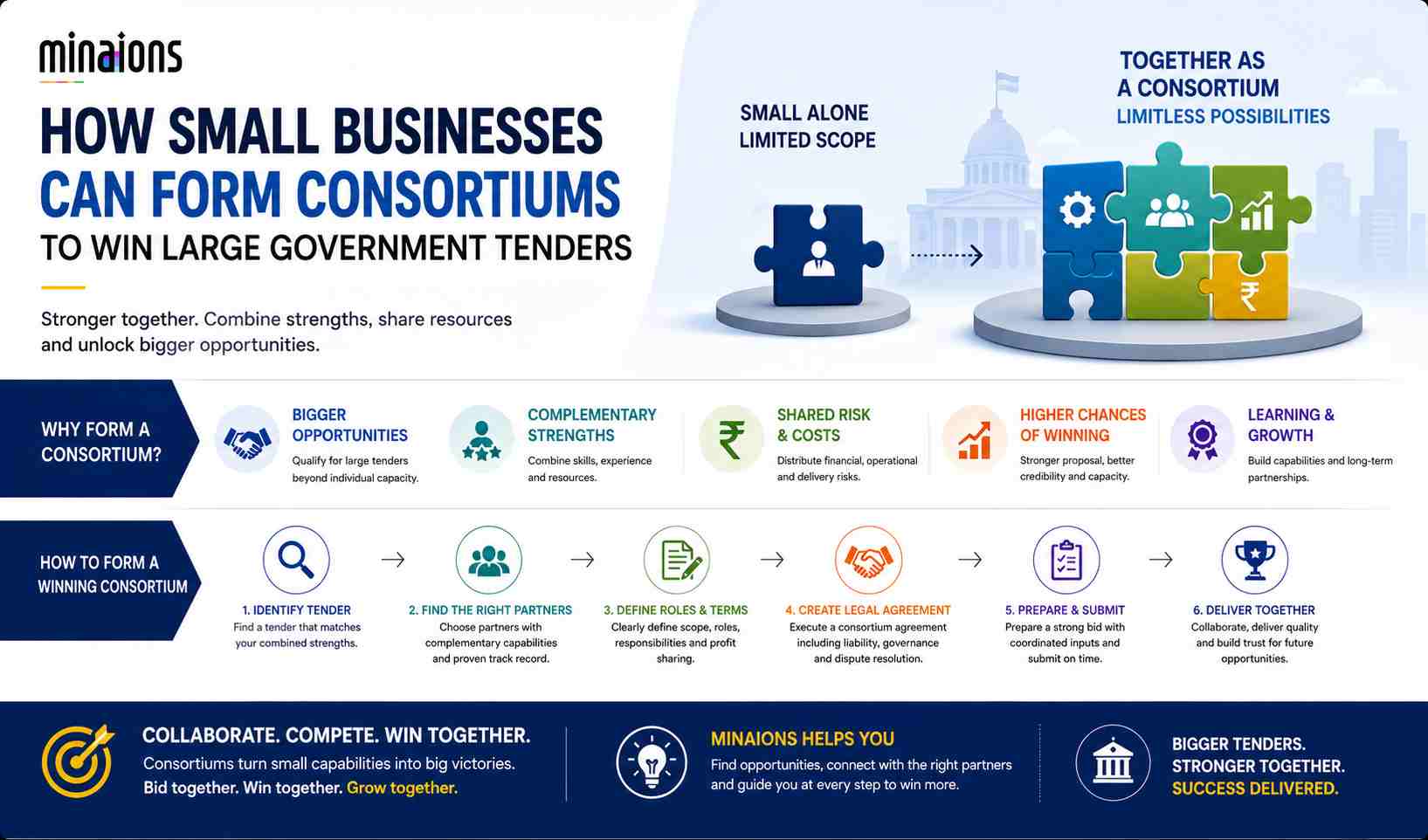
India’s public procurement ecosystem is expanding rapidly, creating enormous opportunities for MSMEs, startups, consultants, EPC firms, IT companies, infrastructure providers, and service vendors. However, many small businesses struggle to qualify for large govt tenders because of strict eligibility requirements, high turnover criteria, technical capability expectations, and large project execution demands.
One of the smartest ways for MSMEs to compete in large govt contracts is by forming consortiums or joint bidding partnerships. Through consortium-based participation, small companies can combine technical expertise, financial capability, manpower, certifications, and project experience to successfully bid in tender opportunities with higher tender value.
Today, businesses participating in online tenders, digital procurement systems, and the broader tender india ecosystem increasingly use consortium models to improve eligibility and procurement success rates. Platforms like Minaions help businesses manage consortium workflows, organize every tender document, automate procurement tracking through a centralized tender portal, and reduce bid management complexity in competitive procurement markets.
Why Consortiums Matter in Govt Tenders
Many govt tenders include strict qualification conditions related to turnover, manpower, technical experience, certifications, and project execution history.
Small businesses often fail to qualify individually for high tender value opportunities because they do not meet all eligibility conditions. By forming consortiums, businesses can collectively qualify and compete for larger govt contracts.
The rise of consortium participation is becoming increasingly common across:
Infrastructure projects
Smart City contracts
IT implementation projects
Consultancy assignments
EPC contracts
Healthcare procurement
Education-sector procurement
Businesses participating in online tenders and the growing tender india ecosystem should actively explore consortium-based procurement strategies.
Understanding the Difference Between Bids and Tenders
Before forming consortiums, businesses should understand the difference between bids and tenders.
The difference between bids and tenders generally relates to procurement terminology and procurement structure.
A tender is the formal procurement opportunity published by procurement authorities, while a bid is the supplier’s response to that tender opportunity.
Understanding the difference between bids and tenders helps businesses organize consortium participation more effectively.
Companies participating in govt bidding and tenders and rfps should carefully analyze procurement terminology before entering joint bidding arrangements.
Purchasing Rules and Consortium Participation
Every consortium participating in govt tenders must comply with applicable purchasing rules.
Modern purchasing rules define:
Eligibility criteria
Consortium participation norms
Financial requirements
Bid submission standards
Liability structures
Businesses participating in online tenders should carefully review all purchasing rules before entering consortium agreements.
Ignoring critical purchasing rules is one of the biggest reasons consortium bids fail during technical evaluation.
Minaions helps businesses manage compliance workflows related to purchasing rules through AI-driven procurement management systems.
Purchasing Rules and Regulations in Public Procurement
The ecosystem of public procurement also operates under detailed purchasing rules and regulations.
These purchasing rules and regulations govern:
Vendor eligibility
Joint venture participation
Consortium liabilities
Technical evaluation
Financial compliance
Procurement transparency
Businesses participating in govt contracts should carefully understand all applicable purchasing rules and regulations before preparing consortium bids.
The increasing complexity of purchasing rules and regulations has made procurement compliance extremely important in the modern tender india ecosystem.
Bid in Tender Through Consortiums
The consortium model allows multiple businesses to jointly bid in tender opportunities.
Through consortium participation, companies can combine:
Technical expertise
Financial turnover
Certifications
Project experience
Operational capability
Businesses trying to bid in tender opportunities with large tender value should carefully identify strategic consortium partners.
The ability to successfully bid in tender opportunities through consortiums significantly improves procurement competitiveness in govt bidding ecosystems.
Tender Agreement Form and Legal Structure
A proper tender agreement form is critical for consortium participation.
The tender agreement form generally defines:
Roles and responsibilities
Revenue sharing
Liability allocation
Lead bidder structure
Operational obligations
Businesses participating in govt contracts should carefully draft the tender agreement form before entering joint procurement opportunities.
A poorly structured tender agreement form often creates operational disputes during project execution.
Minaions helps businesses organize procurement workflows and document management related to the tender agreement form process.
Tender Trends in Consortium Procurement
Modern procurement tender trends are increasingly favoring consortium participation.
Current tender trends show increased consortium opportunities across:
Smart Cities
Digital governance
AI implementation
Infrastructure modernization
Renewable energy projects
The evolving tender trends indicate that procurement authorities increasingly prefer vendors with combined execution capability.
Businesses participating in tenders and rfps should continuously monitor changing tender trends to improve strategic positioning.
Tendering Contractors and Consortium Models
Many large tendering contractors now use consortium-based participation to improve procurement competitiveness.
Large tendering contractors often collaborate with:
Technology firms
Infrastructure companies
MSMEs
Specialized consultants
Local implementation partners
The rise of consortium-based procurement among tendering contractors is transforming the broader tender india ecosystem.
Small businesses participating in govt bidding should actively network with established tendering contractors to improve procurement opportunities.
Govt Bidding and Consortium Strategies
The ecosystem of govt bidding is becoming increasingly competitive.
Businesses participating in govt bidding should focus on:
Consortium capability
Compliance readiness
Technical expertise
Financial strength
Procurement visibility
The rise of consortium participation is helping small businesses improve procurement competitiveness in high tender value opportunities.
Minaions helps businesses automate workflows related to govt bidding, consortium tracking, and procurement collaboration.
Tender Value and Large Procurement Projects
Many infrastructure and technology projects involve very high tender value.
Large tender value projects often include:
Smart City contracts
ERP implementation
Highway construction
Surveillance systems
Renewable energy infrastructure
Small businesses participating in online tenders can use consortium strategies to qualify for projects with higher tender value.
The increasing scale of public procurement is significantly increasing average tender value across the tender india ecosystem.
Tenders and RFPs in Consortium Procurement
Modern tenders and rfps increasingly allow consortium participation.
Businesses participating in tenders and rfps should carefully evaluate:
Consortium eligibility
Lead bidder conditions
Revenue-sharing requirements
Joint liability clauses
The growing complexity of tenders and rfps has increased the importance of procurement automation and centralized bid management.
Minaions provides AI-driven procurement intelligence for managing consortium workflows related to tenders and rfps.
Tender Portal and Procurement Visibility
A centralized tender portal is critical for consortium-based procurement participation.
Businesses participating in govt tenders use a tender portal to:
Track procurement opportunities
Download every tender document
Monitor corrigendums
Submit bids digitally
Track procurement updates
The expansion of digital tender portal systems has significantly improved supplier participation in online tenders.
Companies participating in consortium-based procurement should continuously monitor multiple tender portal systems.
Tender Document and Consortium Compliance
Every consortium bid depends heavily on accurate tender document preparation.
The standard tender document may include:
Eligibility conditions
Consortium clauses
Technical specifications
Financial requirements
Joint venture conditions
Businesses participating in govt contracts should carefully review every tender document before finalizing consortium arrangements.
Incorrect interpretation of a tender document is one of the biggest reasons consortium bids fail during evaluation.
Online Tenders and Digital Procurement
The rise of online tenders has significantly expanded procurement participation opportunities for MSMEs.
Today, suppliers can participate in online tenders remotely through digital procurement systems.
The expansion of online tenders has improved:
Procurement transparency
Supplier participation
Digital bid management
Consortium collaboration
Businesses participating in online tenders should strengthen digital procurement capability to improve consortium participation success rates.
Tender Checklist India for Consortium Bidding
A structured tender checklist India workflow is essential for consortium procurement.
The standard tender checklist India generally includes:
Consortium agreement verification
Lead bidder confirmation
Technical documentation
Financial qualification
Digital signatures
Compliance review
Businesses participating in govt bidding should maintain a strong tender checklist India process to reduce operational risk.
Ignoring critical steps within the tender checklist India workflow often leads to bid rejection.
Minaions and Consortium Tender Management
Platforms like Minaions are transforming consortium procurement participation.
Minaions helps businesses:
Track govt tenders
Monitor online tenders
Organize every tender document
Manage consortium workflows
Automate procurement tracking
Improve procurement collaboration
Businesses participating in tenders and rfps can use Minaions to improve procurement visibility and operational efficiency.
Final Thoughts
Consortium-based procurement is becoming one of the most effective ways for MSMEs and startups to compete in large govt tenders and high tender value projects. Businesses participating in govt bidding, online tenders, and the broader tender india ecosystem should actively explore consortium strategies to improve procurement success rates.
From understanding the difference between bids and tenders to managing the complete tender checklist India, every stage of procurement matters.
Organizations using AI-driven platforms like Minaions to manage consortium workflows, monitor procurement opportunities through a centralized tender portal, and automate compliance related to every tender document can significantly improve their ability to secure long-term govt contracts.
As procurement systems continue to evolve digitally, consortium participation will become an increasingly powerful strategy for small businesses aiming to scale within India’s public procurement ecosystem.
Related Blogs

A small manufacturing firm in Ludhiana missed a ₹2.3 crore contract after spending 14 hours manually scanning the GeM portal, only to find the tender had closed two days earlier. This is not an isolated case.

A small civil engineering firm in Lucknow spent three weeks manually parsing a 420-page NHAI tenders document, only to miss a critical clause in the contractor registration requirements and lose eligibility.

A small manufacturing firm in Ludhiana missed a ₹2.
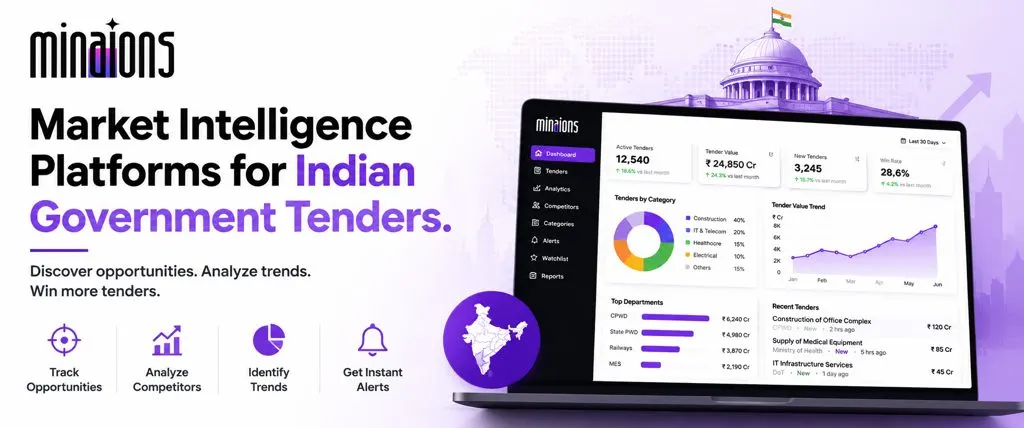
Discover how AI-powered market intelligence platforms streamline tender registration, procurement compliance, and government bidding success.