What Is a Corrigendum and How Should You Respond to Tender Amendments?
India’s public procurement ecosystem is becoming increasingly digital, transparent, and highly dynamic. Businesses participating in government procurement often focus heavily on bid preparation but overlook one of the most important procurement updates — corrigendums.
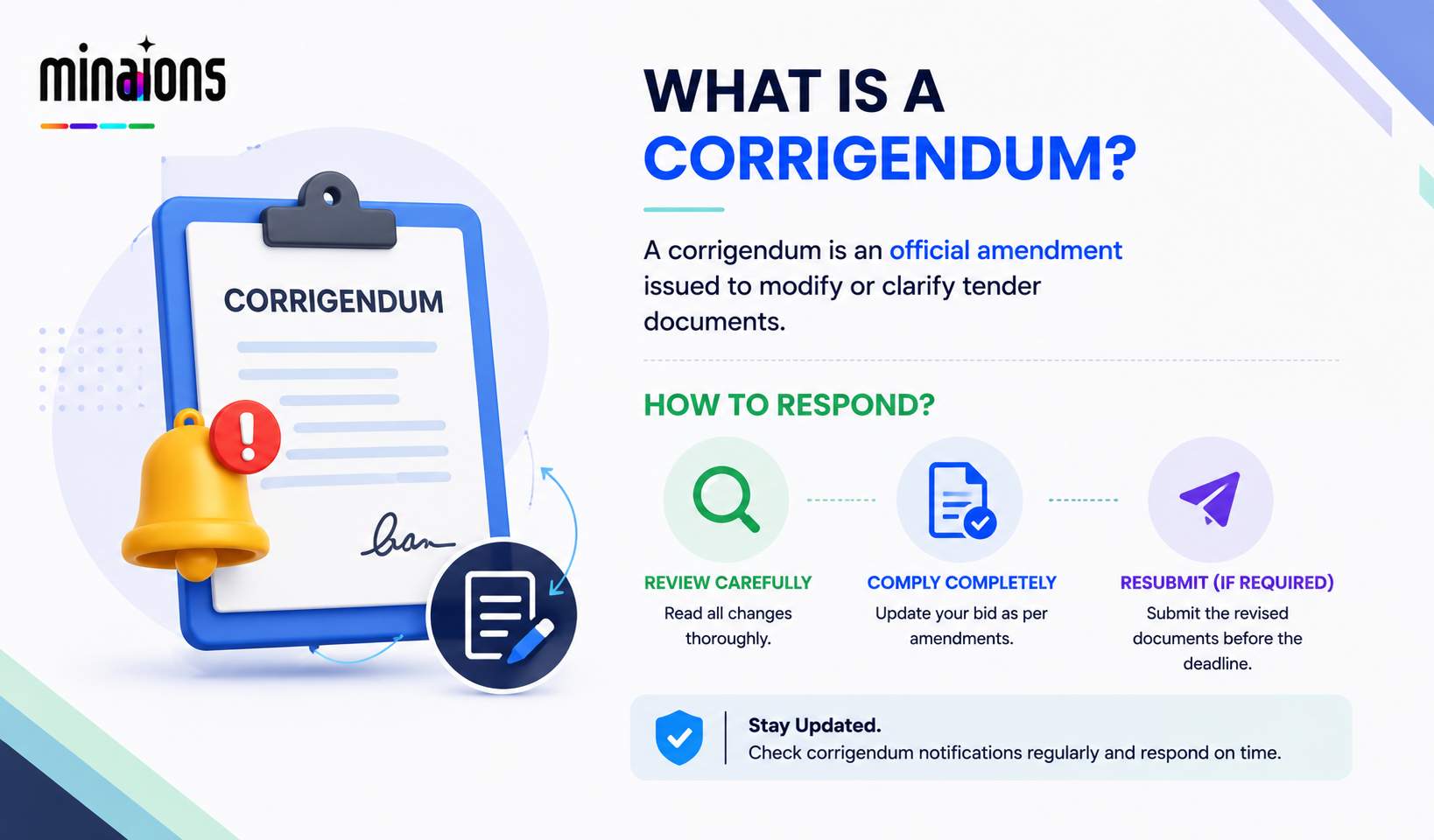
A corrigendum is a formal amendment issued after a tender is published. It may include changes to eligibility criteria, technical specifications, pricing formats, timelines, or procurement conditions. Businesses participating in the tendering process in procurement must therefore continuously monitor corrigendums to avoid rejection, compliance failure, or operational disruption.
Today, companies participating as a government supplier, managing e procurement form submissions, and competing through eproc government systems must understand how to respond quickly and accurately to procurement amendments.
Platforms like Minaions are helping businesses track changes in tender details, monitor the latest bid updates, improve participation in tender in gem portal workflows, and reduce procurement risks caused by missed corrigendums.
What Is a Corrigendum?
A corrigendum is an official amendment or correction issued by procurement authorities after tender publication.
During the tendering process in procurement, procurement departments may revise:
Eligibility criteria
Technical specifications
Bid submission deadlines
Commercial conditions
Compliance requirements
Scope of work
These updates are published as corrigendums within eproc government systems and procurement portals.
Businesses participating as a government supplier should therefore continuously monitor all procurement updates during the tendering process in procurement.
The increasing complexity of digital procurement has made corrigendum tracking highly important for building a successful tender strategy.
Why Corrigendums Are Issued
Procurement authorities issue corrigendums for multiple reasons.
Typical reasons include:
Technical clarification
Vendor queries
Specification correction
Timeline extension
Compliance modification
Procurement policy updates
Businesses participating in tender in gem portal procurement should understand that corrigendums are a normal part of the tendering process in procurement.
Ignoring corrigendums often leads to procurement rejection or missed opportunities.
Tender Details and Corrigendum Monitoring
Accurate monitoring of tender details is essential for procurement success.
Critical tender details often change after corrigendums are issued.
Typical revised tender details may include:
Eligibility conditions
Technical requirements
Delivery timelines
Pricing structure
Evaluation methodology
Businesses participating in eproc government systems should therefore review updated tender details carefully after every amendment.
Poor monitoring of tender details is one of the biggest reasons suppliers lose procurement opportunities.
Minaions helps businesses track changing tender details using AI-driven procurement intelligence systems.
Tendering Process in Procurement and Amendment Risks
The modern tendering process in procurement is becoming increasingly dynamic.
Today, the tendering process in procurement involves:
Multiple evaluation stages
Digital bid submission
Procurement analytics
Vendor clarifications
Technical amendments
Because of this complexity, procurement authorities frequently issue corrigendums during the tendering process in procurement.
Businesses participating as a government supplier should therefore establish strong amendment monitoring workflows.
The increasing scale of procurement digitization has made corrigendum management a critical part of the tendering process in procurement.
Tender Result and Procurement Impact
Corrigendums can significantly impact the final tender result.
Changes in eligibility conditions or technical specifications may alter:
Supplier qualification
Bid pricing
Procurement competition
Vendor ranking
Businesses participating in tender in gem portal procurement should continuously evaluate how corrigendums affect the expected tender result.
The final tender result often depends on how effectively suppliers adapt to procurement amendments.
Minaions helps businesses analyze the impact of corrigendums on the expected tender result using procurement analytics.
Government Supplier Responsibilities
Every government supplier participating in public procurement has a responsibility to monitor amendments carefully.
A professional government supplier should:
Track corrigendums daily
Review updated tender conditions
Adjust technical submissions
Recalculate pricing if needed
Update procurement documentation
Businesses participating as a government supplier should never assume that original procurement conditions remain unchanged throughout the procurement lifecycle.
The increasing competition in digital procurement has made amendment management essential for every government supplier.
Eproc Government Systems and Digital Amendments
Modern eproc government systems have transformed procurement amendment management.
Today, procurement authorities use eproc government systems to:
Publish corrigendums
Update procurement timelines
Modify tender conditions
Release clarification notices
Extend submission deadlines
Businesses participating in eproc government procurement should therefore continuously monitor procurement portals for updates.
The increasing complexity of eproc government systems has encouraged businesses to adopt AI-driven procurement monitoring tools like Minaions.
Successful Tender Strategy and Corrigendum Management
A strong successful tender strategy includes effective corrigendum management.
Businesses building a successful tender workflow should:
Monitor procurement updates regularly
Analyze revised tender conditions
Revalidate compliance
Update pricing calculations
Review submission timelines
The ability to respond quickly to procurement amendments significantly improves the probability of creating a successful tender outcome.
Businesses participating in the tendering process in procurement should therefore treat corrigendum monitoring as a core procurement activity.
Latest Bid and Procurement Adjustments
The role of the latest bid becomes extremely important after corrigendums are issued.
Businesses participating in e procurement form submissions should ensure that the latest bid reflects all updated procurement conditions.
Typical updates to the latest bid may include:
Revised pricing
Updated compliance documents
Technical specification changes
Delivery timeline modifications
Failure to align the latest bid with corrigendum updates is one of the major causes of procurement rejection.
Minaions helps suppliers track the latest bid changes and maintain procurement accuracy during the amendment process.
E Procurement Form and Compliance Updates
The modern e procurement form workflow is highly compliance-driven.
When corrigendums are issued, businesses participating in e procurement form submissions may need to:
Re-upload documents
Modify pricing structures
Update technical declarations
Revise compliance certificates
Businesses participating in tender in gem portal procurement should therefore carefully review every e procurement form requirement after amendments are published.
The increasing complexity of e procurement form workflows has made procurement automation highly valuable.
Tender in GeM Portal and Corrigendum Tracking
The ecosystem of tender in gem portal procurement is growing rapidly.
Today, businesses participating in tender in gem portal systems must continuously monitor:
Procurement updates
Bid amendments
Technical clarifications
Timeline changes
Vendor notifications
Corrigendums in tender in gem portal workflows can significantly influence procurement competition and bid evaluation.
Businesses participating in tender in gem portal procurement should therefore establish centralized procurement tracking systems.
Minaions helps businesses monitor corrigendums across tender in gem portal procurement workflows using AI-driven procurement analytics.
Common Mistakes Suppliers Make
Many businesses lose contracts because they mishandle corrigendums.
Typical mistakes include:
Ignoring amended tender details
Submitting outdated documents
Missing revised deadlines
Not updating the latest bid
Failing to revise the e procurement form
Businesses participating as a government supplier should therefore strengthen procurement governance and compliance management.
Best Practices for Handling Corrigendums
Businesses participating in eproc government systems should follow several best practices.
Monitor Tender Details Daily
Frequent review of tender details reduces procurement risk.
Revalidate the Latest Bid
Every corrigendum should trigger a review of the latest bid.
Update E Procurement Form Carefully
All revised e procurement form requirements should be checked thoroughly.
Improve Tendering Process in Procurement
Businesses should strengthen workflows within the tendering process in procurement.
Use AI-Driven Procurement Tools
Platforms like Minaions help suppliers automate corrigendum monitoring and procurement tracking.
Minaions and Smart Corrigendum Management
Minaions is helping businesses modernize procurement participation through AI-driven automation.
Minaions supports organizations through:
AI-powered procurement tracking
Corrigendum alerts
Smart monitoring of tender details
Procurement analytics
Bid intelligence
Automated update tracking
Improved management of the latest bid
Businesses participating in tender in gem portal procurement can use Minaions to improve procurement efficiency and reduce amendment-related risks.
Final Thoughts
Corrigendums are now a critical component of India’s digital procurement ecosystem. Businesses participating in eproc government systems, managing e procurement form submissions, and competing in the modern tendering process in procurement must clearly understand how procurement amendments work.
From monitoring changing tender details to updating the latest bid, every stage of procurement matters.
Organizations actively strengthening amendment management, improving workflows for successful tender participation, and using AI-driven procurement platforms like Minaions can significantly improve procurement success rates.
As tender in gem portal procurement and digital procurement systems continue to evolve, businesses investing in intelligent procurement monitoring and automation will gain a major competitive advantage.
Related Blogs

A small manufacturing firm in Ludhiana missed a ₹2.3 crore contract after spending 14 hours manually scanning the GeM portal, only to find the tender had closed two days earlier. This is not an isolated case.

A small civil engineering firm in Lucknow spent three weeks manually parsing a 420-page NHAI tenders document, only to miss a critical clause in the contractor registration requirements and lose eligibility.

A small manufacturing firm in Ludhiana missed a ₹2.
Discover how AI-powered market intelligence platforms streamline tender registration, procurement compliance, and government bidding success.