Why OEMs Are Losing Crores in India's Government Market, And Don't Even Know It
India’s public procurement ecosystem is worth lakhs of crores every year. Thousands of OEMs participate in procurement opportunities across healthcare, defence, infrastructure, education, railways, Smart City projects, PSU procurement, and industrial supply chains. Yet most OEMs still fail to fully capitalize on the enormous government procurement opportunity available through e tender all india systems and modern digital procurement platforms.
The shocking reality is that many OEMs are losing crores every year simply because they fail to properly get tender opportunities, monitor the right central portal tender systems, analyze government tender details, and efficiently manage tenders across multiple departments.
Most OEMs believe they are losing because of pricing competition. But in reality, they are losing because they are missing opportunities before the competition even starts.
Today, procurement is no longer just about bidding. It is about procurement intelligence, automation, analytics, compliance visibility, and smart decision-making. Platforms like Minaions are helping OEMs identify hidden opportunities, automate workflows, optimize sales tender pipelines, track corporate tenders in india, and improve participation in large-scale government tender details ecosystems.
The Hidden Problem: OEMs Don’t Even See Most Opportunities
One of the biggest reasons OEMs fail to get tender opportunities is poor visibility.
Every day, hundreds of procurement opportunities are published across:
State procurement systems
PSU procurement portals
Defence procurement websites
GeM
CPPP
Railways procurement systems
Healthcare procurement systems
Specialized central portal tender platforms
Most OEMs only track a few procurement websites manually. This means they miss a massive percentage of government tender details published every week.
The inability to monitor every central portal tender creates huge revenue leakage.
Minaions solves this problem by centralizing procurement discovery through AI-driven procurement intelligence that helps businesses automatically manage tenders, monitor e tender all india opportunities, and identify high-conversion procurement leads faster.
Why OEMs Lose Crores in Government Procurement
Many OEMs assume they are participating in enough bids. But the actual numbers tell a different story.
The biggest reasons OEMs lose revenue in the government tenders ecosystem include:
Missing request for tender documents
Poor tracking of government tender details
Failure to properly manage tenders
Weak visibility into corporate tenders in india
Lack of centralized procurement analytics
Delayed responses to sales tender opportunities
Poor bid qualification processes
Most OEMs participating in medical device tender opportunities or infrastructure procurement only bid reactively instead of strategically.
Without centralized procurement intelligence, companies cannot effectively get tender opportunities consistently.
The Problem with Manual Tender Tracking
Manual procurement tracking is one of the biggest operational mistakes OEMs make.
Most procurement teams still:
Search portals manually
Download spreadsheets manually
Monitor central portal tender websites individually
Track deadlines through emails
Store request for tender documents in folders
This outdated approach creates enormous inefficiencies.
The more procurement portals increase, the harder it becomes to properly manage tenders and monitor all relevant government tender details.
The rise of e tender all india systems has dramatically increased procurement complexity.
This is why modern OEMs are shifting toward AI-driven procurement automation platforms like Minaions.
The Explosion of Corporate Tenders in India
The ecosystem of corporate tenders in india is expanding rapidly.
Today, large private enterprises, industrial groups, hospitals, logistics companies, telecom firms, and infrastructure developers regularly release procurement opportunities similar to public procurement workflows.
The number of corporate tenders in india has increased because enterprises are adopting centralized procurement systems.
OEMs that fail to track corporate tenders in india lose significant business opportunities outside traditional government procurement.
Platforms like Minaions help businesses discover both public procurement and corporate tenders in india through centralized procurement intelligence systems.
Medical Device Tender Opportunities Are Growing Rapidly
The healthcare procurement ecosystem is creating enormous opportunities through every major medical device tender project.
Today, AIIMS, ESIC, state hospitals, medical colleges, and healthcare missions regularly publish medical device tender opportunities for:
Diagnostic equipment
ICU systems
Surgical devices
Monitoring equipment
Imaging systems
Healthcare software
However, many OEMs still fail to properly monitor government tender details related to healthcare procurement.
Missing even one large medical device tender opportunity can cost an OEM crores in lost revenue.
Minaions helps healthcare suppliers identify every relevant medical device tender opportunity through AI-powered procurement tracking systems.
Why Sales Teams Fail in Procurement Markets
Traditional sales teams are not designed to handle public procurement complexity.
Most sales teams focus on:
Lead generation
Client meetings
Proposal pitching
Relationship management
But procurement markets require specialized systems for:
Monitoring central portal tender updates
Tracking request for tender documents
Managing compliance
Handling sales tender workflows
Monitoring evaluation timelines
Without procurement automation, sales teams struggle to consistently get tender opportunities.
This is why OEMs increasingly need procurement-focused platforms instead of traditional CRM-only systems.
Sales Tender Opportunities Need Speed
The speed of response plays a major role in procurement success.
Many sales tender opportunities are lost simply because OEMs:
Miss deadlines
Fail to review procurement changes
Delay technical approvals
Miss corrigendum updates
The ability to quickly identify and respond to sales tender opportunities significantly improves procurement win rates.
Minaions helps businesses automate sales tender workflows and improve operational efficiency.
E Tender All India Has Increased Competition
The rise of e tender all india systems has completely transformed procurement participation.
Today, suppliers from any state can participate in procurement opportunities across India through digital procurement systems.
While e tender all india has increased transparency, it has also increased competition dramatically.
OEMs that fail to use procurement analytics and automation struggle to compete in the modern e tender all india ecosystem.
The companies winning consistently are not always the cheapest.
They are the companies that can:
Monitor opportunities faster
Analyze procurement patterns
Improve proposal quality
Better manage tenders
Respond quickly to procurement updates
Request for Tender Documents and Bid Intelligence
Most OEMs underestimate the importance of properly analyzing request for tender documents.
Every request for tender documents contains valuable intelligence related to:
Competitor qualification requirements
Pricing structures
Technical expectations
Procurement trends
Buyer priorities
Companies that properly analyze request for tender documents gain a massive strategic advantage.
Minaions helps businesses organize and analyze request for tender documents more efficiently using AI-driven procurement intelligence systems.
Why Procurement Intelligence Matters
The procurement market is becoming increasingly data-driven.
Modern OEMs must analyze:
Bid participation trends
Procurement categories
Historical procurement data
Department spending patterns
Win-loss ratios
Vendor competition
Without procurement intelligence, OEMs cannot properly manage tenders or optimize procurement strategy.
This is where platforms like Minaions are changing the procurement landscape.
Minaions: Helping OEMs Stop Losing Crores
Minaions is helping OEMs transform how they participate in procurement markets.
Minaions supports businesses through:
AI-driven procurement discovery
Automated central portal tender tracking
Smart government tender details monitoring
Intelligent bid qualification
Automated procurement alerts
Faster sales tender management
Better workflows to manage tenders
Tracking corporate tenders in india
Monitoring every major medical device tender
Centralized access to request for tender documents
Instead of manually searching dozens of portals every day, businesses can use Minaions to centralize procurement intelligence and improve procurement efficiency.
Final Thoughts
India’s procurement ecosystem is growing faster than ever before. But most OEMs are still operating with outdated procurement workflows.
The companies winning today are not simply bidding more.
They are using procurement intelligence to:
Discover opportunities faster
Track every central portal tender
Analyze government tender details
Respond quickly to sales tender opportunities
Better manage tenders
Monitor e tender all india systems efficiently
OEMs that fail to modernize procurement operations will continue losing crores silently every year.
Businesses investing in AI-driven procurement intelligence platforms like Minaions can dramatically improve procurement visibility, operational efficiency, and long-term revenue growth in the expanding world of government tenders, corporate tenders in india, and digital procurement ecosystems.
Related Blogs

A small manufacturing firm in Ludhiana missed a ₹2.3 crore contract after spending 14 hours manually scanning the GeM portal, only to find the tender had closed two days earlier. This is not an isolated case.

A small civil engineering firm in Lucknow spent three weeks manually parsing a 420-page NHAI tenders document, only to miss a critical clause in the contractor registration requirements and lose eligibility.

A small manufacturing firm in Ludhiana missed a ₹2.
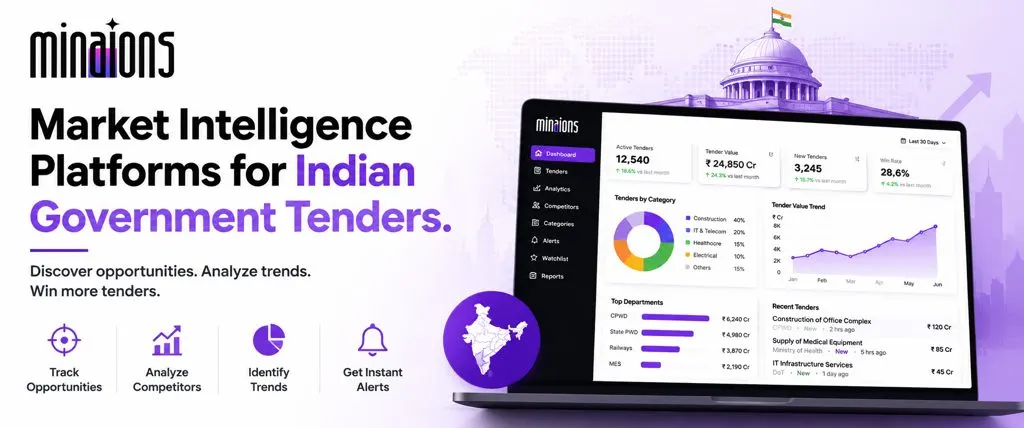
Discover how AI-powered market intelligence platforms streamline tender registration, procurement compliance, and government bidding success.