Agentic AI vs RPA vs Generative AI: What's the Difference in a Tendering Context?
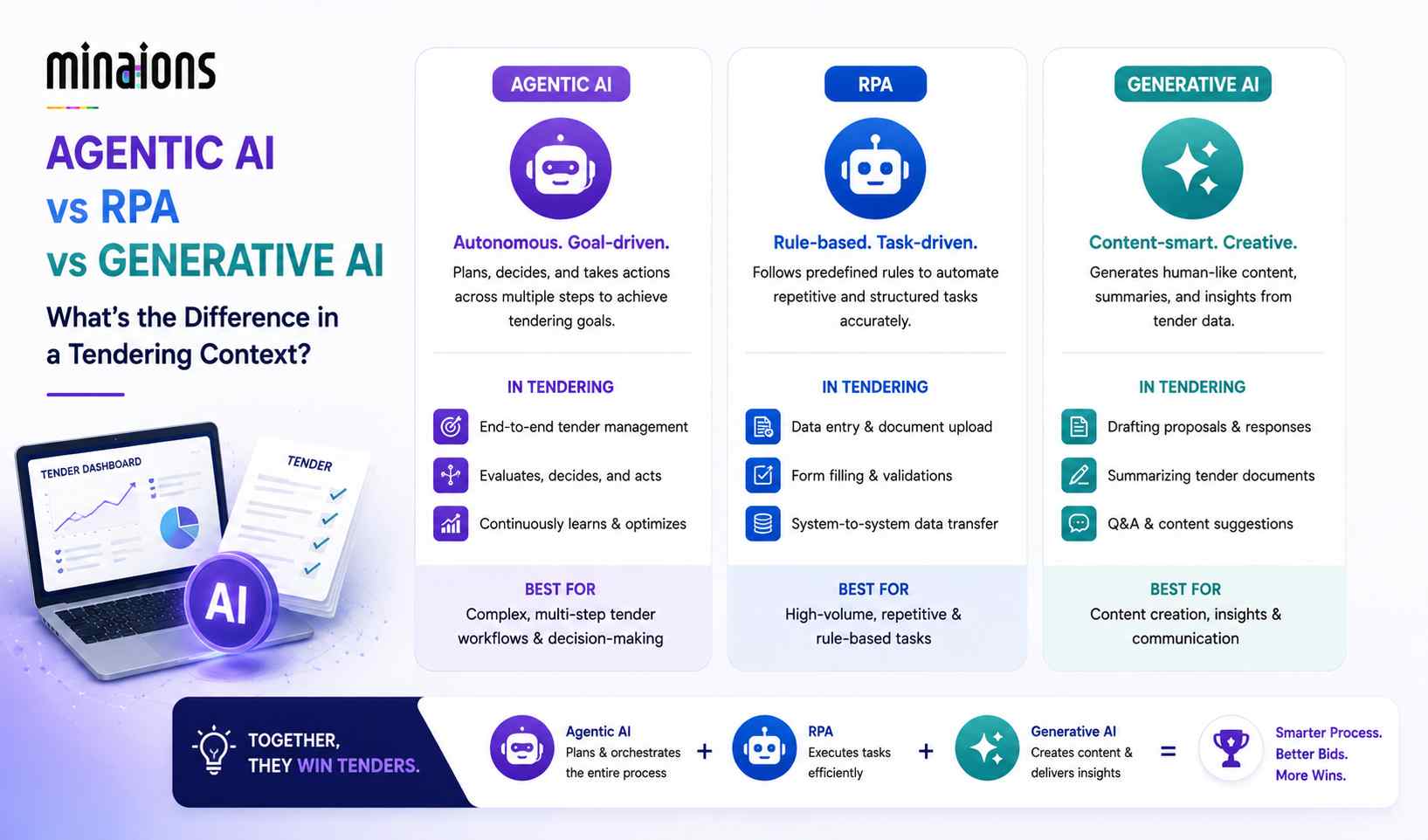
The global procurement industry is rapidly evolving because of automation, artificial intelligence, and digital transformation. Businesses participating in public sector procurement, managing the tendering process, and competing for government contracts for tender opportunities are increasingly adopting AI-driven procurement technologies to improve efficiency and win rates.
Today, companies participating in procurement tenders, handling large volumes of tender document submissions, and managing workflows across multiple tender portals are using technologies such as RPA, Generative AI, and Agentic AI to automate operations and improve decision-making.
The rise of AI-powered government tender software and modern bid management software India solutions has completely transformed how businesses manage the tendering system and optimize the evaluation tender workflow. Platforms like Minaions are helping businesses automate procurement intelligence, improve compliance, manage business tenders, and simplify every stage of the tendering process steps using AI-driven procurement systems.
The Growing Complexity of the Tendering Process
The modern tendering process has become increasingly complex and documentation-heavy.
Businesses participating in public sector procurement and large-scale government contracts for tender must manage:
Multiple tender portals
Large procurement datasets
Compliance-heavy tender document workflows
Technical bid preparation
Financial bid analysis
Multi-stage evaluation tender processes
The increasing scale of procurement tenders has created strong demand for automation technologies within the modern tendering system.
Organizations participating in business tenders are now investing heavily in AI-powered government tender software and bid management software India platforms to remain competitive.
What is RPA in a Tendering Context?
RPA or Robotic Process Automation is a rule-based automation technology that performs repetitive procurement tasks automatically.
In the tendering process, RPA is commonly used for:
Downloading documents from tender portals
Organizing tender document files
Monitoring procurement updates
Data entry automation
Bid submission tracking
Compliance reminders
RPA works effectively for repetitive and structured workflows within the tendering system.
Businesses participating in public sector procurement often use RPA to automate repetitive tasks associated with procurement tenders and business tenders.
However, RPA does not “think” or make strategic procurement decisions. It simply follows predefined workflows.
What is Generative AI in a Tendering Context?
Generative AI is an advanced AI technology capable of creating content, summarizing information, generating proposals, and assisting with procurement intelligence.
In the tendering process, Generative AI is commonly used for:
Drafting a tender document
Creating technical proposals
Summarizing procurement requirements
Preparing responses for government contracts for tender
Generating compliance checklists
Supporting evaluation tender analysis
Businesses participating in procurement tenders increasingly use Generative AI to improve proposal quality and reduce manual effort.
Modern government tender software platforms now integrate Generative AI to automate workflows within the tendering system.
Platforms like Minaions use AI-powered automation to improve bid preparation, procurement visibility, and participation in business tenders.
What is Agentic AI in a Tendering Context?
Agentic AI is the next evolution of procurement intelligence.
Unlike RPA or standard Generative AI, Agentic AI can make autonomous decisions, execute tasks independently, monitor procurement environments continuously, and optimize procurement strategies dynamically.
In the tendering process, Agentic AI can:
Monitor multiple tender portals
Analyze procurement trends
Track competitor activity
Automate the tendering process steps
Prioritize procurement opportunities
Support strategic evaluation tender workflows
Optimize bid/no-bid decisions
Agentic AI acts like a digital procurement strategist inside the tendering system.
Businesses participating in public sector procurement are increasingly adopting Agentic AI to improve procurement efficiency and maximize success rates in government contracts for tender.
Difference Between RPA, Generative AI, and Agentic AI
The biggest difference between these technologies lies in decision-making capability.
RPA
RPA focuses on repetitive automation within the tendering process.
Examples include:
Downloading files from tender portals
Organizing procurement data
Tracking procurement deadlines
RPA improves operational efficiency but cannot analyze procurement tenders strategically.
Generative AI
Generative AI focuses on content generation and procurement intelligence.
Examples include:
Drafting a tender document
Generating proposal summaries
Supporting evaluation tender preparation
Generative AI improves proposal quality but still requires human supervision.
Agentic AI
Agentic AI combines automation, decision-making, procurement analytics, and strategic execution.
Examples include:
Monitoring business tenders
Optimizing procurement participation
Evaluating bid profitability
Managing the complete tendering process steps
Agentic AI is becoming the future of AI-powered government tender software and modern bid management software India solutions.
Why Public Sector Procurement Needs AI
The scale of modern public sector procurement has increased significantly across India.
Today, businesses participating in government contracts for tender must manage:
Multiple procurement workflows
Complex compliance requirements
Large procurement datasets
Intense competition
Multi-stage evaluation tender systems
The increasing complexity of public sector procurement is driving demand for intelligent automation platforms.
Organizations participating in procurement tenders now use AI-powered government tender software to improve procurement visibility and operational efficiency.
Tender Portals and AI-Driven Procurement
Modern tender portals generate massive amounts of procurement data daily.
Businesses participating in business tenders must monitor multiple tender portals simultaneously to avoid missing opportunities.
Agentic AI can continuously analyze:
Procurement notices
Bid updates
Corrigendums
Procurement patterns
Historical evaluation tender data
The integration of AI with tender portals is significantly improving procurement intelligence.
Minaions helps businesses automate procurement monitoring across multiple tender portals using AI-driven procurement systems.
Tender Document Automation with AI
Preparing a compliant tender document is one of the most time-consuming stages in the tendering process.
AI-powered systems can automate:
Proposal drafting
Compliance mapping
Technical requirement analysis
Financial structure recommendations
Procurement summaries
Businesses participating in government contracts for tender are increasingly adopting Generative AI to optimize tender document workflows.
The use of AI-driven government tender software is significantly reducing proposal preparation time.
Evaluation Tender and Procurement Intelligence
The evaluation tender stage is critical for procurement success.
Traditional procurement workflows often rely heavily on manual analysis during the evaluation tender process.
Agentic AI can improve evaluation tender workflows through:
Bid scoring analysis
Risk evaluation
Competitor benchmarking
Pricing optimization
Technical proposal analysis
Businesses participating in procurement tenders can significantly improve procurement success rates by automating evaluation tender intelligence.
Government Tender Software and AI Evolution
The future of government tender software is becoming increasingly AI-driven.
Modern government tender software platforms now integrate:
RPA automation
Generative AI proposal engines
Agentic AI procurement intelligence
Procurement analytics
Smart compliance systems
Businesses participating in public sector procurement are rapidly adopting AI-powered government tender software to remain competitive.
Minaions is helping organizations modernize procurement workflows using AI-driven automation and procurement intelligence systems.
Bid Management Software India and Smart Procurement
The rise of digital procurement has increased demand for advanced bid management software India solutions.
Modern bid management software India platforms help businesses:
Automate the tendering process
Monitor business tenders
Track procurement opportunities
Improve proposal collaboration
Optimize procurement planning
Agentic AI is becoming the next major evolution in bid management software India systems because of its autonomous decision-making capability.
How Minaions is Transforming Tendering Systems
Minaions is helping businesses modernize the complete tendering system through AI-driven procurement automation.
Minaions supports businesses by:
Monitoring multiple tender portals
Automating tendering process steps
Simplifying tender document preparation
Improving evaluation tender workflows
Supporting participation in government contracts for tender
Enhancing procurement visibility for business tenders
Businesses participating in public sector procurement can use Minaions to improve procurement efficiency and reduce operational complexity.
Final Thoughts
The future of procurement is rapidly shifting toward intelligent automation. Businesses participating in public sector procurement, managing complex tendering process workflows, and competing for government contracts for tender opportunities must understand the differences between RPA, Generative AI, and Agentic AI.
While RPA automates repetitive procurement tasks and Generative AI improves proposal quality, Agentic AI represents the future of intelligent procurement strategy and autonomous decision-making.
Organizations participating in procurement tenders, managing multiple tender portals, and optimizing the complete tendering system will increasingly rely on AI-powered government tender software and advanced bid management software India solutions.
As procurement becomes more competitive and data-driven, businesses investing in Agentic AI platforms like Minaions will gain a major advantage in managing business tenders, improving evaluation tender performance, and winning more public procurement opportunities.
Related Blogs
A small manufacturing firm in Ludhiana missed a ₹2.3 crore contract after spending 14 hours manually scanning the GeM portal, only to find the tender had closed two days earlier. This is not an isolated case.

A small civil engineering firm in Lucknow spent three weeks manually parsing a 420-page NHAI tenders document, only to miss a critical clause in the contractor registration requirements and lose eligibility.

A small manufacturing firm in Ludhiana missed a ₹2.
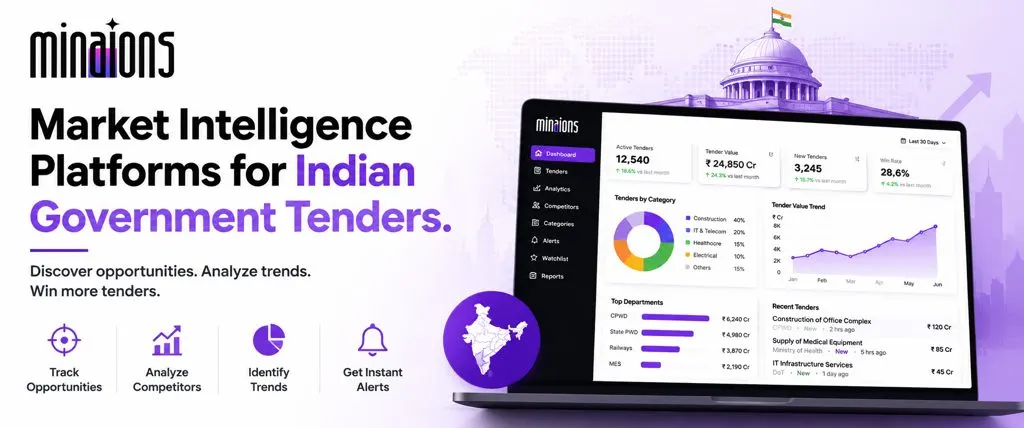
Discover how AI-powered market intelligence platforms streamline tender registration, procurement compliance, and government bidding success.