How L1 is Decided in GeM Reverse Auction?
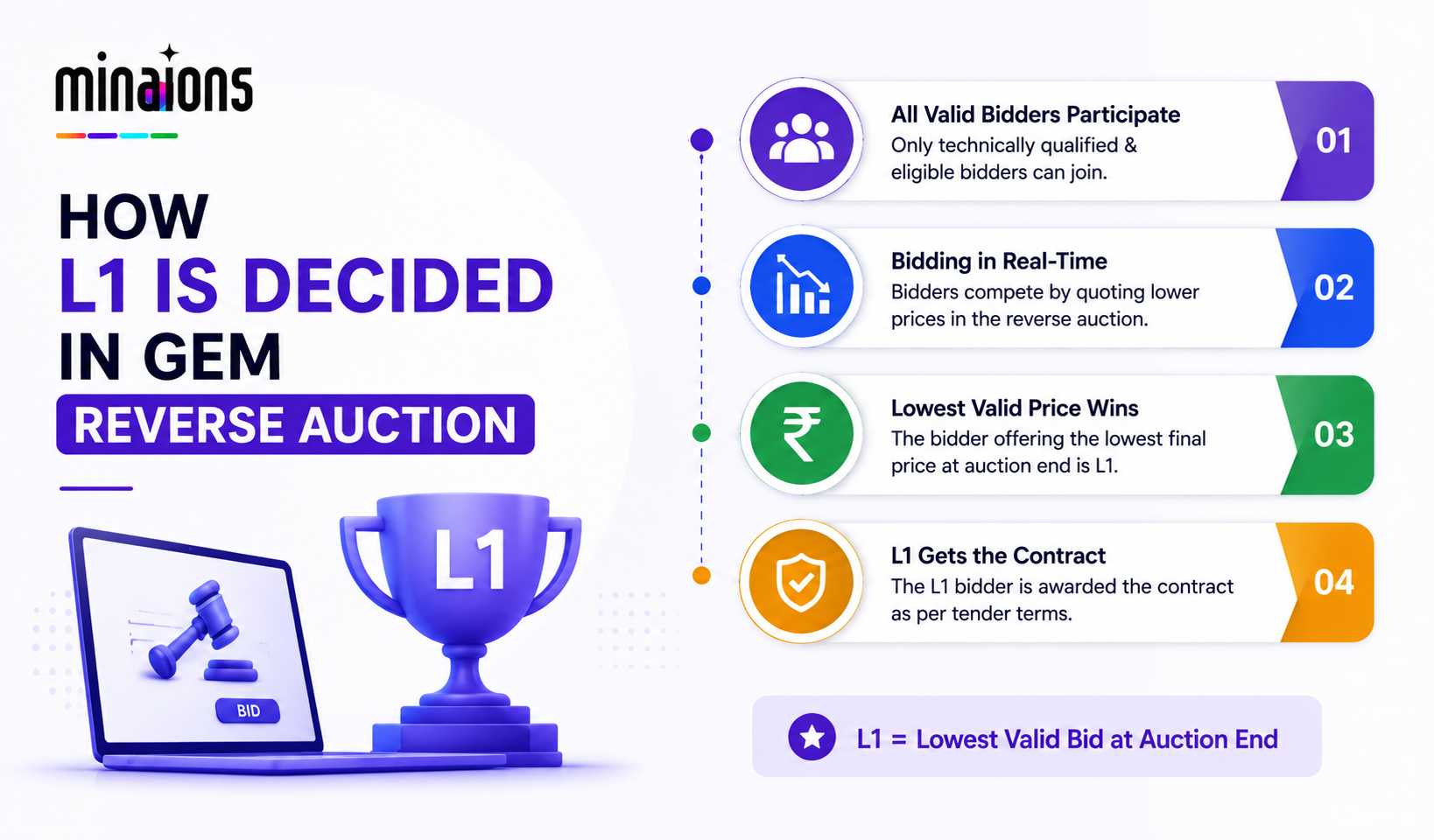
India’s public procurement ecosystem is rapidly becoming digital, transparent, and highly competitive. Businesses participating in procurement opportunities through the GeM platform must clearly understand how the reverse auction GeM mechanism works, especially how the L1 bidder is selected.
Today, companies participating in tender indian government opportunities, managing tender participation, and competing in the modern public procurement system must optimize pricing strategy, compliance readiness, and operational efficiency to improve procurement success rates.
The rise of e tender india, AI-driven procurement systems, and digital evaluation models has transformed how suppliers compete to win contracts. Platforms like Minaions are helping businesses optimize L1 bidder strategy India, improve the tender review process, and strengthen participation across the growing ecosystem of reverse auction GeM procurement workflows.
Understanding the Public Procurement System in India
The Indian public procurement system is designed to improve transparency, supplier participation, and procurement efficiency.
Today, the public procurement system supports:
Digital procurement workflows
Automated bid evaluation
Vendor transparency
Real-time procurement visibility
Online reverse auctions
Businesses participating in tender indian government opportunities should clearly understand how the public procurement system works before participating in reverse auction GeM workflows.
The increasing complexity of the public procurement system has also increased the importance of strategic pricing and procurement analytics.
What Is Reverse Auction GeM?
The reverse auction GeM model is a digital procurement mechanism where suppliers compete by lowering prices in real time.
Unlike traditional procurement where suppliers submit one final quote, the reverse auction GeM system allows eligible vendors to continuously revise pricing during the auction period.
The primary objective of reverse auction GeM is to:
Increase procurement transparency
Improve price competitiveness
Reduce procurement cost
Increase supplier participation
Businesses participating in e tender india procurement should therefore understand the operational structure of reverse auction GeM carefully.
What Does L1 Mean in GeM?
In the GeM procurement ecosystem, L1 refers to the lowest eligible bidder after technical and commercial evaluation.
The L1 bidder is generally the supplier offering the lowest acceptable price while meeting all procurement requirements within the public procurement system.
Businesses participating in tender participation workflows should understand that the lowest bidder is not automatically selected unless all technical and compliance conditions are satisfied.
The increasing competition in reverse auction GeM systems has made L1 bidder strategy India extremely important for suppliers trying to win contracts consistently.
Tender Indian Government Procurement and GeM
The growth of tender indian government opportunities has significantly increased participation on GeM.
Today, tender indian government procurement projects include:
IT procurement
Infrastructure procurement
Smart city systems
Healthcare procurement
Educational procurement
Defence procurement
Businesses participating in tender indian government procurement should strengthen operational readiness for participating in reverse auction GeM workflows.
The increasing scale of tender indian government opportunities has also increased the importance of procurement automation and pricing intelligence.
Tender Participation in Reverse Auctions
The process of tender participation in GeM reverse auctions involves multiple stages.
Typical tender participation workflows include:
Vendor registration
Product/service listing
Bid eligibility verification
Technical qualification
Participation in reverse auction GeM
Final commercial evaluation
Businesses participating in tender participation should focus heavily on compliance accuracy before entering live auction stages.
The increasing competition in e tender india systems has made strategic tender participation more important than ever.
E Tender India and Digital Procurement Transformation
The rise of e tender india systems has transformed procurement participation across sectors.
Modern e tender india systems support:
Digital bid submission
Vendor qualification
Reverse auctions
Automated compliance workflows
Procurement analytics
Businesses participating in tender indian government procurement should optimize digital procurement readiness within the evolving e tender india ecosystem.
The increasing adoption of e tender india workflows has improved procurement transparency while increasing supplier competition.
How L1 Is Decided in Reverse Auction GeM
The final L1 bidder in reverse auction GeM is generally decided based on multiple factors.
Technical Qualification
Only technically qualified suppliers can participate in the live reverse auction GeM process.
Price Competition
Suppliers continuously revise pricing during the auction to improve ranking.
Compliance Verification
The final L1 bidder must comply fully with procurement conditions within the public procurement system.
Final Evaluation
After the auction closes, procurement authorities conduct a final tender review process before awarding contracts.
Businesses participating in tender participation workflows should understand that pricing alone does not guarantee success.
Tender Review Process in GeM Procurement
The tender review process plays a major role in finalizing L1 selection.
The standard tender review process generally includes:
Technical qualification review
Compliance validation
Commercial evaluation
Reverse auction analysis
Final approval workflows
Businesses participating in reverse auction GeM procurement should carefully prepare for every stage of the tender review process.
The increasing complexity of the tender review process has made procurement automation highly valuable.
Minaions helps businesses optimize workflows related to the tender review process through AI-driven procurement analytics.
L1 Bidder Strategy India
An effective L1 bidder strategy India requires more than simply lowering prices.
Businesses implementing a successful L1 bidder strategy India generally focus on:
Accurate cost analysis
Competitive pricing
Operational efficiency
Procurement analytics
Smart bidding behavior
The increasing competition in reverse auction GeM systems has made L1 bidder strategy India critical for long-term procurement success.
Businesses participating in e tender india procurement should therefore build structured pricing models before participating in auctions.
GeM Portal Guide for MSME
A proper GeM portal guide for MSME participation is essential for startups and small suppliers.
The modern GeM portal guide for MSME generally includes:
Vendor registration
Product listing
Bid participation
Reverse auction participation
Compliance management
Businesses participating in tender indian government opportunities should carefully follow the GeM portal guide for MSME to improve procurement readiness.
The increasing participation of MSMEs in reverse auction GeM has created strong opportunities for startups and local suppliers.
Minaions helps businesses simplify workflows related to the GeM portal guide for MSME through AI-driven procurement management systems.
Global Tenders India and International Competition
The ecosystem of global tenders india is also growing rapidly.
Today, global tenders india include procurement opportunities involving:
International suppliers
Imported technology
Specialized infrastructure
Advanced healthcare systems
Defence modernization
Businesses participating in global tenders india should carefully evaluate pricing competitiveness before participating in reverse auction GeM workflows.
The increasing scale of global tenders india has significantly increased procurement competition.
Common Mistakes During Reverse Auction GeM
Many suppliers make avoidable mistakes during reverse auction GeM participation.
Typical mistakes include:
Aggressive underpricing
Weak cost analysis
Poor compliance preparation
Incomplete documentation
Lack of pricing strategy
Businesses participating in tender participation should therefore strengthen procurement planning before entering live auctions.
Minaions helps businesses reduce procurement risk during reverse auction GeM participation through intelligent procurement analytics.
How to Win Contracts in GeM Reverse Auctions
Businesses aiming to win contracts consistently in GeM reverse auctions should focus on:
Understanding the public procurement system
Building strong L1 bidder strategy India
Improving compliance readiness
Optimizing operational efficiency
Monitoring the tender review process
Strengthening pricing intelligence
Organizations participating in e tender india procurement should continuously improve procurement workflows to increase the probability to win contracts.
Minaions and Reverse Auction Intelligence
Minaions is helping businesses improve participation in reverse auction GeM procurement workflows through AI-driven procurement automation.
Minaions supports organizations through:
AI-powered procurement analytics
Smart pricing analysis
Procurement tracking
Tender monitoring
Reverse auction intelligence
Optimized L1 bidder strategy India
Improved tender review process
Businesses participating in tender indian government procurement can use Minaions to improve operational efficiency and procurement competitiveness.
Final Thoughts
The GeM reverse auction ecosystem is becoming one of the most important components of India’s digital public procurement system. Businesses participating in tender indian government procurement and modern e tender india systems must clearly understand how L1 is finalized during reverse auction GeM workflows.
From optimizing tender participation to building a strong L1 bidder strategy India, every stage of procurement matters.
Organizations actively improving the tender review process, following a proper GeM portal guide for MSME, and using AI-driven procurement platforms like Minaions can significantly improve their ability to win contracts consistently.
As global tenders india and digital procurement systems continue to evolve, businesses investing in intelligent procurement management and pricing automation will gain a major competitive advantage.
Related Blogs

A small manufacturing firm in Ludhiana missed a ₹2.3 crore contract after spending 14 hours manually scanning the GeM portal, only to find the tender had closed two days earlier. This is not an isolated case.
A small civil engineering firm in Lucknow spent three weeks manually parsing a 420-page NHAI tenders document, only to miss a critical clause in the contractor registration requirements and lose eligibility.

A small manufacturing firm in Ludhiana missed a ₹2.
Discover how AI-powered market intelligence platforms streamline tender registration, procurement compliance, and government bidding success.