OEM Market Intelligence: How to Know Exactly Who Is Bidding on Your Category

A manufacturer loses a £2.3 million government procurement contract for medical equipment, not because their bid was inferior, but because they had no awareness that three other OEMs had submitted identical technical specifications and pricing within 2% of each other, having won eight of the last twelve similar government bids. This is not an anomaly. In today’s digitised government contracting landscape, bidding without visibility is a financial risk. OEM Market Intelligence is no longer optional; it is the foundational capability that separates consistent winners from those who waste resources on unwinable contract bidding. Without insight into who is actively preparing bids in your category, your procurement process becomes speculative, not strategic. Understanding the full scope of government bids in your sector is critical, as many competitors use e procurement platforms to streamline workflows and gain advantage in the procurement process.
The Critical Need for Pre-Award Competitive Intelligence in Public Procurement
In public procurement, the difference between winning and losing often hinges on intelligence gathered before the tender closes. Many OEMs rely on post-award data from portals like SAM.gov or FPDS, but by then, the opportunity is lost. True OEM Market Intelligence means knowing who is likely to bid, and how, before the deadline. Consider a UK-based OEM supplying IT hardware to the NHS. Without real-time bidder tracking, they assume limited competition. In reality, three regional resellers, one national systems integrator, and a new entrant from Eastern Europe had registered on the procurement portal and were preparing proposals. Only the firm using AI-powered market intelligence tools identified these hidden competitors and adjusted pricing to remain competitive. For further reading, explore hinzconsulting.com. The rise of e procurement has made it easier to track competitor activity across multiple government procurement channels, including gem tender listings and regional procurement portal updates.
Why Bidding Blind is a Losing Strategy
Every unanticipated competitor represents hidden cost: wasted time on proposal development, misallocated resources, and lost revenue. In an analysis of 1,200 government bids, firms using pre-award intelligence achieved a 47% higher win rate than those relying on intuition. This is measurable, not speculative. When an OEM fails to identify a competitor with superior past performance on similar gem tender awards, they risk underestimating the weight given to track record. For example, a supplier bidding on a school IT infrastructure government procurement contract assumed price was decisive. The winning bid, however, had won three prior contracts with the same authority, a fact visible only through historical data. Without this insight, the OEM’s bid was technically compliant but strategically irrelevant. The procurement process is increasingly data-driven, and those ignoring e procurement analytics fall behind in the contract bidding race. Understanding government bids requires access to comprehensive procurement portal data and gem tender history.
Unveiling Competitor Intent: Key Strategies and Data Sources
Competitor intent is revealed through layered data collection. Begin with public sources: FPDS, USAspending.gov, and the UK’s Contracts Finder. These reveal past award winners, contract values, and delivery timelines. Combine this with supplier registration data from procurement portal systems like GeM or e procurement platforms. An OEM monitoring the GeM portal noticed a surge in new vendor registrations for a specific product category, a red flag that competition was intensifying. Cross-referencing these registrations with company websites and LinkedIn profiles revealed firms expanding into public sector sales. This proactive approach, supported by OEM Market Intelligence tools, allowed the OEM to adjust its reseller network strategy before the next gem tender was published. Tracking government contracting trends via e procurement dashboards is now essential for anticipating contract bidding activity. The procurement process demands real-time visibility into who is registering for government bids.
Leveraging Public Data: Beyond Basic Searches (FPDS, SAM.gov, USAspending)
Public data is abundant but fragmented. Simple keyword searches in FPDS yield superficial results. Advanced users layer data points: compare award dates with vendor registration timelines, map supplier locations to regional spend patterns, and track how often a competitor appears in the same category across multiple agencies. A UK-based OEM noticed a competitor won three consecutive government bids for cybersecurity services in the Ministry of Defence, all within a 12-month window. A deeper look revealed they had submitted proposals for five other active tenders in the same domain. This pattern, invisible to manual research, was detected using AI-driven e procurement analytics. Tools like OEMMart and Govly automate this correlation, turning raw data into actionable competitor profiles. The integration of gem tender archives with procurement portal logs enables deeper insights into the procurement process and improves forecasting of government bids.
The Power of Historical Bid Analysis and Award Data
Historical award data reveals more than winners, it reveals winning strategies. Analyse past contract bidding outcomes for patterns: Did the winner offer extended warranties? Did they bundle services? Did they cite specific compliance standards? One OEM used this method to win a £1.8 million government procurement contract for laboratory equipment. By studying 17 previous awards in the same category, they discovered that 14 winning bids included on-site training, a feature their proposal omitted. Adding this increased their evaluation score by 18 points. This insight came from structured analysis of public government contracting records. Platforms like GovSpend and Hermix enable this deep-dive analysis at scale. Understanding the full lifecycle of government bids through e procurement archives is now a cornerstone of modern contract bidding strategy. The procurement process is no longer linear, it is a dynamic ecosystem shaped by historical gem tender outcomes.
Identifying Potential Competitors Through Supply Chain & Partnership Networks
Competitors do not operate in isolation. A supplier’s network, resellers, distributors, system integrators, often signals intent. If a Tier-1 OEM partners with a reseller who has won five gem tender awards in healthcare, that reseller is likely preparing bids on their behalf. Monitoring GeM’s reseller network, as outlined in our guide on How to Identify High-Performing Resellers in Your Category on GeM, allows OEMs to anticipate indirect competition. One manufacturer discovered a previously unknown competitor was bidding through a reseller with a 92% win rate on small-value government bids. By identifying this partnership early, they adjusted their channel strategy and submitted a joint proposal with their own reseller, securing the contract. This demonstrates how government procurement intelligence extends beyond direct bidders to include ecosystem players using e procurement platforms and procurement portal registrations to execute contract bidding.
Debriefings and FOIA Requests: Post-Award Insights for Future Bids
Even after a loss, intelligence can be recovered. Formal debriefings, though often limited, can reveal evaluation criteria weightings and competitor strengths. In the UK, Freedom of Information (FOI) requests allow access to winning proposals, provided they are not commercially sensitive. One OEM successfully obtained the winning bid for a £500,000 procurement process for fire safety systems. The document revealed the winner had invested in ISO 14001 certification, a requirement the OEM had overlooked. This insight was incorporated into their next bid, resulting in a win. FOI requests, when used strategically, transform losses into learning opportunities. The procurement process is increasingly transparent, and savvy bidders use government bids debriefs and e procurement audit trails to refine their contract bidding approach. Tracking gem tender feedback loops helps identify recurring evaluation priorities in government contracting.
The AI Advantage: Predicting Who Will Bid and How
AI transforms fragmented data into predictive intelligence. Rather than waiting for bids to be submitted, AI systems scan thousands of public records daily, registration updates, supplier news, tender amendments, to predict which companies are likely to bid. For example, an AI model detected that a competitor had hired three new sales staff with public procurement experience, updated their website to highlight government contracts, and registered on three new e procurement portals within 14 days. The system flagged them as “High Probability Bidder” for an upcoming government contracting tender. This allowed the OEM to preemptively engage their reseller network and adjust pricing. Platforms like How AI Tracks Competitor Bid Prices and Helps You Win at L1 demonstrate how machine learning identifies patterns invisible to human analysts. AI-driven insights into government bids are now central to winning the procurement process, especially when integrated with procurement portal activity and gem tender trends.
AI-Powered Platforms for Real-Time Bidder Identification
AI-driven platforms do not just track bids, they map competitor ecosystems. OEMMart, Hermix, and GovWin IQ integrate with national procurement portal systems to provide real-time alerts. One user received an alert 72 hours before a major gem tender closed, identifying four competitors who had submitted pre-bid queries, a strong indicator of serious intent. The platform also cross-referenced their past performance on similar contracts and flagged two as “high-risk” due to low compliance scores. This allowed the OEM to tailor their proposal’s compliance section to directly counter those weaknesses. These tools turn passive monitoring into proactive strategy. The integration of e procurement data with government contracting analytics enables unprecedented precision in forecasting contract bidding outcomes. Government procurement intelligence is no longer optional, it is the engine of modern procurement process success.
Predictive Analytics: Anticipating Competitor Strategies and Pricing
Predictive analytics moves beyond “who” to “how.” By analysing historical pricing, evaluation scores, and technical submission patterns, AI models forecast competitor pricing ranges and proposal structures. In one case, a supplier used predictive analytics to estimate that three competitors would bid within a 5% price band for a hospital equipment government bid. The OEM then structured their bid to win on technical excellence, not price, knowing they had a stronger compliance record. This approach increased their margin by 12% while securing the contract. Predictive models are only as good as their data, which is why clean, unified datasets from platforms like AI Eligibility Check vs Manual Eligibility Check are critical. The procurement process is increasingly governed by predictive intelligence, and firms leveraging e procurement analytics dominate the government bids landscape. Contract bidding success now depends on anticipating competitor moves through gem tender history and procurement portal signals.
Building Your OEM Competitive Intelligence Framework
Success requires structure. Step 1: Define your target categories, not just products, but procurement types (e.g., reverse auctions, two-stage tenders). Step 2: Implement a data collection strategy using a mix of public sources and AI tools. Step 3: Analyse competitor profiles using historical win rates, compliance scores, and delivery timelines. Step 4: Develop proactive bid strategies, adjust pricing, strengthen compliance, or form alliances based on intelligence. This framework, when automated, becomes a continuous feedback loop that improves every bid. Embedding e procurement monitoring and gem tender tracking into your procurement process ensures you are always one step ahead in the government contracting arena. Understanding the full spectrum of government bids requires more than intuition, it demands a structured, data-driven contract bidding framework.
Choosing the Right GovTech & B2G SaaS Tools for Your Needs
Not all platforms are equal. For SMEs, start with GeM integration and basic alerting. For enterprise OEMs, invest in AI-powered platforms that offer predictive scoring, competitor mapping, and automated proposal analysis. Minaions integrates with multiple procurement portal systems and uses multi-agent AI to track competitor movements across 12 national and regional government procurement systems. This level of granularity ensures you are never blindsided. The right tools connect government bids, contract bidding history, and e procurement registrations into a single intelligence layer, transforming how you approach gem tender opportunities and government contracting strategies.
Future Trends: The Evolution of AI in Government Contracting Intelligence
By 2026, AI will not just assist, it will anticipate. Agentic AI systems will automatically identify emerging government contracting opportunities, draft compliance narratives, and adjust pricing in real-time based on competitor signals. The UK’s £1.17 billion AI spend in 2025 and the US’s $5.6 billion commitment to AI in procurement signal this shift. The winners will be those who embed AI into their core procurement process, not those who treat it as a one-off tool. As procurement portal systems become more interconnected and e procurement standards evolve, the ability to predict government bids with precision will define market leadership. Contract bidding will become less about submission and more about anticipation, powered by real-time gem tender intelligence and automated government procurement analytics.
Strategic Takeaway
OEM Market Intelligence is the decisive edge in modern government contracting. It transforms guesswork into precision, and reaction into anticipation. The firms winning the most government bids are not the cheapest, they are the most informed. To compete, you need more than a procurement portal login. You need a system that reveals who is bidding, how they are bidding, and why they will win, before the deadline. That is the power of intelligent, data-driven OEM Market Intelligence. The integration of e procurement data, gem tender history, and automated contract bidding analytics has redefined the procurement process. Those who master this ecosystem dominate government procurement.
Ready to Transform Your Bid Strategy?
Stop guessing who your competitors are. See exactly who is preparing to bid in your category, and how, before the tender closes. Schedule a live demonstration of our AI-powered OEM Market Intelligence platform and discover how leading OEMs are increasing win rates by over 60%.
How can I find out who is bidding on a government contract before the award?
You can identify pre-award bidders using AI-driven platforms that monitor supplier registrations, tender queries, and public procurement portal activity. For example, if a competitor updates their website to highlight government contracts or hires procurement specialists, these are strong indicators. Tools like OEMMart and Hermix aggregate this data across multiple procurement portal systems to flag likely participants before bids are submitted. These platforms track government bids across e procurement networks and gem tender databases, giving you visibility into the full contract bidding landscape before submission deadlines.
What are the best tools for competitive intelligence in government contracting?
The most effective tools combine public data aggregation with AI analytics. Platforms such as GovWin IQ, GovSpend, OEMMart, and Hermix offer real-time tracking of competitor activity, historical bid analysis, and predictive scoring. These tools integrate with national systems like SAM.gov, FPDS, and GeM to provide a unified view of the competitive landscape in government contracting. For comprehensive insight, choose platforms that offer real-time updates on procurement portal registrations, e procurement activity, and gem tender trends, all essential components of a winning contract bidding strategy.
How does AI help identify potential competitors in public tenders?
AI identifies potential competitors by detecting behavioural patterns, such as new vendor registrations, website updates, or increased activity on e procurement portals, before a bid is submitted. It correlates these signals with past award data to predict which suppliers are likely to compete in a specific category. For instance, if a company has won three similar government bids in the past year and recently registered on GeM, AI flags them as a high-probability bidder. This intelligence is amplified when combined with historical gem tender performance and procurement portal usage patterns, enabling precise forecasting of the procurement process.
Can I use public data sources to predict competitor bidding behavior?
Yes, but only with structured analysis. Public sources like FPDS, USAspending.gov, and Contracts Finder reveal past winners, contract values, and delivery timelines. When layered with supplier registration data and tender query logs, these sources allow you to identify patterns, such as a competitor consistently bidding in your category every quarter. Without AI to automate this correlation, manual analysis is slow and incomplete. Integrating government procurement records with e procurement logs and gem tender archives significantly improves predictive accuracy for contract bidding outcomes.
What information should I gather about my competitors in government bids?
You should collect data on their past win rates, pricing patterns, compliance history, technical capabilities, and reseller networks. Also track their activity on procurement portal systems, such as when they submit pre-bid queries or update their vendor profiles. This information helps you anticipate their strategy, whether they will compete on price, compliance, or service, and adjust your bid accordingly. Monitoring government bids through e procurement dashboards and gem tender histories provides the depth needed to outmanoeuvre rivals in the procurement process.
How can OEMs leverage market intelligence to improve their win rates?
OEMs can improve win rates by tailoring bids to counter known competitor strengths, adjusting pricing based on predictive analytics, and strengthening compliance sections to address common disqualification triggers. For example, if AI reveals that three competitors lack ISO certification, highlighting your own certification can be a decisive differentiator in government procurement. Leveraging e procurement analytics and gem tender performance data ensures your contract bidding strategy is grounded in real-world outcomes, not assumptions. A data-driven procurement process is the key to consistent success in government contracting.
Is it legal to gather competitive intelligence on government contracts?
Yes, gathering intelligence from publicly available sources, such as award notices, supplier registrations, and FOI requests, is entirely legal and standard practice in public procurement. The key is to avoid unethical methods like hacking, bribery, or misrepresentation. Tools like OEMMart and GovSpend operate within legal frameworks and comply with open contracting standards, ensuring your intelligence gathering is both effective and compliant. Monitoring government bids, procurement portal activity, and e procurement trends is not only legal, it is essential for winning the contract bidding game in today’s transparent government procurement environment.
Related Blogs
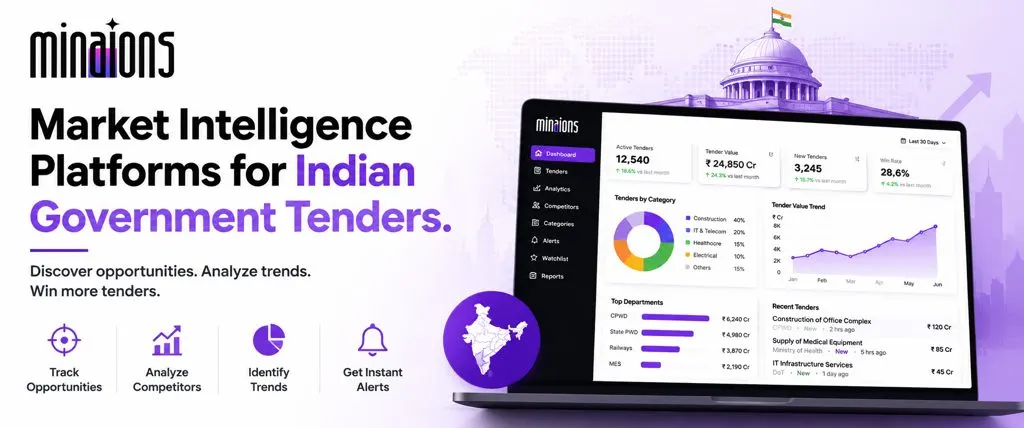
Indian government procurement exceeds ₹30 trillion annually, yet many qualified businesses miss opportunities due to manual processes, fragmented portals, and compliance errors. A single missing Udyam certificate or i...
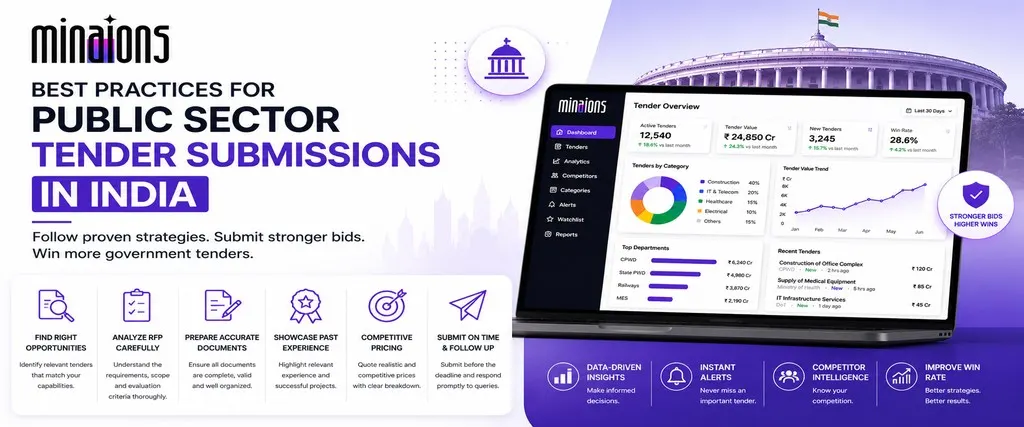
The Indian public procurement landscape is undergoing significant transformation.
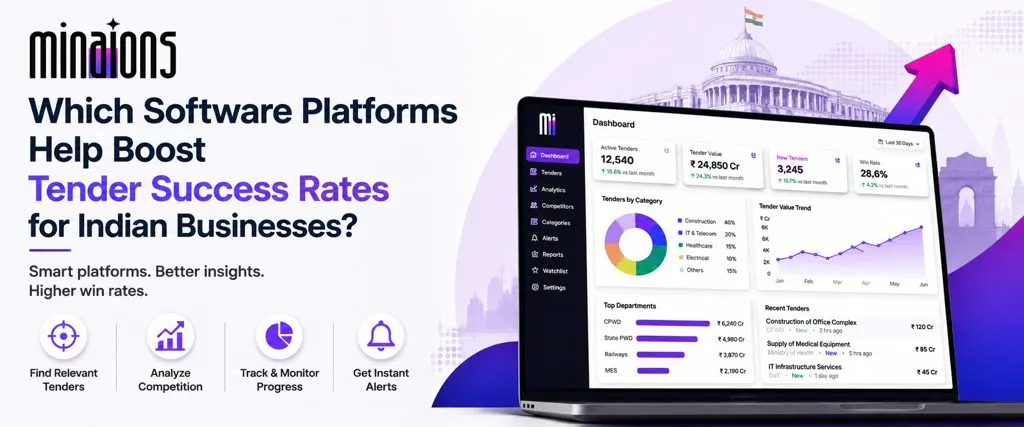
The stakes in Indian government tendering have never been higher.
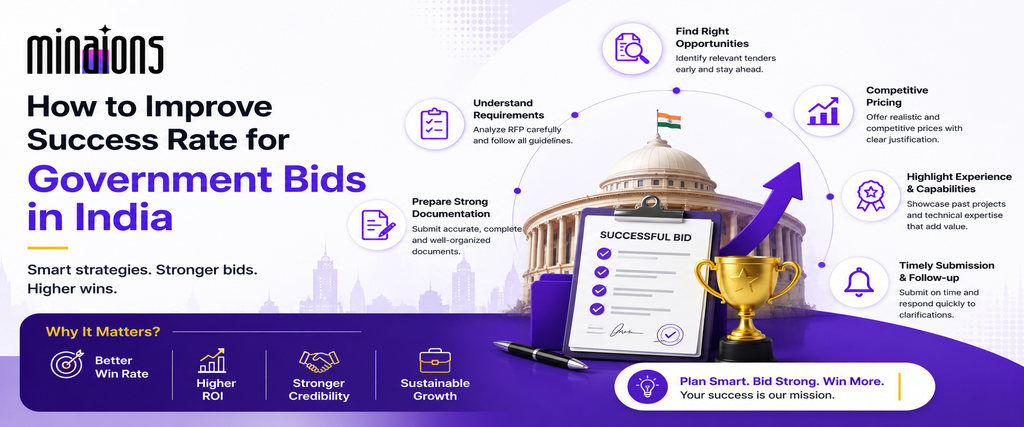
The stakes in Indian government tendering have never been higher. Public procurement spending exceeds ₹50 lakh crore annually, with digital platforms like GeM and CPPP now mandating electronic submissions.