OEM Registration & Vendor Assessment on GeM: Q1, Q2, Q3, Q4 OEM Quadrants Explained
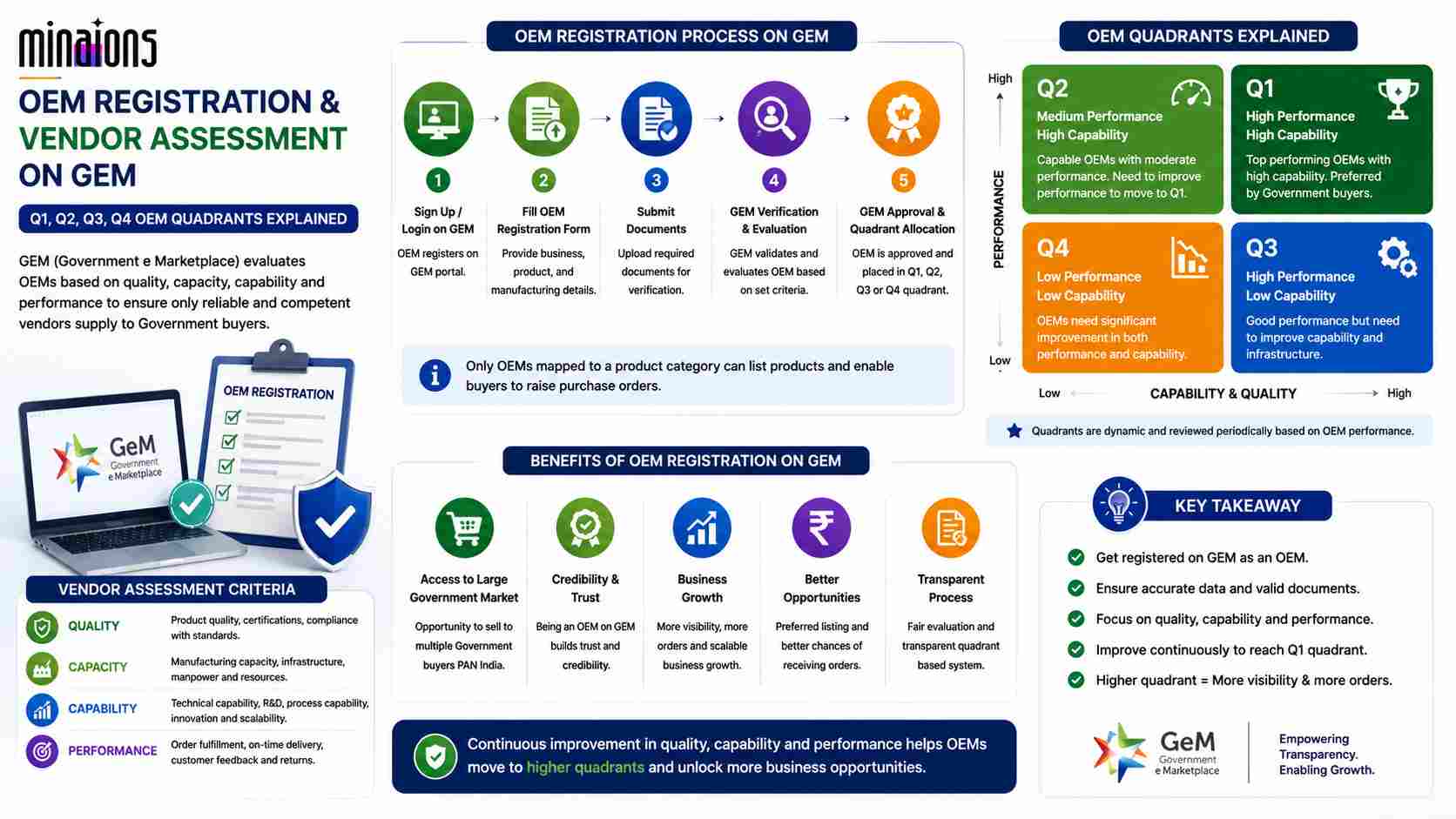
India’s procurement ecosystem is rapidly becoming digital, transparent, and performance-driven. The Government e-Marketplace (GeM) has transformed the way businesses participate in public sector procurement, access public sector tenders, and manage the overall tender process. Today, businesses looking to participate in tender india opportunities must understand how OEM registration and vendor assessment work on GeM.
One of the most important aspects of the modern government procurement system is OEM categorization through Q1, Q2, Q3, and Q4 quadrants. Businesses participating in all tenders, tracking the government tender list, and using the public procurement portal should understand how these OEM quadrants affect procurement visibility, credibility, and tender eligibility.
Companies participating in marketing tenders, technology procurement, manufacturing supply, and infrastructure procurement increasingly rely on gem tender registration to improve participation in public sector procurement opportunities.
What is GeM in the Government Procurement System?
GeM or Government e-Marketplace is a centralized government procurement system created to simplify procurement for government departments, PSUs, ministries, and public sector organizations.
The GeM platform acts as a digital public procurement portal where buyers and sellers interact directly for procurement activities.
Businesses participating in public sector procurement can use the GeM platform to:
Complete gem tender registration
Access public sector tenders
Participate in the tender process
Track the government tender list
Sell products and services digitally
Improve visibility in tender india
The growth of the government procurement system has significantly improved transparency and accessibility in public procurement operations.
Importance of Gem Tender Registration
For businesses participating in public sector procurement, proper gem tender registration is extremely important.
Without accurate gem tender registration, businesses cannot efficiently participate in public sector tenders or access procurement opportunities available through the public procurement portal.
Effective gem tender registration helps businesses:
Improve procurement visibility
Access the government tender list
Participate in all tenders
Build credibility in the government procurement system
Expand opportunities in tender india
Businesses participating in marketing tenders and infrastructure procurement should ensure that all compliance documents are updated during gem tender registration.
Understanding the Tender Process on GeM
The tender process on GeM is designed to ensure transparency, compliance, and efficient procurement management.
The standard tender process generally includes:
Completing gem tender registration
Product or service listing
Vendor assessment
Participation in public sector tenders
Bid submission
Technical evaluation
Commercial evaluation
Contract award
Understanding the complete tender process is essential for businesses participating in all tenders through the GeM-based government procurement system.
Companies participating in marketing tenders and digital procurement projects should continuously optimize workflows related to the tender process.
What are OEM Quadrants on GeM?
OEM quadrants on GeM categorize Original Equipment Manufacturers based on vendor assessment parameters.
The Q1, Q2, Q3, and Q4 classification system helps procurement authorities evaluate supplier credibility within the government procurement system.
Businesses participating in public sector procurement and public sector tenders should understand how these OEM quadrants influence procurement opportunities.
The OEM quadrant classification is especially important for businesses competing in:
Technology procurement
Manufacturing supply
Infrastructure contracts
Marketing tenders
Specialized procurement projects
The quadrant system improves transparency in the overall tender process and procurement evaluation.
Q1 OEM Category Explained
The Q1 category represents the highest-rated OEMs within the government procurement system.
Businesses categorized under Q1 generally demonstrate:
Strong financial stability
High-quality manufacturing standards
Proven procurement experience
Strong compliance management
Excellent performance history
Companies participating in public sector procurement with Q1 status often gain better visibility in the public procurement portal and the broader tender india ecosystem.
Businesses participating in all tenders should aim to improve operational standards to qualify for Q1 categorization.
Q2 OEM Category Explained
The Q2 category includes businesses with good procurement capability but relatively lower performance scores compared to Q1 suppliers.
Q2 vendors participating in public sector tenders generally meet essential procurement requirements but may still need operational improvements.
Businesses in the Q2 category should focus on:
Strengthening compliance
Improving delivery performance
Enhancing procurement credibility
Optimizing the tender process
Companies participating in marketing tenders and technology procurement projects often improve their visibility after upgrading from Q2 to Q1 classification.
Q3 OEM Category Explained
The Q3 category represents vendors with limited procurement history or moderate assessment performance.
Businesses categorized under Q3 within the government procurement system should focus on improving:
Financial documentation
Product quality
Vendor assessment scores
Delivery capability
Procurement compliance
Q3 suppliers participating in all tenders should also strengthen their profile within the public procurement portal to improve procurement opportunities.
The increasing competition in tender india makes vendor improvement extremely important for Q3 suppliers.
Q4 OEM Category Explained
The Q4 category generally represents suppliers with limited procurement maturity or incomplete vendor assessment performance.
Businesses categorized under Q4 may face reduced visibility in public sector procurement opportunities.
Companies in Q4 should focus heavily on:
Improving gem tender registration
Updating compliance documentation
Strengthening procurement workflows
Enhancing operational credibility
Improving participation in the tender process
Organizations participating in public sector tenders should continuously improve procurement performance to avoid long-term limitations associated with lower OEM classifications.
Role of Public Procurement Portal in OEM Assessment
The GeM platform functions as a major public procurement portal within India’s digital procurement ecosystem.
The public procurement portal helps procurement authorities:
Evaluate suppliers
Track vendor performance
Manage procurement workflows
Publish procurement opportunities
Improve procurement transparency
Businesses participating in public sector procurement should actively manage their profile within the public procurement portal to improve procurement visibility.
The increasing importance of the public procurement portal is also driving higher competition across all tenders.
Government Tender List and Procurement Visibility
The government tender list is one of the most important resources for businesses participating in public sector tenders.
Companies use the government tender list to:
Track procurement opportunities
Monitor procurement trends
Identify sector growth
Analyze competition
Improve procurement planning
Businesses participating in marketing tenders and technology procurement projects should continuously monitor the government tender list to identify relevant opportunities early.
The expansion of the government tender list has significantly increased opportunities in the broader tender india ecosystem.
Public Sector Procurement and Vendor Competition
The growth of public sector procurement has significantly increased supplier competition.
Today, businesses across sectors actively participate in:
Infrastructure procurement
Technology projects
Manufacturing supply
Renewable energy contracts
Marketing tenders
The increasing competition within public sector procurement has made vendor assessment and OEM classification more important than ever.
Businesses participating in all tenders should continuously improve operational capability and procurement compliance to remain competitive.
Marketing Tenders and OEM Positioning
The growth of digital procurement has also expanded opportunities in marketing tenders.
Government departments increasingly issue marketing tenders for:
Branding campaigns
Digital outreach
Public awareness programs
Advertising services
Media management
Businesses participating in marketing tenders should maintain strong OEM profiles within the government procurement system to improve procurement visibility.
The increasing competition in marketing tenders makes vendor assessment performance highly important.
Future of Tender India and Digital Procurement
The future of tender india is becoming increasingly digital, analytics-driven, and performance-oriented.
The evolving government procurement system will increasingly depend on:
Automated vendor assessment
AI-driven procurement evaluation
Centralized public procurement portal workflows
Smart procurement analytics
Performance-based OEM categorization
Businesses participating in public sector procurement should adapt early to these procurement trends to remain competitive in future public sector tenders.
Final Thoughts
OEM registration and vendor assessment on GeM play a critical role in India’s evolving procurement ecosystem. Businesses participating in public sector procurement, managing gem tender registration, and competing in all tenders must clearly understand the importance of Q1, Q2, Q3, and Q4 OEM quadrants.
From optimizing the tender process to improving visibility within the public procurement portal, every stage of procurement matters.
Organizations actively tracking the government tender list, improving participation in marketing tenders, and strengthening procurement credibility within the government procurement system will be better positioned to succeed in the growing world of tender india and modern public procurement opportunities.
Related Blogs

The bid no-bid decision framework is the strategic backbone of successful government bidding. Without a disciplined approach, MSMEs waste time, capital, and credibility on unwinnable government tenders.

Understanding tender rejection reasons India tender disqualification reasons is critical for MSMEs aiming to secure government tenders.

A small manufacturing firm in Ludhiana missed a ₹2.3 crore contract after spending 14 hours manually scanning the GeM portal, only to find the tender had closed two days earlier. This is not an isolated case.

A small civil engineering firm in Lucknow spent three weeks manually parsing a 420-page NHAI tenders document, only to miss a critical clause in the contractor registration requirements and lose eligibility.