AI Tender Automation ROI: How to Calculate What You Save Per Bid
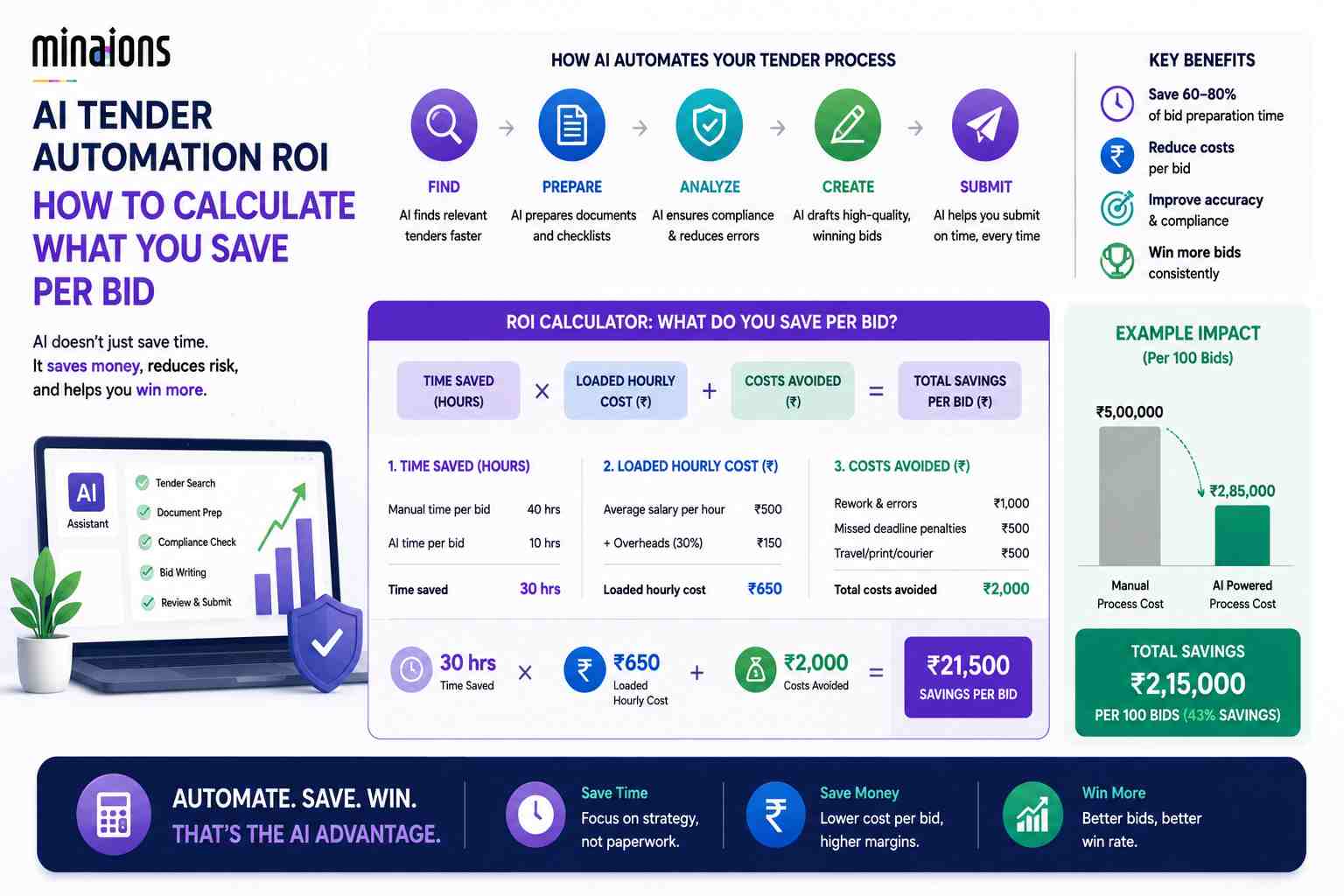
The world of e procurement, government tenders, and public procurement is becoming increasingly competitive and time-sensitive. Businesses participating in government tenders India, govt tenders, and large-scale government contracts are now under constant pressure to improve bid quality, reduce operational cost, and increase win rates.
Traditional manual bidding methods are no longer efficient enough for modern government procurement and digital government contracting ecosystems. Companies managing multiple public tenders, monitoring current tenders, and participating in tender india opportunities are now adopting AI-driven procurement automation to improve operational efficiency and reduce bidding costs.
Today, AI-powered government tender software platforms like Minaions are transforming how businesses manage e procurement, automate bid workflows, improve compliance, and calculate the true ROI of procurement automation.
Why AI Automation Matters in E Procurement
Modern e procurement systems generate massive procurement activity every day. Businesses participating in government tenders, government contracts, and public procurement opportunities must manage:
Bid tracking
Compliance documentation
Technical proposals
Pricing analysis
Procurement timelines
Vendor registrations
The increasing complexity of government procurement and government contracting workflows has made manual operations expensive and inefficient.
Organizations participating in public tenders and govt tenders are now using AI-based government tender software to automate repetitive procurement tasks and reduce operational cost per bid.
Understanding ROI in Government Tender Automation
The ROI of AI automation in e procurement is calculated by comparing:
Time saved per bid
Reduction in manual effort
Increase in bid participation
Improvement in win rates
Reduction in operational errors
Businesses participating in government tenders India, tender india, and large-scale government contracts often spend significant resources managing manual procurement workflows.
AI-driven automation helps suppliers participating in government procurement reduce operational overhead while improving procurement efficiency.
Platforms like Minaions help businesses participating in public procurement and government contracting calculate bid-level savings through automated procurement analytics.
Cost of Manual Government Tender Management
Traditional management of government tenders and public tenders usually involves:
Manual document collection
Bid formatting
Compliance verification
Tender monitoring
Spreadsheet tracking
Team coordination
Businesses participating in multiple govt tenders and current tenders often spend hundreds of hours monthly on repetitive procurement activities.
The increasing complexity of government procurement has made manual operations costly for suppliers participating in government contracts and government tenders India.
Companies trying to learn how to bid on government contracts often underestimate the hidden operational cost involved in procurement management.
How AI Reduces Cost Per Bid
AI-based government tender software significantly reduces operational cost per bid through automation.
Modern AI systems can automate:
Bid tracking
Opportunity discovery
Compliance analysis
Proposal templates
Deadline alerts
Document organization
Businesses participating in e procurement, public procurement, and government procurement can save substantial manpower cost through AI-driven workflows.
Minaions helps suppliers participating in govt contracts and government tenders automate repetitive procurement activities and improve bid efficiency.
Time Savings in Public Procurement
Time savings are one of the biggest ROI drivers in AI-powered public procurement systems.
Traditional procurement teams participating in government tenders India may spend:
4–6 hours identifying current tenders
8–12 hours preparing compliance documents
6–10 hours managing proposal formatting
3–5 hours coordinating teams
AI-driven government tender software reduces these activities dramatically.
Businesses participating in public tenders, govt tenders, and tender india projects can increase bid participation capacity without proportionally increasing manpower.
AI and Bid Qualification
One major challenge in government procurement is deciding which bids are worth pursuing.
Modern AI systems help businesses:
Analyze eligibility
Estimate bid competitiveness
Predict operational feasibility
Evaluate profitability
Assess compliance risk
This is especially important for suppliers participating in multiple government contracts and public procurement projects simultaneously.
Minaions uses AI-driven qualification workflows to help businesses participating in government contracting prioritize the most valuable procurement opportunities.
Reduction in Tender Errors
Manual procurement management often creates operational errors in government tenders and public tenders.
Typical bid errors include:
Missing documents
Incorrect formatting
Expired certifications
Wrong pricing uploads
Missed deadlines
Such errors often lead to rejection in government procurement systems.
AI-powered government tender software reduces operational mistakes by automating compliance validation and procurement workflows.
Businesses participating in govt tenders and government tenders India can significantly reduce bid rejection rates through automation.
Improving Win Rates Through AI
Winning more government contracts is one of the biggest financial benefits of AI automation.
AI-driven systems improve bid quality through:
Better compliance management
Historical bid analysis
Automated templates
Proposal optimization
Competitor benchmarking
Businesses participating in public procurement and government contracting can improve proposal consistency and technical accuracy through automation.
Companies trying to learn how to bid on government contracts effectively should invest in structured AI-driven procurement workflows early.
ROI Formula for Tender Automation
A simple ROI calculation for AI-based e procurement automation can be structured as:
ROI =
(Time Saved + Increased Win Revenue + Reduced Operational Cost – Software Cost) ÷ Software Cost
Businesses participating in government tenders, public tenders, and govt contracts can calculate savings based on:
Average team hours per bid
Number of bids per month
Cost per employee hour
Average project value
Win rate improvement
Minaions helps businesses participating in government procurement measure procurement ROI through analytics dashboards and automation tracking.
Example of AI Tender Automation ROI
Consider a company participating in 40 government tenders India projects monthly.
Manual Workflow
Average manpower cost per bid: ₹8,000
Total monthly cost: ₹3,20,000
Average bids submitted: 40
AI-Based Workflow Using Minaions
Reduced manpower cost per bid: ₹3,500
Total monthly cost: ₹1,40,000
Additional bids submitted: 20
Higher participation in current tenders
Improved visibility across tender india
This creates substantial annual savings while improving procurement capacity.
Government Tender Software and Scalability
Modern government tender software platforms are designed for scalability.
Businesses participating in government contracts, public procurement, and e procurement can use automation to:
Expand procurement coverage
Increase bid participation
Reduce operational dependency
Improve compliance consistency
Minaions provides AI-driven government tender software solutions that help procurement teams scale efficiently across government tenders India and govt tenders ecosystems.
How to Write a Bid Proposal India Using AI
One of the biggest advantages of AI automation is assistance in how to write a bid proposal India effectively.
AI systems help suppliers:
Generate proposal structures
Improve technical language
Maintain compliance formatting
Reuse approved content
Improve consistency
Businesses trying to understand how to write a bid proposal India should focus on automation, proposal standardization, and centralized knowledge management.
Minaions helps suppliers participating in government contracting optimize workflows related to how to write a bid proposal India and proposal quality management.
Future of AI in Government Procurement
The future of government procurement, e procurement, and public procurement is increasingly AI-driven.
Modern procurement systems are rapidly adopting:
AI-based bid analysis
Automated compliance validation
Procurement analytics
Predictive tender scoring
Smart procurement recommendations
Businesses participating in government tenders, public tenders, and government contracts that adopt automation early will gain significant competitive advantages.
Organizations participating in govt tenders and tender india projects should invest in AI-driven procurement systems to remain competitive.
Minaions and AI Tender Automation
Minaions is helping businesses modernize procurement operations through AI-driven automation.
Minaions supports suppliers participating in government tenders India through:
Automated tender tracking
Smart compliance workflows
AI-driven proposal management
Procurement analytics
Bid qualification systems
Centralized procurement dashboards
Businesses participating in government procurement, public procurement, and government contracting can use Minaions to reduce operational cost and improve bid scalability.
Final Thoughts
AI-powered procurement automation is no longer optional for businesses participating in government tenders, government contracts, and public procurement projects. The increasing complexity of government procurement and government contracting workflows makes automation essential for operational efficiency and long-term competitiveness.
From reducing manpower cost to improving bid quality, AI-driven government tender software delivers measurable ROI across the complete procurement lifecycle.
Organizations participating in govt tenders, current tenders, and the expanding tender india ecosystem can significantly improve operational efficiency by automating workflows related to e procurement, compliance management, and proposal preparation.
Businesses trying to learn how to bid on government contracts and optimize how to write a bid proposal India should adopt AI-driven procurement systems early to gain a long-term competitive advantage.
Related Blogs

A small manufacturing firm in Ludhiana missed a ₹2.3 crore contract after spending 14 hours manually scanning the GeM portal, only to find the tender had closed two days earlier. This is not an isolated case.

A small civil engineering firm in Lucknow spent three weeks manually parsing a 420-page NHAI tenders document, only to miss a critical clause in the contractor registration requirements and lose eligibility.

A small manufacturing firm in Ludhiana missed a ₹2.
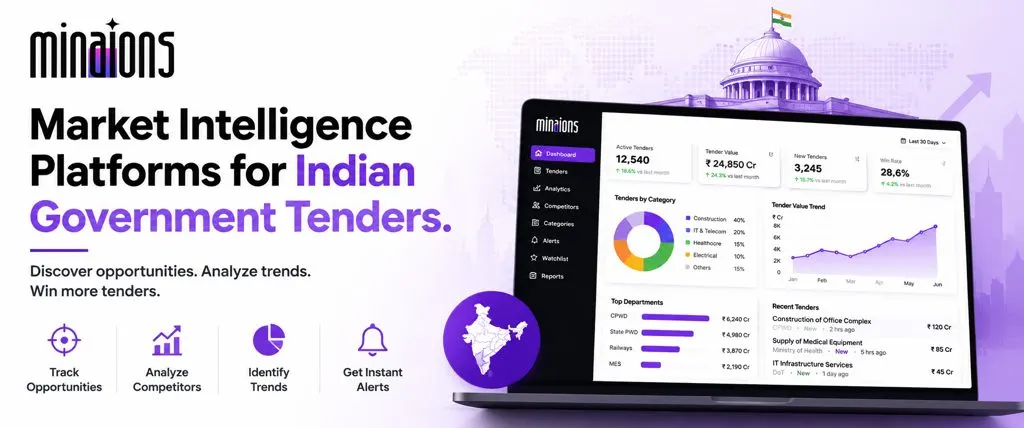
Discover how AI-powered market intelligence platforms streamline tender registration, procurement compliance, and government bidding success.