What are the key differences between open tender and limited tender processes?
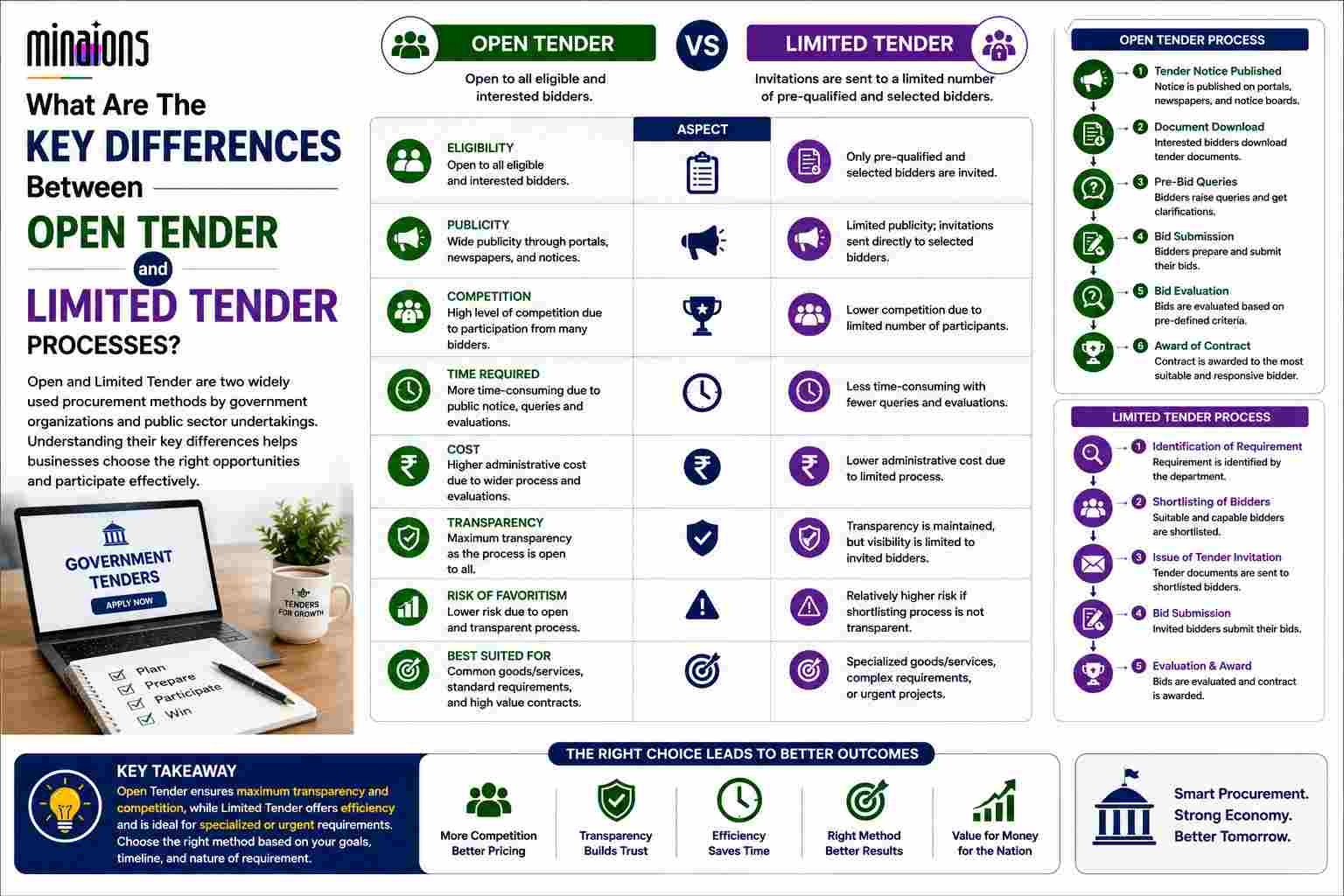
The procurement ecosystem in India is rapidly evolving with increased digitization, transparency, and regulatory compliance. Businesses participating in government procurement tenders, managing the bidding process, and competing in the expanding ecosystem of india procurement must clearly understand the differences between open tender and limited tender procurement methods.
Today, organizations involved in indian govt tender opportunities rely heavily on digital procurement platforms, structured compliance workflows, and transparent evaluation systems. Whether businesses are reviewing invitation to tender documents, analyzing public procurement examples, or participating in government procurement tenders, understanding the difference between open and limited tendering is essential for procurement success.
The growth of modern india procurement systems and evolving public procurement rules has made procurement processes more structured, competitive, and technology-driven.
What is Open Tendering?
Open tendering is a procurement method where procurement opportunities are publicly advertised, allowing all eligible suppliers to participate in the bidding process.
In open tendering, procurement authorities publish invitation to tender documents through procurement portals or official procurement systems. Any supplier meeting the eligibility criteria can submit bids.
Open tendering is commonly used in:
Infrastructure projects
Technology procurement
Construction projects
Consulting contracts
Healthcare procurement
Large-scale government procurement tenders
The primary objective of open tendering is to increase transparency and competition within the india procurement ecosystem.
Businesses participating in indian govt tender opportunities should carefully understand the open bidding process to improve procurement success rates.
What is Limited Tendering?
Limited tendering is a procurement method where only selected suppliers are invited to participate.
Unlike open tendering, limited tendering restricts participation to shortlisted vendors identified by procurement authorities.
Limited tendering is commonly used when:
Specialized expertise is required
Procurement timelines are urgent
Security-sensitive procurement is involved
Limited vendors are available
Procurement confidentiality is important
Organizations managing strategic government procurement tenders often use limited tendering to improve procurement speed and operational control.
Businesses participating in india procurement should understand both procurement methods to align their procurement strategy accordingly.
Understanding the Bidding Process
The bidding process is one of the most important aspects of procurement participation.
The standard bidding process generally includes:
Publication of procurement opportunities
Release of invitation to tender documents
Vendor participation
Technical proposal submission
Financial proposal submission
Evaluation
Contract award
In open tendering, the bidding process is accessible to all eligible suppliers.
In limited tendering, the bidding process involves invitation-only participation.
Businesses participating in government procurement tenders should carefully understand every stage of the bidding process to avoid compliance issues.
Invitation to Tender Documents Explained
The role of invitation to tender documents is critical in both open and limited tendering.
Every set of invitation to tender documents generally contains:
Eligibility conditions
Technical specifications
Financial requirements
Submission guidelines
Compliance standards
Evaluation methodology
Businesses participating in indian govt tender opportunities should carefully analyze all invitation to tender documents before preparing submissions.
Incorrect interpretation of invitation to tender documents is one of the most common reasons for rejection during the bidding process.
Organizations participating in india procurement should maintain centralized workflows for reviewing and managing invitation to tender documents.
Public Procurement Rules in Open and Limited Tendering
Both procurement methods operate under structured public procurement rules.
The applicable public procurement rules define:
Supplier eligibility
Evaluation procedures
Procurement transparency requirements
Bid submission guidelines
Contract award processes
Businesses participating in government procurement tenders must comply fully with all public procurement rules to remain eligible.
The role of public procurement rules is especially important in open tendering because of wider supplier participation and higher procurement visibility.
Companies involved in india procurement should continuously monitor updates related to evolving public procurement rules.
Public Procurement Examples in India
Several public procurement examples help explain the difference between open and limited tendering.
Typical public procurement examples of open tendering include:
National highway projects
Public hospital procurement
Smart city infrastructure projects
IT system procurement
Typical public procurement examples of limited tendering include:
Defense procurement
Emergency infrastructure repair
Specialized consulting assignments
Confidential technology procurement
Analyzing real public procurement examples helps businesses understand how procurement authorities select procurement methods.
Companies participating in government procurement tenders should regularly review public procurement examples to improve procurement understanding and proposal quality.
Indian Govt Tender Ecosystem
The ecosystem of indian govt tender opportunities is growing rapidly.
Today, thousands of indian govt tender opportunities are published across sectors such as:
Construction
Healthcare
Technology
Security services
Logistics
Renewable energy
The expansion of the india procurement ecosystem has significantly increased supplier participation in government procurement tenders.
Businesses participating in indian govt tender opportunities should understand whether procurement projects follow open or limited tendering models before entering the bidding process.
Government Procurement Tenders and Competition
The number of government procurement tenders has increased significantly in recent years.
Today, businesses can access government procurement tenders through centralized procurement systems and digital procurement portals.
The growing volume of government procurement tenders has improved business opportunities while also increasing competition.
Organizations participating in government procurement tenders should focus on:
Accurate proposal preparation
Compliance management
Understanding public procurement rules
Careful review of invitation to tender documents
Efficient bidding process workflows
Businesses active in india procurement should continuously improve procurement operations to remain competitive.
India Procurement and Digital Transformation
The rise of digital india procurement systems has transformed procurement operations across sectors.
Modern india procurement platforms now support:
Digital procurement workflows
Automated bid submissions
Centralized compliance management
Real-time procurement visibility
Digital evaluation systems
The growth of digital india procurement systems has increased transparency in government procurement tenders while improving supplier participation.
Businesses participating in indian govt tender opportunities should adopt procurement automation to improve operational efficiency during the bidding process.
Advantages of Open Tendering
Open tendering offers several benefits.
Greater Transparency
Open tendering improves transparency within the india procurement ecosystem.
Wider Competition
More suppliers can participate in government procurement tenders, increasing competition and pricing efficiency.
Equal Opportunity
All eligible suppliers can participate in the bidding process.
Better Procurement Visibility
Businesses gain wider access to procurement opportunities through public procurement systems.
Advantages of Limited Tendering
Limited tendering also provides several advantages.
Faster Procurement
Limited tendering reduces procurement timelines during the bidding process.
Specialized Vendor Selection
Procurement authorities can invite suppliers with specific expertise.
Better Confidentiality
Sensitive procurement activities can be managed securely.
Lower Evaluation Complexity
Fewer suppliers simplify procurement evaluation processes.
Limitations of Open Tendering
Despite its advantages, open tendering also has limitations.
High Competition
Large participation volumes increase competition in government procurement tenders.
Longer Evaluation Timelines
The bidding process may take more time because of higher participation.
Increased Documentation Complexity
Suppliers must carefully manage invitation to tender documents and compliance workflows.
Limitations of Limited Tendering
Limited tendering also has some disadvantages.
Reduced Supplier Participation
Fewer vendors can participate.
Limited Competition
Pricing competitiveness may reduce.
Lower Transparency
Limited supplier participation may reduce procurement visibility.
Final Thoughts
Understanding the key differences between open tendering and limited tendering is essential for businesses participating in government procurement tenders and the growing ecosystem of india procurement.
From reviewing accurate invitation to tender documents to understanding the complete bidding process, every stage of procurement matters.
Organizations actively studying public procurement examples, complying with evolving public procurement rules, and improving operational workflows for indian govt tender participation can significantly improve procurement success rates.
As procurement systems continue to evolve digitally, businesses investing in automation, compliance management, and structured procurement planning will gain a strong competitive advantage in future procurement opportunities.
Related Blogs
The bid no-bid decision framework is the strategic backbone of successful government bidding. Without a disciplined approach, MSMEs waste time, capital, and credibility on unwinnable government tenders.

Understanding tender rejection reasons India tender disqualification reasons is critical for MSMEs aiming to secure government tenders.

A small manufacturing firm in Ludhiana missed a ₹2.3 crore contract after spending 14 hours manually scanning the GeM portal, only to find the tender had closed two days earlier. This is not an isolated case.

A small civil engineering firm in Lucknow spent three weeks manually parsing a 420-page NHAI tenders document, only to miss a critical clause in the contractor registration requirements and lose eligibility.